
100 Days of Wonder – #16
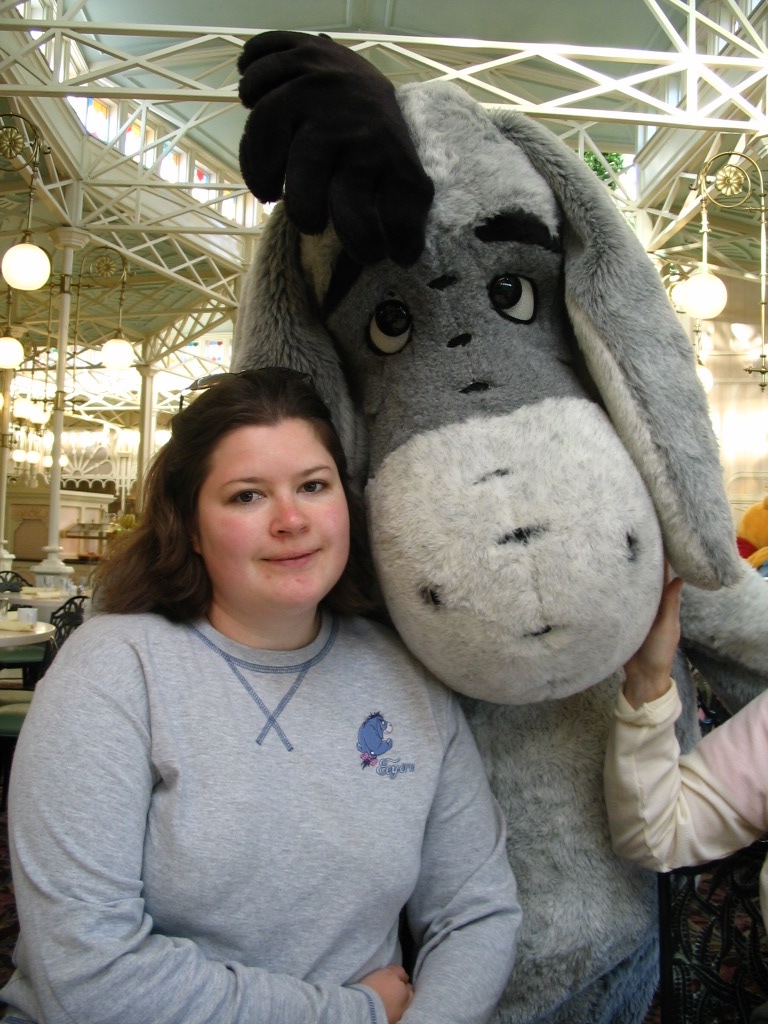
Following yesterday’s post on Fun, I thought it was worth tackling something I haven’t covered yet in this series. The photo is of me and Eyore. We have something in common. We both suffer from depression. Disney has been critical in helping me manage my depression. The escapism when actually there helps hugely to completely re-set my brain but it is more than that. The planning for a trip gives me focus and a way to immerse myself in the escapism in the run up to a trip. The photos I can scroll through (or flip through in the photo books we have created) allow me to reminisce and reflect and to create some of the Disney Bubble at home. Sometimes we have Disney Days where we watch a sunrise series on Disney Plus drinking coffee from our resort mugs, ‘go on’ a ride or two with the help of YouTube and re-create some of the food options we like from the parks. My depression is now pretty well managed and I am very aware of my triggers and the signs it’s coming. I can’t always stop it but I am better able to escape to Disney literally or metaphorically and re-set. Depression for me is about brain overload and not being able to process properly so embracing Disney films and TV series that require no brain power, escaping to the familiarity of Disney characters and enforcing rest (for the brain rather than physical rest) – and allowing the inner child time to play are my antidotes. Understanding that my love of Disney is not silly and childish (in the bad sense) or ridiculous but something that is an important way for me to look after my brain because it nurtures the creativity, story telling and imagination that lights up my soul has been a really important realisation in my depression journey and it, alongside running (more on that in another post), has made staying mentally well much much easier.
Mental Health Awareness Week 2024
I have seen lots of posts marking mental health awareness week and because sharing stories can be powerful, here’s some of mine.
I remember the moment I knew I needed help really clearly which is odd because everything else around the time is vague. I was sitting on our sofa at home and I was working because that’s mostly what I did then. My girlfriend Kath was talking to me and I couldn’t understand her. It was like she was speaking in a language I didn’t know.
I went to see my doctor. She was amazing. I thought I was ‘just a bit tired’ and asked if it would be unreasonable to ask for a week off. She asked me a series of questions and then talked to me about how she thought I had stress induced depression and anxiety. I was confused. I have always been fairly quiet and introvert but depressed? I’ve always been a bit shy but anxious? But as the doctor talked through my symptoms it made sense. She wanted to sign me off for 6 months. I couldn’t comprehend that so we agreed 3 months and and I was sure I’d be back much sooner.
I wasn’t. I went on a stress awareness course. It wasn’t for me. I ran lots of miles, that helped. I moved jobs, that helped for a while. And slowly slowly I began to recognise that the old me didn’t exist anymore, she’s not there for me to ‘get back to’. I began to understand that in many ways I was never going to be well again or at least the sort of well that doesn’t need to think about mental health. I had allowed myself to burn out completely and things are never going to be the same again.
Today I’m mostly fine. I can be ridiculously anxious about the most insignificant things: where can I park the car, have I really booked that train ticket, sending a simple email, going to a new venue while at the same time I’ll happily do things that might be more anxiety inducing for many like stand in a classroom full of students… I haven’t had a day where getting out of bed seems impossible for a long long time but being able to work at home for quite a lot of my time hugely helps. The pace is different, my brain gets more down time.
Because for me that’s how depression and anxiety manifest, my brain gets tired. It stops processing as clearly, coherently or sharply as it can. And as an academic that is scary. So where am I now.
The first episode (not really the right word) wasn’t related to or triggered by a person or incident- it was probably fairly classic burnout. Thereafter the worst times have been the result of bullying, micro aggressions, toxic environment and me trying too hard to cope within those environments. Yet I do still fundamentally trust people. Less so institutions. In my experience universities don’t take mental health seriously. If they did our HE landscape would look very different. That’s taking nothing away from individuals within institutions who do great work in this area.
I have always been loyal to friends and colleagues I think. I am now fiercely protective over their wellbeing, sometimes too much so. I am also fiercely protective over me and much more aware of triggers and warning signs. But I’m not patient with myself. Things take longer, work progresses more slowly and I do less than I did. And while some of it naturally comes with shifting priorities as I have got older, I am not always ok with that. I’m better but not good at not over working and I am far less tolerant of contexts that glorify busy-ness. Sometimes I get scared when my brain needs to go slow.
The thing I have struggled with most is being that flaky colleague. I have, when I’ve been at my worst, let colleagues, co-authors, editors and authors writing for me down. I’ve disappeared on people and not delivered on promises. I hate that. It also has a knock on effect that goes on for a long time. Letting people down is awful and I am not particularly good at apologising and moving on.
But I am moving on, every day. Step by step. It’s taken most of a decade and several job changes, lots of sleep, lots of running miles and lots of breathing to get to where I am now.
I suppose what I am really saying is that I’m ok. I now know my brain pretty well. I have my coping strategies and the privilege of being able to pay for therapy. I have support and I have way more good days than other days. I have my sense of humour back and the confidence to know that it’s ok to not be ok and the confidence to walk away from anything toxic without any hesitation. I’m not special so if I can do this, anyone can.
The relentlessness of academic work in lockdown
In a draft post from the end of February that I have just discarded because it wasn’t going anywhere I wrote: ‘I have also had flu and have been ill or not quite right for 3 weeks now. That means that work has slowed down dramatically adding to the perpetual feeling of being behind with everything…’ Well very soon after that everything changed, campus closed and university life moved online. I was as behind as I always am but not really any more so. I was making progress even if that progress was slow.
In lockdown the perception of time, of productivity and of what is important shifted. In one sense it just put into sharp focus that so much of what we do as academics is utter nonsense. For the first part of lockdown I struggled doing anything. I wrote about some of that in the two previous posts. For me it wasn’t a time thing, I don’t have kids to home school for a start, and it wasn’t that I don’t have the right set-up at home to work effectively – we’d just re-done our study so we can both work in it at the same time and it is really quite lush. No, it was about headspace and focus. Things improved a little bit as time went on but I was still struggling to get anything done really.
Then I started going to really detailed to do lists. I broke up everything into much smaller sub-tasks and wrote each of those down as a thing to do. It meant ticking things off more often, seeing the list get shorter and then longer again and generally created a sense of things moving along. With that system alongside a weekly planner on which I recorded roughly the plan for the week with times of ‘meetings’ blocked out and the time around them allocated to overall tasks like REF output reading, marking or edit joint paper, I had a couple of weeks of getting shit done.
But at the start of the third week I was anxious as hell, exhausted before I had even started the Monday, running on caffeine and really struggling to concentrate. I went through Monday and Tuesday like that – a completely heightened state of alertness (and not in the idiotic government message sense) and hyperactivity that had me racing from one job to the next. It felt like a race to tick things off the list. I stopped writing things on the list but then I promptly forgot them adding to stress levels as I wondered what I’d forgotten or got reminders down the line. I got to the end of that week feeling absolutely knackered.
So yes, I had spent 3 weeks getting shit done and was probably more on top of work than I have been in years but I felt wired, and not in a good way. Last week then I tried to start more slowly, to be more considered and to take more breaks and reflect more. Some of the work I got done was nice work. There’s a paper nearly finished, a new project nearly ready to go and they have been fun to think about. It is nice to have the marking done, some institutional level paperwork pretty much ready to submit by the deadline… so why did the working at home over those 3 weeks feel so relentless?
Well I didn’t work more hours overall. And I didn’t stretch the working over a longer day. What I didn’t do was allow myself time to come round and get into work mode. I basically got out of bed, threw clothes on and started work. It felt useful to get a head start. I stopped to have lunch but only to quickly make lunch and then eat it. I had my drinks at my desk and didn’t stop between tasks. The tasks on my list seemed so little that stopping between them to acknowledge having completed them seemed silly. The result: the feeling of rushing even when not, the feeling of urgency even when there wasn’t any, a slight sense of panic at the length of the list in spite of it shrinking quickly through the day. The tiredness came from the hamster wheel of work that needed to be kept going and therefore felt relentless. A three hour meeting on the Friday of that 3rd week nearly broke me. I needed a brain time out.
Last week was better. I was more aware of the risks of the list. I still want the list because I am forgetting stuff and flit around too much forgetting what I am doing, the list helps with that. But I am back to mornings being more deliberately slow, drinks also functioning as breaks, lunch being about more than quickly making it and eating it to get back to work, and the list as something to help remember things not as something to be rushed through. So last week was better. And next week, well next week will be better again because yesterday Odin, killer of feet, joined our family and he is the perfect play break enforcer!


