
Academic Lockdown Reflections
So today should be the day after the Association of Law Teachers conference in Stirling. I should be a happy exhausted buzzing with thoughts…Covid-19 had other ideas so instead of my annual sanity check and catch up with other law teachers I have been at home. I don’t mind being at home. As you probably know I find conference exhausting (not always in a bad way) and I need to ensure plenty of time away from people while there. I am very very glad to be an introvert in these weird times of lockdown. I think extroverts find this harder. People who draw energy from other people and need social contact to re-charge their batteries and feel happy and healthy are likely to struggle much more than I am right now. I like not being sociable! It’s what I do best. However there are a few things that I wanted to reflect on now that we are all settling into this very weird new way of being.
The Academic World is Run by Extroverts

Me being sociable a couple of summers ago
At least that is what it seems like to me. There has been such a focus on, an obsession with even, connectedness. There seem to be more meetings, more phone calls, more emails, more messages. Meetings can’t be a conference call though, it must be video. We must still ‘see’ each other, we must ‘meet’ regularly, we must make sure to stay connected with each other, with our students with anyone we have ever met anywhere however fleeting. That’s what it feels like to me, to someone who is perfectly happy not seeing or speaking to anyone for, let’s say a few weeks, actually I can do longer I am sure, perfectly happily. The pressure is on to find the perfect angle for you webcam so it shows just the right mix of fun and intellectual books on your book shelf alongside the strategically placed family and pet pictures. I’m exaggerating of course but the pressure to connect with people has been immense over the last few weeks. And with that has come a pressure to respond to people. So many people have got in touch to check in so much more frequently than they would normally…. It’s exhausting. I am all for checking in (and not ungrateful, it’s nice of people to think of me and get in touch). I like to check in with my PhD students for example and with some of my colleagues – but I do that anyway. I check in with the people I check in with. I have not suddenly decided I need to check in with everyone who has ever given me a business card at a conference to ask them if they are ok and remind them to stay safe.
What’s with all the new tech?
And it’s not only this emphasis on connectedness, there’s something that comes with it – it’s the overuse of technologies that we weren’t using before. In the space of a few days I had to use several different apps/programmes to talk to people. From Adobe Connect via Google Hangouts and Skype for Business to Zoom and everyone seemed to feel the need to pop on their video, grab a pet and strategically position themselves to show off their home. And in addition to that 100s of Facebook and WhatsApp groups sprung up, email circulars exploded onto the scene at an alarming rate and the ‘answer some questions about yourself (so we can steal your valuable data) thingies popped up on Twitter and Facebook several times a day. That alongside increased email traffic because of a seemingly constant need to provide information – new or otherwise – has been really quite testing. It seems though that some people at least are enjoying this, that they are happily engaging with each other in this way and indeed even need that contact. I don’t understand that but then I don’t need social contact – or rather I need very little.
Academic carry on as normal rhetoric
Thankfully the thinking that we pretty much just do what we do usually has receded somewhat but somehow the underlying assumptions of the academic year and what we do, how and when have not changed. We are still talking about teaching the rest of the semester, of assessing the students, of progression and awards being decided at summer exam boards… I understand the need to think about these things carefully and think through the consequences and knock on effects but it also seems slightly ridiculous in a global pandemic to just carry on as normal. And mostly that’s what we are doing, we’re just doing it from home, without the infrastructure, without the time to plan it properly and with the assumptions that we can work from home as easily as we can in the office. I still see the odd ‘now that we have more time’ tweets and some people seem to see lockdown as an opportunity to get work done but I am not sure that’s the reality for most or even many of us – I’ll come back to that in a sec. I am not saying we should cancel assessments or that we should just progress students or progress them based on what they’ve done so far or that we find some random clever algorithm to tell us what degrees to award on the basis of grades so far and attendance and grandmorther’s cat’s middle name (or cynically of course parents’ income)… No, I don’t have the answers but I am concerned that we are not really asking the right questions. Are we too focused on getting the job done to focus on keeping each other and ourselves safe and sane or to even stop and think about what exactly this job that needs to be done actually is? I think it is a shame that as a HE sector we are not at the forefront of slowing things down and thinking really carefully about how we get through a pandemic doing as little damage as possible to ourselves, our colleagues, our students and our families. I also understand though why this isn’t really happening. The sort of thinking to do something different and not based on at least business as usual outcomes if not business as usual methods, requires headspace and a good sprinkling of bravery. In a pandemic headspace and bravery are in short supply and perhaps best spent on survival and getting the job at hand done. I honestly don’t know if pushing ahead with assessments etc is the right thing to do and I don’t know because I can’t seem to think it through fully. I get stuck on a thought or sidetracked with something else or I get hungry or sleepy… all further signs that things are really very far from business as usual.
Time is a funny thing
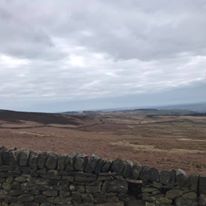 This sort of links to some of the things I have seen pop up on social media about time. There are lots of marketing things seemingly based on the notion that we now have time to get crafty, take up new hobbies, exercise more in the home, learn a language, learn to play a new instrument and in the case of academics, finish those millions of unfinished papers lying around waiting for us to have the time to spend on them. Right, so, is that notion so ridiculous? Do I have more time? Probably. For a start I am cutting out the commute. Door to door it probably takes me roughly an hour so that’s a couple of hours several times a week. Then I am not going out anywhere so time to travel to my gym sessions or yoga classes are also gone and any home workouts are generally shorter, as are the runs I am doing at the moment (although I have been out more frequently than I had been). But just being at home adds work – cooking, cleaning, tidying up all step up a gear when two of you are at home all the time and eating every meal at home etc. Then add the weirdness of lockdown and for me that has meant being unfocused and flitting about between jobs without settling to anything. It has meant struggling to hold on to thoughts for long enough to finish thinking them, it has meant being sleepy randomly and hungry basically constantly. It has meant desperately wanting to go out and being anxious about going out at the same time. So do I have more time? Probably yes, do I feel like I have more time? Nope! Do I want to spend time taking up a new hobby? Fuck off! I am spending the time I have on 2 things. 1. Getting the most important work things done so I do not let students or colleagues down and 2. staying as mentally healthy as I can so I can continue to do 1 as well as enjoy time with my partner and our furballs. So anyone who is managing to get shit done. Awesome. I am happy for you. For everyone else – it doesn’t matter!
And this is me, no kids, zero responsibilities really and with working at home being normal and nothing new and I didn’t even have to move teaching online because I wasn’t doing any face to face teaching this semester. People who have any sort of caring responsibilities in all of this do not have more time, perceived or real. They have less time and they are trying to work, educate, care… this ‘more time because we’re on lockdown’ is bollocks for almost all of us.
So have I learned anything?
Well, I can sleep 12 hours and still be tired and there are really very few people I feel the need to stay particularly connected to and I don’t at all feel the need to be more connected during a lockdown than I was before. I don’t really have any tips for handling any of this because I am not sure I am handling it all that well. The only thing I do want to say though is that all that advice that is out there about routines, about exercise, about being sociable… pick and choose what works for you. Last weekend I spent the entire weekend just reading (Book of Dust 2 if you must know) and clearing out the box room in little bursts. It was great to get lost in the book and not worry about anything else. That’s what helped me reduce the randomly sky high anxiety at the weekend. Walking up to the moor to see lapwings and curlews and take a few deep breaths before gently jogging

Frogspawn and Frog
back down helped with focus and energy levels. Sitting in the garden having a little chat with the cats, the frogspawn and bumble bees helps with making sense of it all. What helps you will be different so work on that, not on some forced notions of connectedness or productivity (though if these things really do help you – and I can see that at some point getting lost in my academic writing could be helpful – then go for it). You do you and allow others to do what they want/need right now. There is no right or wrong way of doing lockdown as an academic or as a human. There’s just a way or ways that work for you.
Stay safe.
Society of Legal Scholars Day 1
I am trying the conference thing again. It’s probably better than spending the next week or so in the office with everyone around me trying to absorb the pressures of the start of term. Still I am conscious that depression has kept me on the sofa much more than I would like and that anxiety levels have been generally high. I am working on the re-set but it’s not easy. So when I set off yesterday it didn’t seem like a great idea to be heading into people and give a paper based mostly on personal experience and reflection.
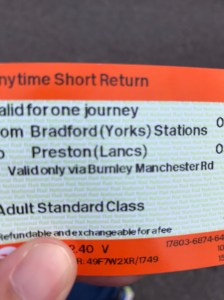 Travel was a bit irritating because the trains into Bradford and then back out to Preston didn’t match at all. I sat at Bradford interchange for 40 minutes watching the world go by…. that’s another story! Then I got on my little train and pootled towards Lancashire through the familiar northern landscape. It suddenly felt important to be staying in the north. Safer, less pressured, more familiar. I watched the hills and fields come and go and longed to be out there breathing the fresh air. I went over my paper. I stared into space and then a few blokes with dogs got on the the dogs were scary and I hoped they would get off at Preston so I didn’t have to go past. I was also suddenly very aware of my own privilege, of what having a job and a secure income at a level where worrying about money isn’t a thing really means; how rare that is in these northern towns I was passing through. I felt both lucky and powerless.
Preston. I walked from the station to the hotel to leave my bags and realised that some time out before people would be good. I found a Costa coffee and had a peppermint tea and bar of dark chocolate. I like Preston. It’s real. It’s a bit of a dump of course, there’s the university and there’s poverty and not much else but the people are real, they are friendly and welcoming and I couldn’t help smiling all the time. I belong in towns like Preston (or Keighley), it feels right. I slowly walked up to the university passing huge building sites and lost in my thoughts. I registered, I bought books, I chatted to one or two people and then it was time for session 1 and my paper.
The session started with Caroline Strevens (Portsmouth) ‘Challenging Assumptions:revisiting the Law Curriculum’ and her paper was packed full of fabulous ideas centred around self determination, motivation, mindsets and teamwork being the answer. I do think self determination theory is useful and it can tell us something about how universities get things wrong by undermining academics and their intrinsic motivation and how we get this wrong with our students too and basically force them to focus on extrinsic motivating factors… I am not sure about teamwork being the answer. I don’t know enough but as an introvert and someone who quite likes working alone and did as a student I wonder…
Then it was me. My paper reflects on two of my publications from 2008 and 2009 both written in the 2007/08 academic year and suggests that I was perhaps rather naive then and got some things wrong, not least arguing for a time turner to make the academic job doable. Instead, I suggest in this paper, we should make better use of an invisibility cloak and marauderers’ map (I do indeed solemnly swear that I am up to no good) to help us do things our way and defend against the dark arts (of neoliberalism, managerialism , marketisation, metrics, ranking, the glorification of busyness…) I am actually really looking forward to properly writing this one up.
The third paper in the session was be Steven Vaughan (UCL) and was, as always, a treat. I love the way Steven presents, it appears easy and effortless and pulls you in. The paper was one I had heard before but that didn’t matter. Steven told us about his work on the structure of LLB programmes and in particular the core subjects. I have often asked why the core is the core. In fact I ask my students and part of me loves the fact that we don’t really know, that it seems to be a historical accident and one which we can’t rally justify on pedagogical or legal grounds. The core is the core because it’s what was predominantly being taught when the core was decided but there were other subjects in contention too. What I find utterly fascinating though is that colleagues often find it impossible to imagine something else. That when you ask them to design a law degree starting with a blank page they start with what they now understand to be the core but they can’t articulate why.
I can write about what I would put in a law degree another time but for now let’s just say I’m not wedded to the core, I wouldn’t teach in the current modular silos and I am not sure I would make anything compulsory other than a sort of legal skills, methods etc course. I see logistical argument for first year compulsory modules but I am struggling for pedagogical and legal ones. But I digress.
I had coffee, there were too many people, I briefly considered going back to the hotel but then just went to the next legal education session instead. It wasn’t a great choice. The papers were just not really my thing. The first was by Roland Fletcher (OU) about apprenticeships and I think I was tired and stopped listening properly. The second was a panel on workplace focused law degrees and while what they were doing seemed quite interesting there is something about the focus of law programmes on providing legal experience to the exclusion of all others that annoys me. It perpetuates the myth that what we do is about our students becoming lawyers and that a degree is/should be about employability. Of course I am being unfair here, they might be doing all sorts and just sharing this particular aspect. I would have liked more on the literature and context though rather than just a ‘here’s what we are doing’ sort of thing.
I went back to the hotel, dumped my bag and checked in and then went back for drinks and dinner. They were fine, conversation was easy because I was with people I knew and people I was content to just listen to. The entertainment folk singing went on for a few songs longer than I felt happy with and I was glad for some air and me time on the walk back. I slept badly. I woke early. I wondered about going for a run but it was raining cats and dogs and the bed was comfy and I felt achey. I didn’t want a battle in my head, I wanted a slow morning. And that’s what I’ve had. Nearly time for SLS Day 2 now!

“I got bored of rules”
I got bored of rules. Well yes I did but not recently. I think I probably got bored of rules a long long long time ago. I got bored of rules the minute I figured out that most of them make no sense, that most of them serve no real purpose, that most of them are bad rules. Was I a pain in the arse child that constantly asked why? I honestly don’t know – ask my parents. I am, like we all are full of contradictions though. I mean it seems a bit odd for someone bored of rules to study law, right? And perhaps even odder then for someone bored of rules to teach law. It’s also odd for someone bored of rules to have coined #MyRunMyRules as their running mantra. So here’s where the blog post splits – keep reading here for my academic-y stuff and click over the my running blog for the running rules stuff.
So what does being bored of rules mean for a legal academic? It’s an interesting one that. I’ve never found rules per se interesting. Law as rules is boring. What is interesting is how we engage with rules, how they impact on our lives and how we choose to navigate that. So when I say I got bored of rules I think what I mean is that I got bored of engaging with rules, particularly rules which I believe are pointless and at best serve no real purpose and at worst do significant damage to us. In the context we were talking in in the therapy session a number of things could have triggered that statement. I am bored of the supposed rules about teaching infrastructure – that our lectures are x minutes long, our workshops the same, that our workbooks for students basically should look the same, that assessment rules stipulate world length for levels etc. Most of these rules serve no useful purpose at all. I am also bored of law as rules. Law is so much more and learning about law shouldn’t be about learning rules. It should be about learning to think about rules and what they mean, how they come to exist and if, why and how there could be better rules, or no rules or just different rules.
I am bored of traditional, outdated, flawed ways of thinking about law and law teaching. I am bored of university rules or rather of engaging with them as if they matter. Mostly they don’t. More and more often I find myself thinking about how things could be better – how do we make changes that really matter – how do we change the rules? What sort of rules should there be? Should there be any? What are the meaningful rules that we need to make a university work? I’m pretty sure they’re not rules about logo placement, about what the VLE looks like or the number of words students have to write at any given level. I wonder if there have to be rules about lectures and seminars and what learning happens when (as if that could ever be a meaningful rule anyway) and I wonder if rules about student attendance really mean anything. What happens when we don’t follow the rules? What happens if we pretend they don’t exist, if we try and think much more creatively about what we want to do in our law schools, why we want to do it and how. What would the rules look like if we did that?
I know I flirt with breaking rules or ignoring them a lot of the time but I am beginning to get a sense that that’s not enough. That doesn’t change the rules, they’re still there being pointless at best and obstructive to good teaching and research, to collegiality and our collective and individual sanity most of the time. I think we probably need something more. I don’t really know what that looks like though because for now I am simply very very very bored of rules at work and in my work. I’m getting irritated and I am getting angry about rules too and I think I need to work through this more fully before I can get to re-writing the rules – by which I mean mostly scrapping the rules because most of them really are just pointless and destructive.
I think.

