
Association of Law Teachers
As always the fabulous Chris Ashford beats me to it and says it better than I could. The ALT is a wonderful organisation to be part of and Chris is a wonderful Chair.

 A commitment that has been occupying my time and will continue to do so over the next couple of years, is the amazing privilege of being Chair of the Association of Law Teachers. The Association is celebrating its 50th birthday this year, but we want to grow the Association to ensure we have an even larger and vibrant community of law teachers, and so that we have the finances to further promote legal education and support the legal education community through grants, awards and pedagogy-focused activities.
The ALT is a vibrant, welcoming and inclusive community of academics, professionals and practitioners engaged in legal education across a number of countries. Our members support legal learning in schools, colleges, universities and professional sectors, on campus, face-to-face and online. Our aim is to inspire and celebrate excellence in the teaching of law, and to share the understanding and practice of legal learning.
View original post 94 more words
The Law Teacher:…
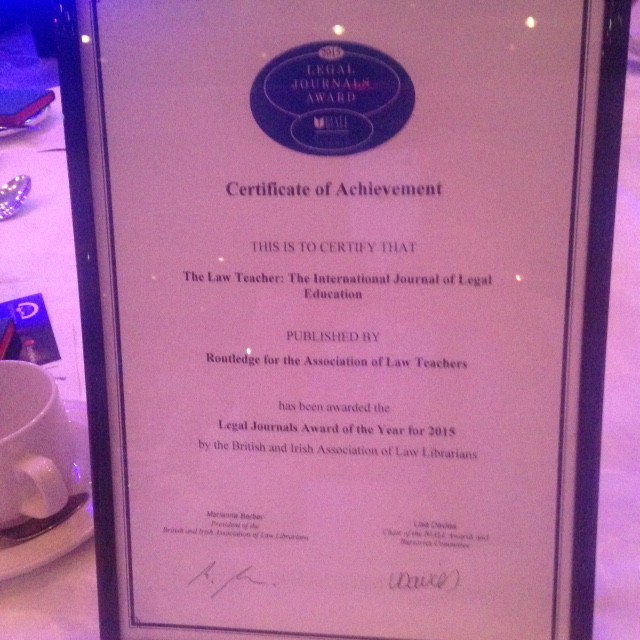
…The International Journal of Legal Education and now also the British and Irish Association of Law Librarians (BIALL) Law Journal of the Year for 2015. How exciting is that!?! It is a real honour and pleasure to be part of the team that makes this possible. The journal’s editor is the wonderful Chris Ashford (Northumbria Uni) and I am the deputy editor. Neither of us could go to the dinner where the award was given so our consultant editor Nigel Duncan (City University) went. This seemed absolutely perfect as Nigel was the editor before Chris and really the journal’s success is down to his work. Chris and I ( well Chris mostly) have been lucky enough to be able to build on that foundation. Nigel sent this picture from the dinner (thank you Nigel!):
 The journal is published by Routledge and they have been fantastically supportive and really do help us produce 3 fantastic issues every year. So if you teach law, whether in a university , college or school I think The Law Teacher is worth a look. I know this sounds like a shameless plug for a journal I am involved with and in a way it is. But it is a shameless plug for a great journal that I enjoy reading and which makes a genuine contribution to my teaching and therefore my students. So if I haven’t convinced you to take a look, maybe the contents of Issue 2 of 2015 will. Take a look here and judge for yourself whether the journal makes your list of top journals. It is certainly on mine.
Thank you BIALL!
Running to feel better – no really.
Here’s a post from my running blog but I think it is useful here too. Academics are often rubbish at looking after themselves and I am no exception. There is a trigger to me feeling as I do but the trigger would be nothing if I wasn’t already so exhausted, irritated and disillusioned with so much of Higher Education. More on that another time.

I seem to have managed to keep the worst of my depression at bay. Let’s keep the black dog metaphor going – I have shut that stupid black mutt out but it is still hanging around outside. For only the second time in my academic career (which now spans well over 10 years) I have withdrawn from a conference. I was due to fly out to Sweden tomorrow but I just couldn’t get my head round flying out there on my own, I couldn’t get my head round exploring somewhere I’d never been before and I couldn’t get me head round giving two papers and putting my research out there for comment. I’ve cancelled. I shall miss seeing some great colleagues and friends but I need to look after myself.
Running and yoga seem to be becoming a part of that. I went to work today and mostly it was…
View original post 271 more words

