
Society of Legal Scholars Day 1
I am trying the conference thing again. It’s probably better than spending the next week or so in the office with everyone around me trying to absorb the pressures of the start of term. Still I am conscious that depression has kept me on the sofa much more than I would like and that anxiety levels have been generally high. I am working on the re-set but it’s not easy. So when I set off yesterday it didn’t seem like a great idea to be heading into people and give a paper based mostly on personal experience and reflection.
 Travel was a bit irritating because the trains into Bradford and then back out to Preston didn’t match at all. I sat at Bradford interchange for 40 minutes watching the world go by…. that’s another story! Then I got on my little train and pootled towards Lancashire through the familiar northern landscape. It suddenly felt important to be staying in the north. Safer, less pressured, more familiar. I watched the hills and fields come and go and longed to be out there breathing the fresh air. I went over my paper. I stared into space and then a few blokes with dogs got on the the dogs were scary and I hoped they would get off at Preston so I didn’t have to go past. I was also suddenly very aware of my own privilege, of what having a job and a secure income at a level where worrying about money isn’t a thing really means; how rare that is in these northern towns I was passing through. I felt both lucky and powerless.
Preston. I walked from the station to the hotel to leave my bags and realised that some time out before people would be good. I found a Costa coffee and had a peppermint tea and bar of dark chocolate. I like Preston. It’s real. It’s a bit of a dump of course, there’s the university and there’s poverty and not much else but the people are real, they are friendly and welcoming and I couldn’t help smiling all the time. I belong in towns like Preston (or Keighley), it feels right. I slowly walked up to the university passing huge building sites and lost in my thoughts. I registered, I bought books, I chatted to one or two people and then it was time for session 1 and my paper.
The session started with Caroline Strevens (Portsmouth) ‘Challenging Assumptions:revisiting the Law Curriculum’ and her paper was packed full of fabulous ideas centred around self determination, motivation, mindsets and teamwork being the answer. I do think self determination theory is useful and it can tell us something about how universities get things wrong by undermining academics and their intrinsic motivation and how we get this wrong with our students too and basically force them to focus on extrinsic motivating factors… I am not sure about teamwork being the answer. I don’t know enough but as an introvert and someone who quite likes working alone and did as a student I wonder…
Then it was me. My paper reflects on two of my publications from 2008 and 2009 both written in the 2007/08 academic year and suggests that I was perhaps rather naive then and got some things wrong, not least arguing for a time turner to make the academic job doable. Instead, I suggest in this paper, we should make better use of an invisibility cloak and marauderers’ map (I do indeed solemnly swear that I am up to no good) to help us do things our way and defend against the dark arts (of neoliberalism, managerialism , marketisation, metrics, ranking, the glorification of busyness…) I am actually really looking forward to properly writing this one up.
The third paper in the session was be Steven Vaughan (UCL) and was, as always, a treat. I love the way Steven presents, it appears easy and effortless and pulls you in. The paper was one I had heard before but that didn’t matter. Steven told us about his work on the structure of LLB programmes and in particular the core subjects. I have often asked why the core is the core. In fact I ask my students and part of me loves the fact that we don’t really know, that it seems to be a historical accident and one which we can’t rally justify on pedagogical or legal grounds. The core is the core because it’s what was predominantly being taught when the core was decided but there were other subjects in contention too. What I find utterly fascinating though is that colleagues often find it impossible to imagine something else. That when you ask them to design a law degree starting with a blank page they start with what they now understand to be the core but they can’t articulate why.
I can write about what I would put in a law degree another time but for now let’s just say I’m not wedded to the core, I wouldn’t teach in the current modular silos and I am not sure I would make anything compulsory other than a sort of legal skills, methods etc course. I see logistical argument for first year compulsory modules but I am struggling for pedagogical and legal ones. But I digress.
I had coffee, there were too many people, I briefly considered going back to the hotel but then just went to the next legal education session instead. It wasn’t a great choice. The papers were just not really my thing. The first was by Roland Fletcher (OU) about apprenticeships and I think I was tired and stopped listening properly. The second was a panel on workplace focused law degrees and while what they were doing seemed quite interesting there is something about the focus of law programmes on providing legal experience to the exclusion of all others that annoys me. It perpetuates the myth that what we do is about our students becoming lawyers and that a degree is/should be about employability. Of course I am being unfair here, they might be doing all sorts and just sharing this particular aspect. I would have liked more on the literature and context though rather than just a ‘here’s what we are doing’ sort of thing.
I went back to the hotel, dumped my bag and checked in and then went back for drinks and dinner. They were fine, conversation was easy because I was with people I knew and people I was content to just listen to. The entertainment folk singing went on for a few songs longer than I felt happy with and I was glad for some air and me time on the walk back. I slept badly. I woke early. I wondered about going for a run but it was raining cats and dogs and the bed was comfy and I felt achey. I didn’t want a battle in my head, I wanted a slow morning. And that’s what I’ve had. Nearly time for SLS Day 2 now!

SLS Day 4
![IMG_2246[1]](https://jessguth.com/wp-content/uploads/2018/09/img_22461.jpg?w=225&h=300) SLS Day 4. Day 4! I have been conferencing for 4 days (as I write this I am waiting for the final plenary to begin) and I feel fine. I have probably overdone the caffeine so far today so if anyone sees me with coffee take it off me. I slept quite well until 4.45am and then I was absolutely, totally and annoyingly awake. Ideas about my paper, yes more ideas but sadly not more coherent ideas, were swirling in my head and I thought I’d get up and do some work on it. I sat up and and felt decidedly creaky. I stood up and just stood for a while and then turned my head to look out of the window and realised I was essentially doing yoga. I kept going for a bit doing as much stretching as was possible in the space. Then I decided I should run. I didn’t really feel like it but I wanted to have a last little trot out before the Great North Run on Sunday. I didn’t go far but it was nice to be out in the early morning sunshine. By 7am I was showered dressed and tucking into scrambled eggs on toast while scribbling notes based on where my brain had got to with my paper.
SLS Day 4. Day 4! I have been conferencing for 4 days (as I write this I am waiting for the final plenary to begin) and I feel fine. I have probably overdone the caffeine so far today so if anyone sees me with coffee take it off me. I slept quite well until 4.45am and then I was absolutely, totally and annoyingly awake. Ideas about my paper, yes more ideas but sadly not more coherent ideas, were swirling in my head and I thought I’d get up and do some work on it. I sat up and and felt decidedly creaky. I stood up and just stood for a while and then turned my head to look out of the window and realised I was essentially doing yoga. I kept going for a bit doing as much stretching as was possible in the space. Then I decided I should run. I didn’t really feel like it but I wanted to have a last little trot out before the Great North Run on Sunday. I didn’t go far but it was nice to be out in the early morning sunshine. By 7am I was showered dressed and tucking into scrambled eggs on toast while scribbling notes based on where my brain had got to with my paper.
Then I packed my bag, checked out and headed to the Legal Education Stream room. My two papers were first. My first paper was a paper on Excellence – it’s a version of the paper I talked about here. It has grown in complexity, breadth and depth and as a result is completely unwieldy. The comments and questions were really helpful but possibly added to the complexity. Tony Bradney however asked whether the question actually ![IMG_2252[1]](https://jessguth.com/wp-content/uploads/2018/09/img_22521.jpg?w=225&h=300) becomes if excellence is an intellectually useful concept to think about and try and ‘find’. I think maybe this is the question around which the paper can be structured
becomes if excellence is an intellectually useful concept to think about and try and ‘find’. I think maybe this is the question around which the paper can be structured
The second paper was really Caroline’s and she did a fabulous job, this was her first conference paper. We reported on a project about critical thinking in law schools. I won’t say too much on this now because we’re still gathering data but basically it seems law teachers agree it’s important, struggle to define it, can talk about the barriers to teaching critical thinking well and run out of ideas when pressed on how we do it better. If you are an undergraduate law teacher and fancy an hour or so chat about critical thinking, get in touch and we’ll set something up.
The final paper in that session was about Law Students, Lawyers, Wellbeing and Vulnerability by Graham Ferris. It addressed many of the issues I struggle with in the wellness debate. It tackled the victim blaming inherent in the resilience discourse (you can’t cope so it is your fault). Drawing on Martha Fineman Graham suggested that thinking about vulnerability as universal yet particular to each person and resilience as the other side of the same coin helps us avoid those conceptual traps the wellness discourse so often falls into. Good paper and a nice reminder that I have a pile of Martha Fineman literature to read.
The second session kicked off with Hélène Tyrrell and Josh Jowitt who gave an updated ![IMG_2256[1]](https://jessguth.com/wp-content/uploads/2018/09/img_22561.jpg?w=300&h=225) version of the paper which won the Stan Marsh best paper prize at the ALT conference this year. They are using cases in teaching in a way that puts them front and centre and encourages students to see them rather than the textbooks as the key reading. They are having great successes with their approach and it is great to see it being used beyond their summer school and in the Judicial Review section of their first year public law teaching. Some of my public law re-write for this coming term is based on some of the techniques and the thinking behind them. They also had the best concluding slide ever! Hélène and Josh were followed by Rachel Nir and Tina McKee who shared their research on attendance which tried to grapple with the why students don’t attend question. They have some really interesting data but I think probably need to link it more to the existing literature which might give some context to what they have found. There is lots in the literature about transition to HE which I think would help and this is my reminder to email them.
version of the paper which won the Stan Marsh best paper prize at the ALT conference this year. They are using cases in teaching in a way that puts them front and centre and encourages students to see them rather than the textbooks as the key reading. They are having great successes with their approach and it is great to see it being used beyond their summer school and in the Judicial Review section of their first year public law teaching. Some of my public law re-write for this coming term is based on some of the techniques and the thinking behind them. They also had the best concluding slide ever! Hélène and Josh were followed by Rachel Nir and Tina McKee who shared their research on attendance which tried to grapple with the why students don’t attend question. They have some really interesting data but I think probably need to link it more to the existing literature which might give some context to what they have found. There is lots in the literature about transition to HE which I think would help and this is my reminder to email them.
![IMG_2255[1]](https://jessguth.com/wp-content/uploads/2018/09/img_22551.jpg?w=300&h=225) The final paper was, I think, about teaching ethics in New Zealand law schools. I was tired and I stopped listening. Sorry. I was really starting to get to overload and I was tempted to duck out but I was well and truly boxed in in the middle of a row. So I sat it out and then headed for lunch. I had to work quite hard to not freak out, it seemed noisy and busy. I sat in a relatively quiet corner next to Peter Alldridge, current (outgoing) president of the SLS who then asked me to draw the prize for a voucher and books from the completed publisher bingo cards. Great, potential spot light, just what I needed. Anyway, somehow I felt better after that. Then I went to talk to Emma Tyce at Routledge and she gave my some fliers for mine and Sanna Elfving’s book and we chatted about ideas for future work. It was lovely and it is really nice and reassuring to have a supportive publisher.
The final paper was, I think, about teaching ethics in New Zealand law schools. I was tired and I stopped listening. Sorry. I was really starting to get to overload and I was tempted to duck out but I was well and truly boxed in in the middle of a row. So I sat it out and then headed for lunch. I had to work quite hard to not freak out, it seemed noisy and busy. I sat in a relatively quiet corner next to Peter Alldridge, current (outgoing) president of the SLS who then asked me to draw the prize for a voucher and books from the completed publisher bingo cards. Great, potential spot light, just what I needed. Anyway, somehow I felt better after that. Then I went to talk to Emma Tyce at Routledge and she gave my some fliers for mine and Sanna Elfving’s book and we chatted about ideas for future work. It was lovely and it is really nice and reassuring to have a supportive publisher.
![IMG_2261[1]](https://jessguth.com/wp-content/uploads/2018/09/img_22611.jpg?w=300&h=225)
Finally I went to the panel on Brexit. A rather depressing way to end a conference I suppose but there we are. First we heard from Catherine Barnard on the future – it was pretty much doom and gloom but that’s because it is! I have been vaguely thinking about the Brexit transition period and how it will work but Catherine is right, the transition period is not as much of a problem as what happens after because it seems clear that a trade deal of any description will take longer than the transition period to negotiate. So what happens in between? Catherine notes that legally there is only a very weak base for 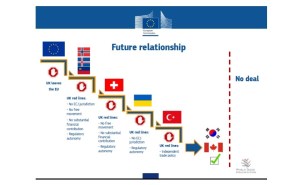 transition in the first place and none for extending it. I have seen Barnier’s steps of doom before but having Catherine’s clear explanation of the reasoning behind suggesting the Canadian type relationship is the only viable option.
![IMG_2265[1]](https://jessguth.com/wp-content/uploads/2018/09/img_22651.jpg?w=150&h=113) Daniel Wincott then spoke about devolution which I also very much enjoyed but realised I don’t know enough about and then Sionaidh Douglas-Scott took a look back to show how the Brexit issues are actually issues that have mostly come up before. I enjoyed that paper and once again thought that doing some historical work would be really nice. I always meant to do something joint with my colleague Fran and we often said we’d do it sometime but for her ‘sometime’ didn’t come so maybe I just need to get on with it.
Daniel Wincott then spoke about devolution which I also very much enjoyed but realised I don’t know enough about and then Sionaidh Douglas-Scott took a look back to show how the Brexit issues are actually issues that have mostly come up before. I enjoyed that paper and once again thought that doing some historical work would be really nice. I always meant to do something joint with my colleague Fran and we often said we’d do it sometime but for her ‘sometime’ didn’t come so maybe I just need to get on with it.
So that’s me done and now on the train home editing and doing the links on a painfully slow wifi connection. It has been a good conference, a really good conference. I was pleased to see so much interest in the Legal Education Stream and on the whole really good quality papers presented in every session I attended. I will leave you with a slide from Fiona Cownie’s presentation on Day 3 and the clear sense that we have moved beyond the sentiment expressed within it:
SLS Day 3
 Day three started with me being lazy! I couldn’t be bothered to go out and run. It looked quite lovely outside but I had ideas swirling round in my head and wanted to play with them and have a slower morning. A cup of tea would have been nice but in student accommodation you just can’t have everything. I played with ideas for a while – I have too much going on in my paper and I know it all fits together somehow but I can’t quite articulate it. Then I vaguely considered running after all and joining the fun run but remembered just in time that I actually don’t like running with people. I spoke to Kath and then went for breakfast and continued playing with ideas but didn’t really get anywhere. I bought myself a cafe mocha and headed back to the room, finished the self care blog post and then headed for the AGM.
The AGM was efficient and smooth and included the election of a new Vice President. I was a little disappointed that the choice was between three white men and spent some time reflecting on diversity at the conference. It doesn’t feel as dominated by white old men as I remember previous conferences but there is still a little too much white men in suits talking to white men in suits going on – though that might just be me not being quite ready to admit that maybe the SLS is not as stuffy as I thought it was. As part of the AGM/Council Meeting session Joanne Conaghan gave a presentation on the REF. There wasn’t much there I didn’t already know but I think the key message (which I agree with) was this: Get yourself REF literate! And if you don’t know where to start with that, have a look here.
I headed straight for the Legal Education stream then which began with a keynote from Fiona Cownie. It’s no secret that she is one of my greatest role models, has been a fantastic mentor and has taught me so much about navigating the, shall we say challenges, of university life. I love listening to her speak. For a start it vaguely takes me back to being an undergrad student and I often chuckle at how much of my large group teaching style is modeled on how I remember hers; then her presentations are always told as a sort of story which is easy to follow, logical, coherent, thought through properly and fun. Today she was taking a look at the history of legal education research. I thoroughly enjoyed the presentation and am pleased to report that I am in fact a political scientist after all:

The next paper was by Lydia Bleasdale and Sarah Humphreys and focused on trigger warnings. I have heard Lydia talk about her resilience research before and the full report is worth taking a look at. This paper focused on a couple of questions the students were asked and I think it really highlighted that most of what we know about trigger warnings is fake news. There is, as they argued, a moral panic around this and that is probably fueled by misconceptions about what trigger warnings are. I actually haven’t given trigger warnings much thought – at least not in the sense of actually calling them that. I do think it is useful for students to know what topics will be discussed/considered so that they can choose how to engage with material they know might have a negative impact on them. To me giving information that helps students better prepare on an emotional and intellectual level for an academic discussion of issues can only be a good thing. What is clear is that much more research is needed here and that the trigger warning stories perpetuated in the media provide lovely teaching materials for the importance of checking your sources properly.
Rossana Deplano then presented her experience from an action research project looking at using concept maps in Public Law teaching. A number of things struck me – Leicester have 6-8 students in tutorials. Wow. Oh my goodness that’s a different universe. I mean that’s how I remember it at Leicester but I presumed it would have changed and the groups would now be bigger. I was also struck by how many of the things Rossana was describing she did in her tutorials that used concept maps are things I often do instinctively in the classroom. I often end up drawing diagrams to try and show links

This could so easily have been my session
between ideas and principles and to work through theoretical ideas and practical problems. I encourage students to do the same and I used to capture may of our joint efforts and share them with other groups on the VLE – I haven’t done that for a while but it’s powerful because it often demonstrates variety of equally valid approaches to the same question, issue or idea. Any way, I’m off to read a bit more about concept maps.
I chatted with lovely people over lunch and then went for coffee with Lisa Webley, another fabulously generous lovely woman who has given up her time again and again to help me figure out how this crazy world of higher education operates. Talking to her was just brilliant and I now have a much clearer picture of quite a few things in my head. Sometimes it really does help hearing someone else articulate what you do really already know but can’t quite grasp hold of. Thank you!
After Lunch Avrom Sherr asked whether legal education research was really about legal education and concluded that legal education was a never ending debate. It was a whistle stop tour through lots of contested questions and issues in legal education and it was kind of fun.


The next presentation was perhaps the one that fit least into the broader discussions we were having about legal education. It was all a bit too business-y and employability-ish and bit ‘yay cash prize’ etc for me. I stopped really listening although I think there could have been some really interesting stuff in there about the nature of learning.
The final paper was by Caroline Gibby on Liminality and morphogenesis and I really really wish this hadn’t been the last paper of the day because I was flagging a little. This stuff is messy in a good way and thinking about the transformation of (legal) educators is interesting and important and I do think what Caroline was getting at is probably right (if I understand her correctly that is) – some legal educators feel locked into narrow roles where opportunities for development are minimal and thus limit the overall progression or evolution of a particular context. I need to go back over the notes I took, her abstract and look at some of the literature Caroline cited to help me think about this some more but I think there are answers to some of my tricky questions in there somewhere.
After the session I went for food with my ALT vice Chair Caroline Strevens to talk about
some ALT stuff and now I am back in my little room and really not far off going to bed (It’s about 9.30pm). I am beginning to have a sense of what I want to say tomorrow and I think sleep and a morning run will do far more good than trying to finalise it completely now.
Day three was good, day three has, it occurred to me walking back to my room through the London drizzle, been genuinely good for the soul.
 My Conversations