
Back in the classroom
So here we are again. It’s the end of September and in universities across the country staff are welcoming new students. I have just spent three days in London in various meetings and they all in some way required me to think about what we teach, how, why… my head is full of that strategic, high level, sometimes theoretical, sometimes just jumping through hoops stuff that I guess is now my job. It’s been interesting, it’s been intense and it’s been fun and as always after these sorts of meetings I am knackered. And yet, as I head back north there is an underlying excitement about the coming week. It took my a while to figure out what it was but now I have it: I’ll be teaching next week. I am excited about teaching! I can’t wait to get back in the classroom. This excitement started to build on Monday evening, just a little bit. I was giving the induction lecture to the new first years on Tuesday morning and on Monday I was getting exctied, on Tuesday I was buzzing. The hour in the lecture theatre on Tuesday was, it seemed at the time, everything I had been working for over the summer. They were here, the first years were here and I could fire the starting pistol for the journeys that can change their lives – that could change the world. Wow.
On Wednesday I took one of the tutorial groups for our sample/intro tutorial and personal tutor meet. Again I was excited and again the experience didn’t disappoint. It was a small group and we sat and chatted about so many of the things that matter to me – law, justice, morality, legal education, making a difference. I can whinge about students as much as the next academic but let’s not forget that we can learn so much from them, that if we encourage them to engage with us, we will be better for it. So, induction is over. I have my first EU Law lecture on Tuesday – I’ll be telling stories about EU citizenship (just in case anyone cares) and I can’t wait. Am I nervours? Hell yes, I will be walking into a lecture theatre with 100+ students and I’ll be putting my views, my research, my knowledge on the line. I’ll be performing and performances can go horribly wrong but I will have fun; and I will learn something and the more I think about it, the more I cannot imagine an academic career without teaching. That’s not an option for me, I need to be in the classroom, thats where I can see my vision, ambitions, hopes and dreams come true; it’s where I make a difference and it’s where I can re-charge my batteries and my sense of humour to help me deal with all the other rubbish being a manager in the HE sector can throw at you. So, I may be Head of School, but I have no intention of shifting all of my teaching – that’s just not me!
Clearing – my thoughts
This week has been all about Clearing and A-Level results for me. It started earlier this week when the University got the results and we worked out how many clearing places we would have for our courses and continued through the week as we got more information, confirmed some more students and got ready for today – A-Level results day.
I have a weird sort of affection for clearing. I went through clearing, I loved my uni days and am grateful for the chance to study law and I get really excited about now being able to give that chance to some of our callers. Working the clearing helpline is a bit of an emotional rollercoaster though. There are the calls from people who are nowhere near the entry tariffs and you just know they will struggle to get a place and it’s heartbreaking; there’s those who are so close and you really want to take them but can’t because os university policy; there are those who have made it and are so excited about getting a place in clearing and those who have done better than expected and are even more over the moon. So basically today I have been in the business of making dreams come true and shattering them in pretty much equal measures. Here are my thoughts/tips whatever you want to call them for surviving clearing
1. Don’t panic – you don’t have to make all the decisions now – don’t let institutions pressure you into accepting a place you don’t really want
2. Come to an open day if possible – most unis have them (For Bradford’s clearing open days see the website)
3. Think about what you want – if it is to study a particular subject at a particular institution and you haven’t got in, can you resit and try again next year? Is it the place or the subject that grabs you? If the place, do they have other courses of interest; if the subject, can you go somewhere else?
4. Have all your info ready – institutions need your UCAS ID, Clearing ID, information about your results, what course you’re interested in and if you have called them before the reference number they gave you.
So for those who got the results and uni places you wanted – well done! For those who haven’t, it feels horrible, really horrible but you know what, I went through clearing and my student days were fabulous and with hindsight I’m actually quite pleased I didn’t get into my first choice! And if this helps a little bit – a lot of our best students have come through clearing. We don’t accept people who we think will struggle too much on our courses so if we offer you a place it’s because we believe in you and want to help you reach your potential. I’ll be back on the phonelines tomorrow afternoon and I am looking forward to it – I just hope that the dreams I can make happen far outnumber the dreams I have to shatter! (Oh and just in case you want to come and study with us at Bradford – we have some places available and all the info including the number to call is on the website.
Political Science Conferences, Winning Awards and Fabulous Colleagues
I have loads of semi-written blog posts in notebooks and on scraps of paper and I will eventually get round to typing them up and finishing them. While I have a few minutes though, I wanted to share what is now no longer really news but is still quite exciting: I won an award. Or rather my paper did. The paper I presented at the International Political Science Association (IPSA) World Congress on 24th July 2014 in Montreal won the Francesco Kjellberg award for new scholars. Ok I see you raising an eyebrow, new scholar? Well I wasn’t entirely comfortable about that either but this is measured by time since PhD and I therefore do fit the criteria. Details of the prize are on the IPSA website. I am totally blown away that anyone would think that my work is ‘outstanding and worthy of publication in a leading political science journal’ (the other criteria). I therefore wanted to say thank you publically to those who made this possible and who are responsbile for this hideous picture of me grinning like a drunk (I wasn’t!) Cheshire cat coming into existence. There are several more pictures from the conference including another of me receiving the award on the conference flickr stream.
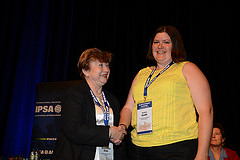
Me at IPSA 2014 Closing Ceremony receiving my award
First Heather MacRae of York University in Toronto for introducting me to the idea that political science might be fun (and being right) and for nudging me to submit the abstract; next to Yvonne Galligan of Queen’s University Belfast for nominating the paper and then for pushing me to finish it and allowing me a little extra time to do so while I was in hopsital; to Bradford University School of Management for agreeing to fund the trip and of course to the prize panel who awarded the prize.
However, the prize wasn’t the highlight of Montreal, far from it. The highlight was actually having dinner with colleagues from a handfull of different countries chatting away, partly about our work, partly just about life. I was again struck by how much real academic work and thinking happens when you just start talking to people who are interested in similar things. So dinner was great and our panel session really just formalised some of those discussions. Political scientists do things differently to lawyers in terms of conferences. There is an overuse of discussants which apparently is normal and I’ve never been to a conference without coffee breaks before. There was also a lot I just didn’t know anything about or understand but I did like the atmosphere generally. Heather said, as we left ‘I’ll never turn you into a political scientist, will I?!’ – well Heather, you may be closer to that than you think!
Oh and if anyone actually cares what the paper was – it was on Gender and the Court of Justice of the EU and the draft (yes I know about the typos etc) can be downloaded below. I’ll let you know what I do with it next! but if you have comments let me know.

