
Political Science Conferences, Winning Awards and Fabulous Colleagues
I have loads of semi-written blog posts in notebooks and on scraps of paper and I will eventually get round to typing them up and finishing them. While I have a few minutes though, I wanted to share what is now no longer really news but is still quite exciting: I won an award. Or rather my paper did. The paper I presented at the International Political Science Association (IPSA) World Congress on 24th July 2014 in Montreal won the Francesco Kjellberg award for new scholars. Ok I see you raising an eyebrow, new scholar? Well I wasn’t entirely comfortable about that either but this is measured by time since PhD and I therefore do fit the criteria. Details of the prize are on the IPSA website. I am totally blown away that anyone would think that my work is ‘outstanding and worthy of publication in a leading political science journal’ (the other criteria). I therefore wanted to say thank you publically to those who made this possible and who are responsbile for this hideous picture of me grinning like a drunk (I wasn’t!) Cheshire cat coming into existence. There are several more pictures from the conference including another of me receiving the award on the conference flickr stream.
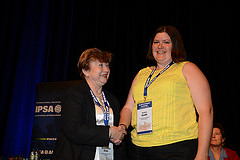
Me at IPSA 2014 Closing Ceremony receiving my award
First Heather MacRae of York University in Toronto for introducting me to the idea that political science might be fun (and being right) and for nudging me to submit the abstract; next to Yvonne Galligan of Queen’s University Belfast for nominating the paper and then for pushing me to finish it and allowing me a little extra time to do so while I was in hopsital; to Bradford University School of Management for agreeing to fund the trip and of course to the prize panel who awarded the prize.
However, the prize wasn’t the highlight of Montreal, far from it. The highlight was actually having dinner with colleagues from a handfull of different countries chatting away, partly about our work, partly just about life. I was again struck by how much real academic work and thinking happens when you just start talking to people who are interested in similar things. So dinner was great and our panel session really just formalised some of those discussions. Political scientists do things differently to lawyers in terms of conferences. There is an overuse of discussants which apparently is normal and I’ve never been to a conference without coffee breaks before. There was also a lot I just didn’t know anything about or understand but I did like the atmosphere generally. Heather said, as we left ‘I’ll never turn you into a political scientist, will I?!’ – well Heather, you may be closer to that than you think!
Oh and if anyone actually cares what the paper was – it was on Gender and the Court of Justice of the EU and the draft (yes I know about the typos etc) can be downloaded below. I’ll let you know what I do with it next! but if you have comments let me know.
Reviewing ‘Straight Expectations’ by Julie Bindel
Curled up in our summerhouse on a giant beanbag in middle class sort of suburbia not a million miles away from Hebden Bridge I have just finished reading Julie Bindel’s new book ‘Straight Expectations’. Before I had finished the book Professor Chris Ashford published his review of the text on his blog. Initially I thought I didn’t really have anything to add to his thoughts. I agree with everything he says in that post so blogging a review repeating what he has already said seemed pointless. However, having finished the book now, I think I do have something to say.
Bindel’s book was on my list to read urgently (I have various lists!) for a number of reasons. I contributed to one of her surveys and was interested to see the results of that survey, I am strangely fascinated by identity; often disagree profoundly with Bindel and was slightly irritated by the subtitle ‘What Does it Mean to be Gay Today’ because surely that depends on a whole host of factors and I also thought the book might help me also develop my own research on LGBTQ legal academics.
Let me start by saying that I think you should read the book. It is an amazingly honest and open book and we need more of those. Ashford is right in calling it a very personal book and it is a book that certainly made me reflect, think, laugh cry, get angry and think a bit more. It’s a few hours since I finished the book and I can’t shake off the feeling that, as a lesbian, I must be such a disappointment to Bindel. But let me try and do this in some kind of order.
One of Bindel’s key arguments is that the campaign for equality and in particular marriage equality as well as the right to ‘acquire’ (her words) children is actually inherently conservative. I don’t really disagree with her. I have never been at all interested in marriage, gay or straight. I don’t particularly like weddings, I don’t get the point, the significance or why anyone would want to get married – actually particularly women. However, what I do get is that it is really really important to some people and that these people are not being screwed by the patriarchy, they don’t need liberating, they have thought about it and the implications and made the decision to get married. That of course doesn’t always hold true and I remain deeply suspicious of the institution of marriage but I just don’t believe that everyone entering into wedded bliss has been brainwashed into supporting the patriarchy.
It may surprise some people that the sections in Bindel’s book about children and the increasing trend amongst gay men and lesbians to have children irritated me the most. I don’t like kids. There are very few children I tolerate, even fewer that I like. I have friends with children and in spite of the joy that their offspring clearly bring them, I fail to see why anyone would want to put themselves through all of that. Quite frankly I find having cats stressful enough, I don’t have a biological clock (and strongly suspect it’s a societal clock rather than a biological one anyway), I have no maternal instincts… and even if I did I am not sure I understand this urge to have biologically related children. There are so many kids out there who would benefit from a loving stable home – why not look at adoption/fostering etc, particularly now the legal barriers have been removed (I do agree with Bindel here though that the law is way ahead of societal attitudes here). So, so far I have agreed with the narrative in the book – so why the irritation. Well, I feel deeply uncomfortable about making claims about what is and isn’t right for people. Personally I can’t really think of anything worse in my life than pregnancy and having a sprog but I have also seen a lot of people who have genuinely blossomed and come alive once they had children. Why criticise that? Why suggest that if they are gay or lesbian and have the desire to have children of their own, they are somehow letting the side down by wanting to become just like ‘them’ (meaning straight folk). I also felt a little uneasy about the distinction made (implicitly) between lesbians who had kids from straight relationships which they had left (good lesbian) and lesbians who decide to have children as single lesbians or in lesbian couples (bad or at least not so good lesbian). I just do not think that Bindel, me or indeed anyone else are in a position to tell people what they should or shouldn’t want from their lives, be that babies or marriage
This brings me to the points she makes about marriage and marriage equality. I was genuinely excited about the change in the law that allows same-sex couples to marry. Why? Because I believe in equality. Do I think it takes the gay rights agenda any further forward – well no not really. Gay culture is about much much more and just because we have achieved equal rights does not mean the fight is over. There is a long ling way to go and Bindel captures this well. I am not sure I agree with her that we shouldn’t have bothered with marriage rights but should have always worked to overthrow the patriarchy though – maybe the patriarchy can still be dismantled! But the thing is, I have never been particularly activist or political. I have never been radical in that sense. I have never dressed ‘lesbian’ (whatever that means), I have always just been me and that me has never had a particularly lesbian identity. My sexual orientation has never been a big deal. I have no coming out story, at some point in my life I started having sex with women that was that, then I fell in love with one, that didn’t work out, then I fell in love with another. No dramas, no big political statement, no big personal statement. Did I choose to be a lesbian or was I born this way (another key debate Bindel picks up on). I don’t know, I don’t care, I don’t see why we should get so hung up about this. I understand the arguments Bindel makes here but I don’t find them that interesting and do not think they help us further. I am who I am and I have always been open about my personal life but I have never made that personal political in the sense that Bindel clearly has. Part of me admires her for that.
So I said towards the beginning of this post that I felt Bindel would surely be disappointed in me as a lesbian. I am not an activist, I am not radical, I do not speak out against the patriarchy all that much, my life can hardly be described as alternative. I am not even hippy enough to feel comfortable in Hebden Bridge, I don’t often go to gay/lesbian events and the last Pride I went to was a few years ago in Halifax. I don’t wear cocktail dresses or high heels but I also don’t express my identity as a lesbian through what I wear. I live in a pretty middle class area in domestic bliss… The only two things that might make me an acceptable lesbian in Bindel’s eyes is that I am suspicious of the institution of marriage and that I don’t want kids. But I guess to Bindel I am still letting the side down, I am still striving to be too much like ‘them’ and am still too much of a respectable face of lesbianism.
Or am I? I say I’m just me but that just being me isn’t always easy. I challenge my students to think differently, to challenge the patriarchy, to accept me for me as a professional, as a woman and as a lesbian. Sometimes what I say and do in the classroom is radical. Sometimes what my friends with children do is radical, sometimes being just like them is radical… Bindel’ hints at some of this and I welcomed that acknowledgement even though she is quite dismissive of it in the end. So, I am aware that I am now just rambling – you should read Bindel’s book, it’s thought provoking and it gives a snapshot of what it means to be gay for some of us today – actually I don’t mean ‘us’ here because even though I responded to her survey and even though there are some sections with which I absolutely agree, I just don’t see myself in the book, I don’t fit and that is bothering me.
CRonEM Annual Conference – Reflections and Thoughts
I have spent the last two days at the Centre for Research on the European Matrix Annual Conference in Surrey. The conference was titled Sex Gender and Europe and was run in conjunction with the ESRC International Network: Unintended Gender Consequences of EU Policies. The programme is online here
I am writing this on the train home as I reflect on the last two days and just let my – rather full – mind wander. It might therefore be the case that I change my mind about the thoughts captured here, that I think differently in a few day’s time when I have slept, processed ideas and reflected further. For that I make no apologies, it’s all part of the process!
Day one was long and intense but at the same time inspiring and encouraging in the sense that it created a really productive environment for sharing ideas. As Roberta Guerrina introduced the Gender network and the work it had been doing over the last two years it struck me (not for the first time recently!) how creative, innovative and productive a bunch of people with similar interests can be when given the time and space to talk to each other, to think, to challenge and to support. The work that comes out of these collaborations have had the benefit of feedback at all levels – from basic idea to finished paper and it is amazing work for it. What that means is that the network is significantly more than the sum of its parts and this is something to really think about in research funding. Academics, or at least this bunch of academics and I suspect many others too, need to be able to engage with each other in a meaningful way over a sustained period of time to be able to produce their best work
The papers on day 1 were all great, many given by PhD students who are engaging in some really interesting work which made me more hopeful that there is a bright future for gender and EU studies. I really enjoyed Muireann O’Dwyer (University College Dublin) speaking on the EU democratic deficit and although I am still grappling with her use of some of the concepts (like intersectionality) I am sure she has tapped into something which can push our understanding forward – I am looking forward to reading the full paper. I also enjoyed Gill Allwood on the prostitution debates and whether we should construe prostitution as sex work or violence against women. While I have on occasion picked this theme up in discussions in my Law and Society module, I hadn’t particularly thought about this in an EU context but I think it might be worth re-visiting some of the worker case law involving prostitutes in the light of the discussions we had. Koen Slootmaeckers spoke about Pride in Serbia which made me think about Pride and what it means – this will continue to whirl through my head for a while because here the personal does turn into the political. I can so absolutely see the political and symbolic importance of Pride in some contexts and yet Pride is not something that I have ever particularly engaged with. On day 2 the panels related mostly to gendering the economic crisis and I found Rosalind Cavaghan and Emanuela Lombardo’s paper helpful because it pointed me in the direction of literature which will help me get my head round some of these issues more. Denise Amram presented from Italy via Skype and by outlining the legal position of married couples where one spouse changes their sex in several European Countries, she made me think about what a European Union response might be and how this might then play out in a free movement context. Wow!
The highlight for me however was Carl Stychin who gave the plenary paper on Day 1: Status Symbols: European Same-Sex Couples on the Move. The absurdity that can arise where people marry in one state, live in another, move to a third, potentially divorce…. It’s complex for heterosexual couples who usually do not have to worry about their marriages being accepted as valid (although of course, these issues could also come up!) For same sex couples these questions are even more complex. I started trying to reason this out in a paper published in 2011 but Carl’s reasoning takes this debate further and is rather more sophisticated than I managed!
So, here I am on the train reflecting on a really packed but great 2 days which were full of conversations, excitement and a mutual belief that the work we are doing is important and worth persevering with and that is something to hold on to as we all go back to the everyday grind of the academic job.
 My Conversations