
Feeling seen, feeling the history and feeling the possibilities
I have lost count of the number of Law Schools I have walked into over the years. I have obviously studied in and worked at several. I have visited many many more. But I can count the number of Law Schools I have walked into where the walls have been dominated by portraits or photos of women. Until earlier this month that number was precisely zero. One of my more famous (read public) tantrums came in one of my previous roles where, in a staff meeting, we had agreed that we should brighten up the hallways in the Law School with some law relevant pictures. A week or so after that meeting I arrived at work and pictures of long dead white men adorned the walls and I lost the plot. It was not one of my finest moments but I do think I was right. I am not suggesting that we erase history or that we should ban Law Schools from putting images of dead white men on their walls, I am saying that we should be mindful of whose history we are portraying, who we are championing and what it means if you can or rather if you can’t see yourself reflected in the imagery that the place you are working or studying in chooses to put on the walls.
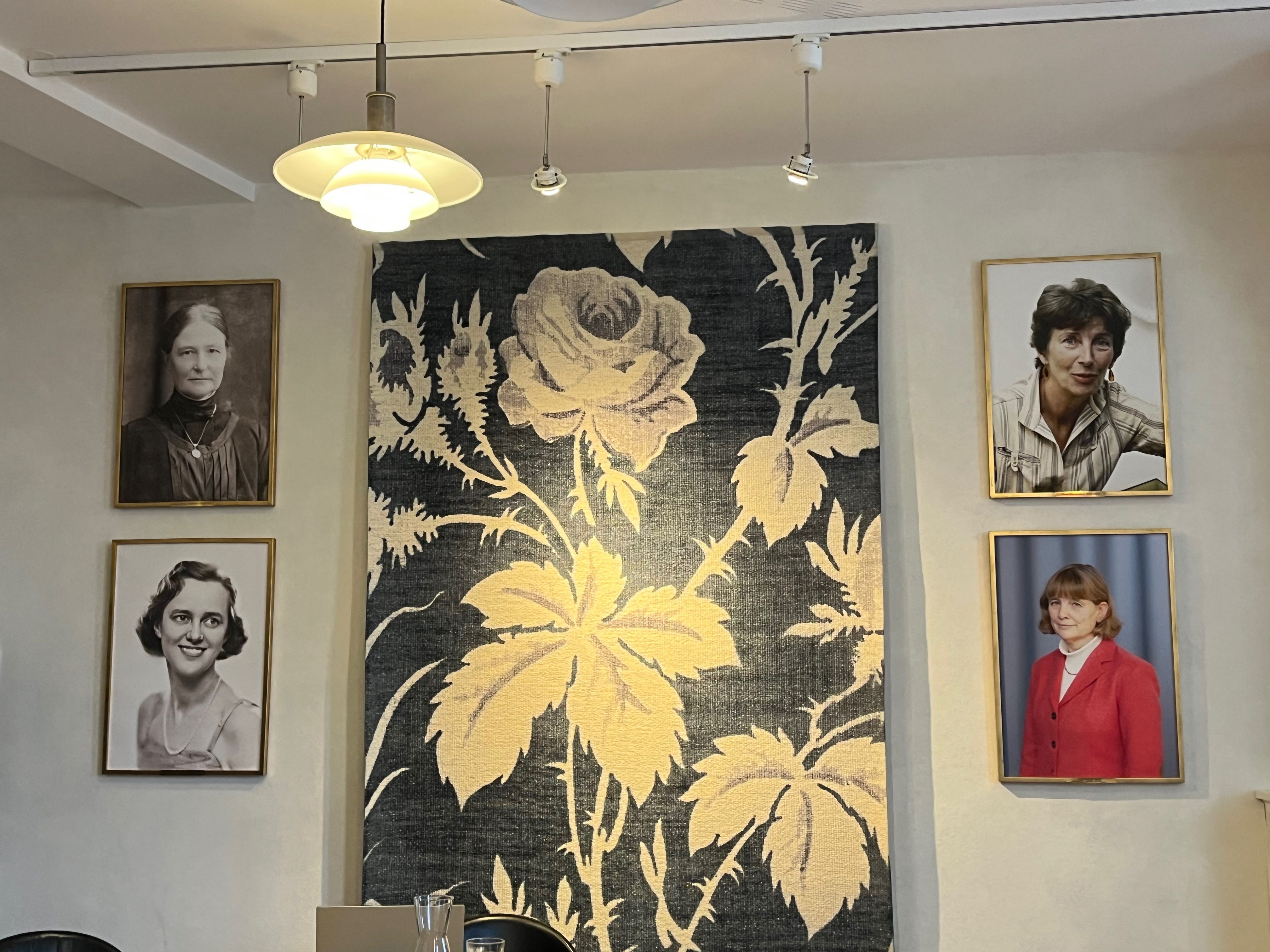
So when, on the 12th February, I was ushered into a smallish room in the Law Faculty of Lund University alongside a group of academics working on various aspects of EU Law, Policy and Politics for our 2 day workshop, my breath was literally taken away. As I made my way down a few steps, I was facing pictures of 4 women. I had no idea who they were at this point but the impact felt almost physical. The room screamed ‘you belong here’. There we were, mostly female academics being encouraged by those who went before us, those who made us being here possible. The 4 women are Anna Bugge Wicksell (1862-1928), Gunvor Mallin (1911-2010), Anna Christensen (1936 – 2001) and Christina Moëll (1959 -) and they are important and impressive figures in the Swedish legal world. Look them up! The Svenskt kvinnobiografiskt lexikon which has biographies of important Swedish Women is a good place to start.
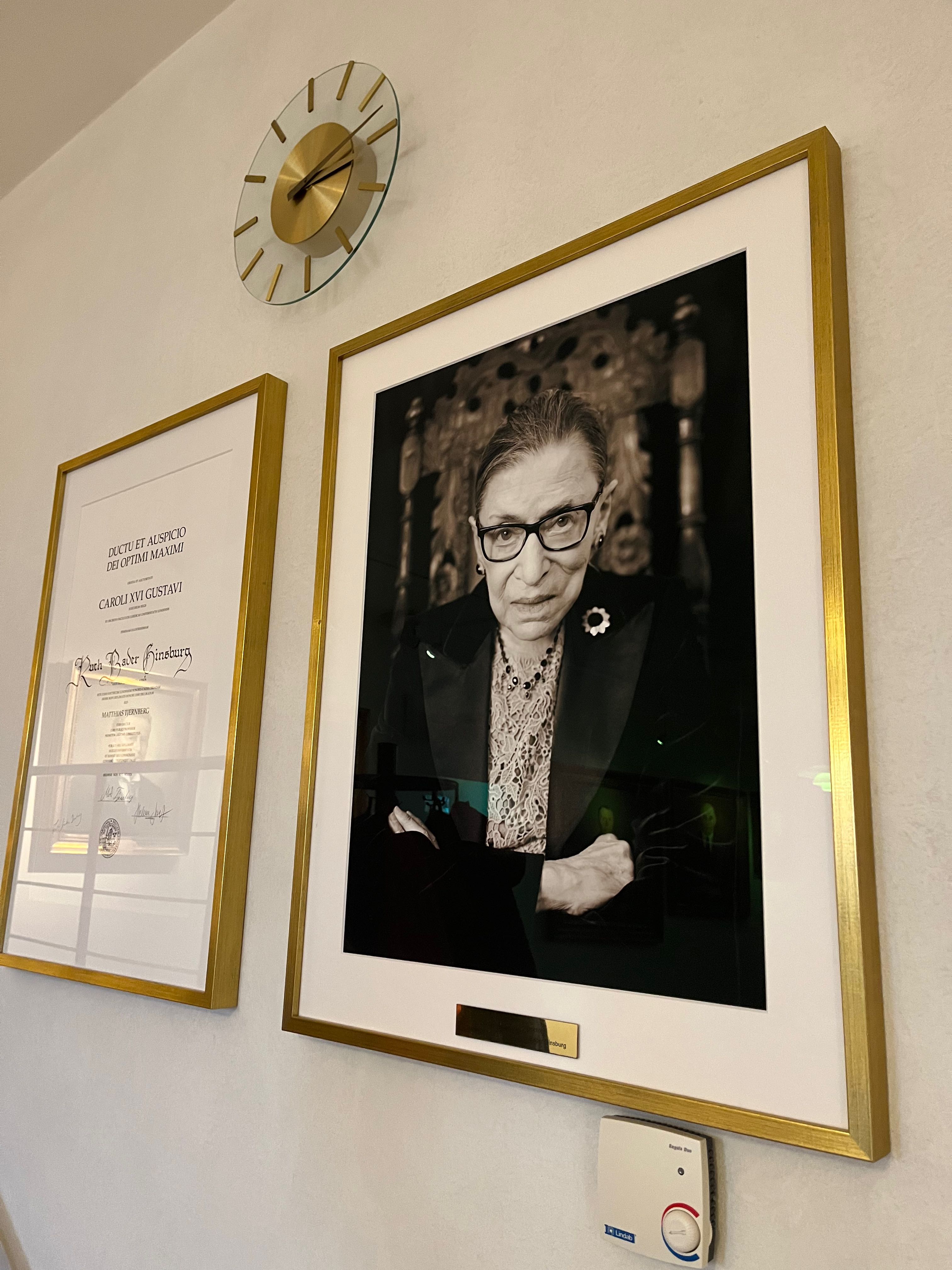
As I took my seat and looked back at the door I had just come through, I noticed a further picture. And this time I did know who the woman looking back at me from inside the frame was: Ruth Bader Ginsburg. I think I just stared. As it turns out RBG received an honorary jubilee doctorate from Lund University and the document is framed next to her picture. It was vaguely intimidating to give a paper with such a legal heavyweight, such a trailblazer, such a brilliant woman looking down at me with that iconic look but I hope she would have been proud of us and interested in our discussions.
Having the women on the walls made a difference. It is hard to explain why. Apart from immediately making me feel like I belonged in that room, genuinely. Apart from being in a room with pictures of important people on the walls and for once not having to roll my eyes about the choice of who is important and apart from the complete novelty of it, I don’t know why it made such a difference. It just did. It was nice and over the two days I think we all commented on it.
It made me think about the importance of representation which I have been thinking about lots lately but also about how far we have come since we saw the first female law graduates, the first female lawyers, first female professors, Deans of School… and how far we still have to go. There are still female firsts to be had and that’s before we even start thinking about intersections with other characteristics. But thinking about how much work there is still to do seemed less heavy with the 5 watching over our conversations. There they were, evidence of change and progress, evidence that we belong, that we are capable and important. I like how they are all different, the pictures chosen are not all the same style and they are not super formal either. They somehow felt more real and their roles and positions somehow more attainable. Ok, perhaps not RBG because, you know, she was RBG – but the others were just women doing their thing – just like we were in that workshop. It felt like by being there and by discussing work that had a focus on gender, we were honouring the work they had done, the way they had paved. It felt good to be seen, to see, to begin to understand our histories and think about the possibilities.
Turns out there were also some paintings of men on the walls – they were behind me throughout, I don’t know who they were, I didn’t bother to check. They just didn’t seem important over those two days. They probably are important, but not in this story and not today.
SLS Day 4
![IMG_2246[1]](https://jessguth.com/wp-content/uploads/2018/09/img_22461.jpg?w=225) SLS Day 4. Day 4! I have been conferencing for 4 days (as I write this I am waiting for the final plenary to begin) and I feel fine. I have probably overdone the caffeine so far today so if anyone sees me with coffee take it off me. I slept quite well until 4.45am and then I was absolutely, totally and annoyingly awake. Ideas about my paper, yes more ideas but sadly not more coherent ideas, were swirling in my head and I thought I’d get up and do some work on it. I sat up and and felt decidedly creaky. I stood up and just stood for a while and then turned my head to look out of the window and realised I was essentially doing yoga. I kept going for a bit doing as much stretching as was possible in the space. Then I decided I should run. I didn’t really feel like it but I wanted to have a last little trot out before the Great North Run on Sunday. I didn’t go far but it was nice to be out in the early morning sunshine. By 7am I was showered dressed and tucking into scrambled eggs on toast while scribbling notes based on where my brain had got to with my paper.
SLS Day 4. Day 4! I have been conferencing for 4 days (as I write this I am waiting for the final plenary to begin) and I feel fine. I have probably overdone the caffeine so far today so if anyone sees me with coffee take it off me. I slept quite well until 4.45am and then I was absolutely, totally and annoyingly awake. Ideas about my paper, yes more ideas but sadly not more coherent ideas, were swirling in my head and I thought I’d get up and do some work on it. I sat up and and felt decidedly creaky. I stood up and just stood for a while and then turned my head to look out of the window and realised I was essentially doing yoga. I kept going for a bit doing as much stretching as was possible in the space. Then I decided I should run. I didn’t really feel like it but I wanted to have a last little trot out before the Great North Run on Sunday. I didn’t go far but it was nice to be out in the early morning sunshine. By 7am I was showered dressed and tucking into scrambled eggs on toast while scribbling notes based on where my brain had got to with my paper.
Then I packed my bag, checked out and headed to the Legal Education Stream room. My two papers were first. My first paper was a paper on Excellence – it’s a version of the paper I talked about here. It has grown in complexity, breadth and depth and as a result is completely unwieldy. The comments and questions were really helpful but possibly added to the complexity. Tony Bradney however asked whether the question actually ![IMG_2252[1]](https://jessguth.com/wp-content/uploads/2018/09/img_22521.jpg?w=225) becomes if excellence is an intellectually useful concept to think about and try and ‘find’. I think maybe this is the question around which the paper can be structured
becomes if excellence is an intellectually useful concept to think about and try and ‘find’. I think maybe this is the question around which the paper can be structured
The second paper was really Caroline’s and she did a fabulous job, this was her first conference paper. We reported on a project about critical thinking in law schools. I won’t say too much on this now because we’re still gathering data but basically it seems law teachers agree it’s important, struggle to define it, can talk about the barriers to teaching critical thinking well and run out of ideas when pressed on how we do it better. If you are an undergraduate law teacher and fancy an hour or so chat about critical thinking, get in touch and we’ll set something up.
The final paper in that session was about Law Students, Lawyers, Wellbeing and Vulnerability by Graham Ferris. It addressed many of the issues I struggle with in the wellness debate. It tackled the victim blaming inherent in the resilience discourse (you can’t cope so it is your fault). Drawing on Martha Fineman Graham suggested that thinking about vulnerability as universal yet particular to each person and resilience as the other side of the same coin helps us avoid those conceptual traps the wellness discourse so often falls into. Good paper and a nice reminder that I have a pile of Martha Fineman literature to read.
The second session kicked off with Hélène Tyrrell and Josh Jowitt who gave an updated ![IMG_2256[1]](https://jessguth.com/wp-content/uploads/2018/09/img_22561.jpg?w=300) version of the paper which won the Stan Marsh best paper prize at the ALT conference this year. They are using cases in teaching in a way that puts them front and centre and encourages students to see them rather than the textbooks as the key reading. They are having great successes with their approach and it is great to see it being used beyond their summer school and in the Judicial Review section of their first year public law teaching. Some of my public law re-write for this coming term is based on some of the techniques and the thinking behind them. They also had the best concluding slide ever! Hélène and Josh were followed by Rachel Nir and Tina McKee who shared their research on attendance which tried to grapple with the why students don’t attend question. They have some really interesting data but I think probably need to link it more to the existing literature which might give some context to what they have found. There is lots in the literature about transition to HE which I think would help and this is my reminder to email them.
version of the paper which won the Stan Marsh best paper prize at the ALT conference this year. They are using cases in teaching in a way that puts them front and centre and encourages students to see them rather than the textbooks as the key reading. They are having great successes with their approach and it is great to see it being used beyond their summer school and in the Judicial Review section of their first year public law teaching. Some of my public law re-write for this coming term is based on some of the techniques and the thinking behind them. They also had the best concluding slide ever! Hélène and Josh were followed by Rachel Nir and Tina McKee who shared their research on attendance which tried to grapple with the why students don’t attend question. They have some really interesting data but I think probably need to link it more to the existing literature which might give some context to what they have found. There is lots in the literature about transition to HE which I think would help and this is my reminder to email them.
![IMG_2255[1]](https://jessguth.com/wp-content/uploads/2018/09/img_22551.jpg?w=300) The final paper was, I think, about teaching ethics in New Zealand law schools. I was tired and I stopped listening. Sorry. I was really starting to get to overload and I was tempted to duck out but I was well and truly boxed in in the middle of a row. So I sat it out and then headed for lunch. I had to work quite hard to not freak out, it seemed noisy and busy. I sat in a relatively quiet corner next to Peter Alldridge, current (outgoing) president of the SLS who then asked me to draw the prize for a voucher and books from the completed publisher bingo cards. Great, potential spot light, just what I needed. Anyway, somehow I felt better after that. Then I went to talk to Emma Tyce at Routledge and she gave my some fliers for mine and Sanna Elfving’s book and we chatted about ideas for future work. It was lovely and it is really nice and reassuring to have a supportive publisher.
The final paper was, I think, about teaching ethics in New Zealand law schools. I was tired and I stopped listening. Sorry. I was really starting to get to overload and I was tempted to duck out but I was well and truly boxed in in the middle of a row. So I sat it out and then headed for lunch. I had to work quite hard to not freak out, it seemed noisy and busy. I sat in a relatively quiet corner next to Peter Alldridge, current (outgoing) president of the SLS who then asked me to draw the prize for a voucher and books from the completed publisher bingo cards. Great, potential spot light, just what I needed. Anyway, somehow I felt better after that. Then I went to talk to Emma Tyce at Routledge and she gave my some fliers for mine and Sanna Elfving’s book and we chatted about ideas for future work. It was lovely and it is really nice and reassuring to have a supportive publisher.
![IMG_2261[1]](https://jessguth.com/wp-content/uploads/2018/09/img_22611.jpg?w=300)
Finally I went to the panel on Brexit. A rather depressing way to end a conference I suppose but there we are. First we heard from Catherine Barnard on the future – it was pretty much doom and gloom but that’s because it is! I have been vaguely thinking about the Brexit transition period and how it will work but Catherine is right, the transition period is not as much of a problem as what happens after because it seems clear that a trade deal of any description will take longer than the transition period to negotiate. So what happens in between? Catherine notes that legally there is only a very weak base for  transition in the first place and none for extending it. I have seen Barnier’s steps of doom before but having Catherine’s clear explanation of the reasoning behind suggesting the Canadian type relationship is the only viable option.
![IMG_2265[1]](https://jessguth.com/wp-content/uploads/2018/09/img_22651.jpg?w=150) Daniel Wincott then spoke about devolution which I also very much enjoyed but realised I don’t know enough about and then Sionaidh Douglas-Scott took a look back to show how the Brexit issues are actually issues that have mostly come up before. I enjoyed that paper and once again thought that doing some historical work would be really nice. I always meant to do something joint with my colleague Fran and we often said we’d do it sometime but for her ‘sometime’ didn’t come so maybe I just need to get on with it.
Daniel Wincott then spoke about devolution which I also very much enjoyed but realised I don’t know enough about and then Sionaidh Douglas-Scott took a look back to show how the Brexit issues are actually issues that have mostly come up before. I enjoyed that paper and once again thought that doing some historical work would be really nice. I always meant to do something joint with my colleague Fran and we often said we’d do it sometime but for her ‘sometime’ didn’t come so maybe I just need to get on with it.
So that’s me done and now on the train home editing and doing the links on a painfully slow wifi connection. It has been a good conference, a really good conference. I was pleased to see so much interest in the Legal Education Stream and on the whole really good quality papers presented in every session I attended. I will leave you with a slide from Fiona Cownie’s presentation on Day 3 and the clear sense that we have moved beyond the sentiment expressed within it: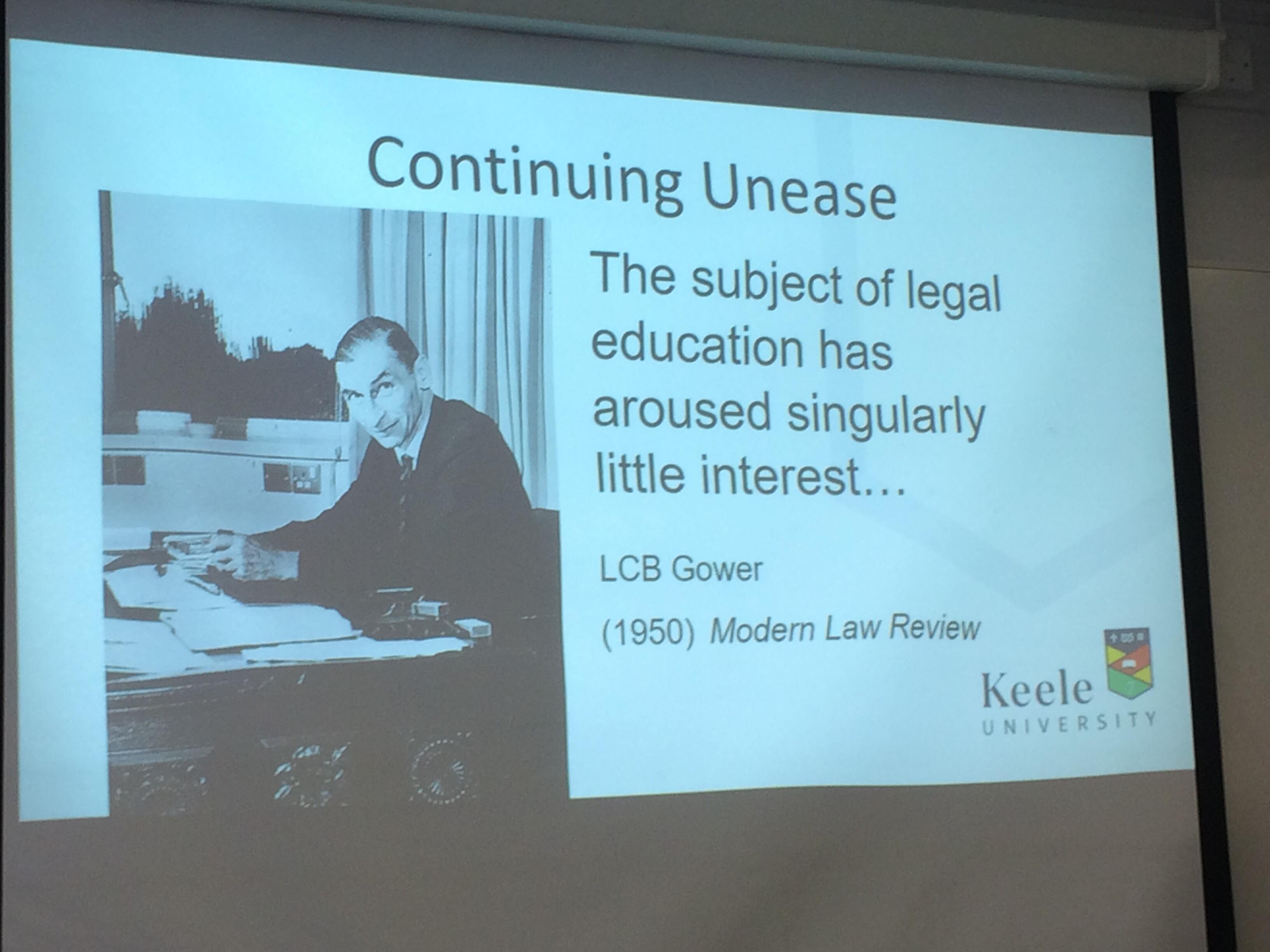

Gender and the CJEU
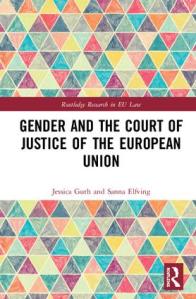 I’ve been meaning to do this shameless self promotion post since our book was published but somehow never got round to it. But now we are waving the summer off and are hitting the new academic year hard it seems sort of ok to do this. I’m not really keen on the ‘yay look at me’ stuff so this post is really about the book and the process of writing it. If you happen to want to persuade your library to buy a copy or two that would of course be awesome too! You can find it on the Publisher’s website here.
So the book. Well it’s basically an examination of the Court of Justice of the European Union and its work on a couple of substantive law areas and it is written from a feminist perspective. In writing the book we were interested in understanding the role gender plays in the CJEU’s work. The first half sets out our approach and the background – composition of the Court, how it works etc and the second half looks at gender equality case law, equality case law more generally and citizenship case law. If you do read it, we’d love to hear your thoughts on it.
I am really proud of this book – not necessarily because of the content and the writing, I can already see plenty of ways it could all be improved – but because it was such a genuine collaboration and joint effort which proved that collegiality is alive and well and because we were able to work with one of our undergraduate students and use sections of her dissertation as part of our research. It was such a privilege to work with Dr Sanna Elfving who I had appointed and who is an absolute star and with Sophie Mayat, a fabulous former student particularly because I missed supervising most of her dissertation while off sick with depression and anxiety just before I left Bradford. It was amazing to see the hard work she put in and the genuinely high quality research, thinking and writing that she produced.
I learned a lot during the writing of that book. First, it always takes longer than you think it will, a lot longer. Second, I need to work with people who have much more patience than I have a right to ask for. I will at some point in the process fuck up and/or fall off the wagon and I need to trust my co-authors to stick with me, call me out, catch my mistakes and point me back in the right direction. That means they need to have incredible patience and they need to be able to cope with me being a bit of a control freak (ok a lot). Sanna deserves a medal. Third, working with someone who works very differently from me is great. The writing process was really interesting. It seems I map out, Sanna inserted tons of information, I edited, Sanna sorted the references. I had the big picture in my head, she took care of the detail. We are good at different things and that means we can focus on the things we like and are good at but all of it still gets done.
I think the key thing I learned was that a book needs to be really strictly mapped out. We had way too much material and trying to work out how to do it all justice caused some of our issues about structure and the overall argument. Once we decided we would just have to leave some of it out, it actually came together well. We have a couple of ideas for some of the stuff that didn’t make it into the book and definitely have more to say on the subject.
Writing a book is a long slog and I thought that it might be like a PhD or running a marathon – you have to forget the pain before you can even begin to think about doing anything like it again – but actually I’d like to write another one, it was overall a really enjoyable experience. Sure, it had its moments but it was also fun. I have a couple of ideas but lots of research work to do before I can begin to really put pen to paper (probably actual pen to actual paper) but watch this space.
 My Conversations