Skip to content

Posts from the ‘Equality/Diversity’ Category

16
May

Mental Health Awareness Week 2024

I have seen lots of posts marking mental health awareness week and because sharing stories can be powerful, here’s some of mine.

I remember the moment I knew I needed help really clearly which is odd because everything else around the time is vague. I was sitting on our sofa at home and I was working because that’s mostly what I did then. My girlfriend Kath was talking to me and I couldn’t understand her. It was like she was speaking in a language I didn’t know.

I went to see my doctor. She was amazing. I thought I was ‘just a bit tired’ and asked if it would be unreasonable to ask for a week off. She asked me a series of questions and then talked to me about how she thought I had stress induced depression and anxiety. I was confused. I have always been fairly quiet and introvert but depressed? I’ve always been a bit shy but anxious? But as the doctor talked through my symptoms it made sense. She wanted to sign me off for 6 months. I couldn’t comprehend that so we agreed 3 months and and I was sure I’d be back much sooner.

I wasn’t. I went on a stress awareness course. It wasn’t for me. I ran lots of miles, that helped. I moved jobs, that helped for a while. And slowly slowly I began to recognise that the old me didn’t exist anymore, she’s not there for me to ‘get back to’. I began to understand that in many ways I was never going to be well again or at least the sort of well that doesn’t need to think about mental health. I had allowed myself to burn out completely and things are never going to be the same again.

Today I’m mostly fine. I can be ridiculously anxious about the most insignificant things: where can I park the car, have I really booked that train ticket, sending a simple email, going to a new venue while at the same time I’ll happily do things that might be more anxiety inducing for many like stand in a classroom full of students… I haven’t had a day where getting out of bed seems impossible for a long long time but being able to work at home for quite a lot of my time hugely helps. The pace is different, my brain gets more down time.

Because for me that’s how depression and anxiety manifest, my brain gets tired. It stops processing as clearly, coherently or sharply as it can. And as an academic that is scary. So where am I now.

The first episode (not really the right word) wasn’t related to or triggered by a person or incident- it was probably fairly classic burnout. Thereafter the worst times have been the result of bullying, micro aggressions, toxic environment and me trying too hard to cope within those environments. Yet I do still fundamentally trust people. Less so institutions. In my experience universities don’t take mental health seriously. If they did our HE landscape would look very different. That’s taking nothing away from individuals within institutions who do great work in this area.

I have always been loyal to friends and colleagues I think. I am now fiercely protective over their wellbeing, sometimes too much so. I am also fiercely protective over me and much more aware of triggers and warning signs. But I’m not patient with myself. Things take longer, work progresses more slowly and I do less than I did. And while some of it naturally comes with shifting priorities as I have got older, I am not always ok with that. I’m better but not good at not over working and I am far less tolerant of contexts that glorify busy-ness. Sometimes I get scared when my brain needs to go slow.

The thing I have struggled with most is being that flaky colleague. I have, when I’ve been at my worst, let colleagues, co-authors, editors and authors writing for me down. I’ve disappeared on people and not delivered on promises. I hate that. It also has a knock on effect that goes on for a long time. Letting people down is awful and I am not particularly good at apologising and moving on.

But I am moving on, every day. Step by step. It’s taken most of a decade and several job changes, lots of sleep, lots of running miles and lots of breathing to get to where I am now.

I suppose what I am really saying is that I’m ok. I now know my brain pretty well. I have my coping strategies and the privilege of being able to pay for therapy. I have support and I have way more good days than other days. I have my sense of humour back and the confidence to know that it’s ok to not be ok and the confidence to walk away from anything toxic without any hesitation. I’m not special so if I can do this, anyone can.

5
Sep

Society of Legal Scholars (SLS) conference Day 1

40914303_661272807588961_1187270286513274880_nI have not been to a Society of Legal Scholars conference for some time. I was looking forward to it. I was particularly excited to be able to go to all of the conference rather than just the half in which my paper was scheduled. I am doing 2 papers in the Legal Education section – more on those another time.

Travel to London was uneventful. I like uneventful. I got a fair bit of work done on the train in spite of the supposed quiet coach being the noisiest coach I have been in for a long time. Is it the thing where you’re told you’re not allowed to do something and therefore immediately want to do it? I got the tube out to Mile End and found the campus and even the right building very quickly. I also managed to get a ticket for the dinner at the end of day 1. I hadn’t booked because I wasn’t going to go but then the opportunity for a catch up with Richard C arose so I really wanted to go.

I had arrived in time for lunch –  a rather ordinary pasta with a veggie sauce (I think there was a chicken one too) and then I headed to the first session. The first paper was great. I expected it to be. It was a paper by Marc Mason (Westminster) and Steven Vaughan (UCL) reporting on their research with LGBT+ barristers in England and Wales. Bonus points if you ‘get’ the title ‘Going to the Gay Bar, Gay Bar, Gay Bar…’ (if you do, your taste in music is as horrendous as mine!). The paper was fascinating and sort of heartbreaking and a little puzzling…. For a start the survey Marc and Steven did shows quite clearly that the Bar Standards Board statistics on sexuality at the Bar are hugely underestimating the number of LGBT+ barristers across the levels. That in itself means that there is something going on there because some are clearly happy to take part in surveys and interviews for research purposes but are not happy to declare their sexuality as part of the BSB statistics reporting. I wonder why that is. The paper’s sections on homophobia and on the performance of being out were fascinating. The data shows that homophobia is quite common but also that barristers play it down as nothing serious and no big deal. I’m really interested in this lack of advocating for themselves. Where does this come from. Is this a professional thing? Do they advocate for each other? This is fascinating and I’m not sure how we’d get to the bottom of this fully. I’ll ponder this.

I loved the notion that came up in one of the quotes about challenging or disrupting the ‘normal rule of engagements’. So men (mostly) finding it difficult to work out what exactly is going on when faced with a powerful lesbian QC, knowing something is slightly ‘off’ and not being able to work out what the rules of engagement now are. I like that. The section on performance of being out (or not) was depressing because there was lots of evidence of concealing sexuality and lying and because clearly there is a huge amount of the ‘bleached professional’ going on. Where barristers are ‘out’ they are often out in relation to their partners only – so they build their professional gay identity around having a same sex partner rather than on being gay – playing the ‘good gay’ game and performing heteronormativity albeit within a same sex relationship.

The second paper was by Ben Waters (Canterbury Christ Church) on ADR and Civil Justice. I also enjoyed this paper although it’s not really my thing and I was still reflecting on the previous one so drifted in and out.

Anyway it was a  fabulous start to the conference. Next I was going to hear more legal education/legal profession stuff and listen to Nigel Duncan (City) on teaching legal ethics but over coffee I realised that I was really flagging. I decided to check into the accommodation and have a little power nap so that’s what I did. Then I headed back to the publisher exhibition area and spent a lovely half hour looking at books (sooooooooo many books, so little time to read….) and then people started filtering in from the sessions for the drinks reception. At the reception I met up with Richard C and we spent the evening talking about well being and anxiety in the legal academy and it was lovely. I left dinner when Richard did and then I went to bed early and fell asleep almost immediately. A good day and a sensible one! I have a blog post started over a year ago on conference self care and I think maybe now is a good time to look at that draft and finish it. I’ll see if I get to it today.

1
Sep

Gender and the CJEU

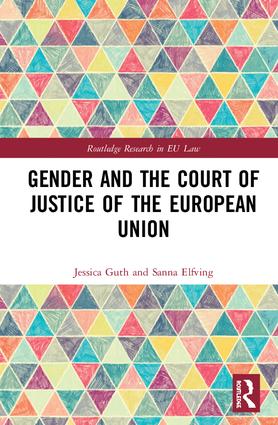
9780415785792I’ve been meaning to do this shameless self promotion post since our book was published but somehow never got round to it. But now we are waving the summer off and are hitting the new academic year hard it seems sort of ok to do this. I’m not really keen on the ‘yay look at me’ stuff so this post is really about the book and the process of writing it. If you happen to want to persuade your library to buy a copy or two that would of course be awesome too! You can find it on the Publisher’s website here.

So the book. Well it’s basically an examination of the Court of Justice of the European Union and its work on a couple of substantive law areas and it is written from a feminist perspective. In writing the book we were interested in understanding the role gender plays in the CJEU’s work. The first half sets out our approach and the background – composition of the Court, how it works etc and the second half looks at gender equality case law, equality case law more generally and citizenship case law. If you do read it, we’d love to hear your thoughts on it.

I am really proud of this book – not necessarily because of the content and the writing, I can already see plenty of ways it could all be improved – but because it was such a genuine collaboration and joint effort which proved that collegiality is alive and well and  because we were able to work with one of our undergraduate students and use sections of her dissertation as part of our research. It was such a privilege to work with Dr Sanna Elfving who I had appointed and who is an absolute star and with Sophie Mayat, a fabulous former student particularly because I missed supervising most of her dissertation while off sick with depression and anxiety just before I left Bradford. It was amazing to see the hard work she put in  and the genuinely high quality research, thinking and writing that she produced.

I learned a lot during the writing of that book. First, it always takes longer than you think it will, a lot longer. Second, I need to work with people who have much more patience than I have a right to ask for. I will at some point in the process fuck up and/or fall off the wagon and I need to trust my co-authors to stick with me, call me out, catch my mistakes and point me back in the right direction. That means they need to have incredible patience and they need to be able to cope with me being a bit of a control freak (ok a lot). Sanna deserves a medal. Third, working with someone who works very differently from me is great. The writing process was really interesting. It seems I map out, Sanna inserted tons of information, I edited, Sanna sorted the references. I had the big picture in my head, she took care of the detail. We are good at different things and that means we can focus on the things we like and are good at but all of it still gets done.

I think the key thing I learned was that a book needs to be really strictly mapped out. We had way too much material and trying to work out how to do it all justice caused some of our issues about structure and the overall argument. Once we decided we would just have to leave some of it out, it actually came together well. We have a couple of ideas for some of the stuff that didn’t make it into the book and definitely have more to say on the subject.

Writing a book is a long slog and I thought that it might be like a PhD or running a marathon – you have to forget the pain before you can even begin to think about doing anything like it again – but actually I’d like to write another one, it was overall a really enjoyable experience. Sure, it had its moments but it was also fun. I have a couple of ideas but lots of research work to do before I can begin to really put pen to paper (probably actual pen to actual paper) but watch this space.