
100 Days of Wonder – #1
I have Covid so I have been both bored and incapable of actually doing anything useful for the last few days. Yesterday, to cheer ourselves up, we booked tickets for Disney on Ice: 100 Years of Wonder for next spring and as it happens, today it is 100 days until we go on our next Disney Adventure. As a result I have been daydreaming, reflecting, thinking… whatever, about the idea of wonder and of escapism. In my induction talks to our new students I also talked about finding the joy in what we do, particularly when we are having a hard time. So as I have been drifting in and out of conscious thought staring at random stuff on TV and coughing my lungs out, I was trying to look for wonder and joy. Here’s number 1 of what may or may not be a 100 day series of finding them and using my Disney or Disney related photos to do so. Of course it is Disney based, that’s where my brain goes when it needs to either escape or is bored or needs cheering up. But in scrolling through photos and closing my eyes and mentally flicking through memories I have thought about so much more than Disney. So bear with me over these post, some will be about work, some will be about running, some will be about life. I hope some will make you laugh and some will make you think but most of all I hope they inspire us all to pause and find joy in the wonder of our lives. I remember the first time I saw Disney World fireworks. I had never seen anything like it. I had never seen anything like Disney World and I was already pretty overwhelmed after a day of having my mind blown repeatedly. I remember standing at the edge of a very busy Main Street USA. I remember that it should have been noisy but that it felt like I was in my own bubble and everything else faded into the background as I was completely in the moment. When I am trying to write or really focus on something, that’s the feeling I try and re-create. It’s both happy and joyful and completely focused. The Disney Fireworks can still do it for me. Here they are from our last trip.

The Law Teacher: The International Journal of Legal Education
Last month, Professor Chris Ashford and I stepped down as General Editors of The Law Teacher and handed over the journal to Dr Emma Jones. Honestly, it’s a funny feeling. The Law Teacher has given me so much over the course of my career, working with Chris has been such a joy and such a rich learning experience and in one way or the other I have always somehow worked on something related to the Law Teacher. I wasn’t going to write anything beyond a quick tweet to mark the occasion but since then, my time linked to the Law Teacher keeps popping into my head.
I published my first book review in the Law Teacher in Issue 1 of 2008, just a few months after starting my first lectureship. I published my first article in the Law Teacher in 2009 (Issue 2) – A Case for Timeturners. I look back on that paper now it and it is somehow completely naive and yet hopeful at the same time. I should maybe write an update. The Editorial of Issue 1 of 2010 welcomes me (and others) to the board and I had forgotten that Chris and I joined at the same time. Over the next few years I had a go at editing book reviews as well as the Policy and Educational Developments sections. Then in 2014, Chris took over as General Editor of the journal and I joined as his Deputy. I remember thinking that I really wasn’t quite sure how I had found myself in that position and hoped that nobody would notice that I didn’t really have a clue what I was doing. in 2018 I got the chance to edit my first special issue (a reflection on the Legal Education and Training Review and a great change to critique the thinking on the SQE as it was then).
We found our feet fairly quickly, we did battle with Editorial Manager, our new online submission system (and if it is possible for a system to actively dislike a person, EM hated me) and we sort of dealt with stuff that came up. We bounced ideas off each other, stepped in to support each other, sense checked each other and reminded each other that we’d also need other voices because we are too similar in our approach to most things. We expanded the editorial board, we established a peer review college, we drove up the quality of work submitted and published and we actively tried to support the legal education community through workshops and being available for conversations. We introduced social media editors to raise the profile of the journal…We did a lot. It’s hard to know now where the ideas came from, I would probably say Chris but actually maybe it was the combination that worked and we had a fantastic team who made the magic happen (and still do).
I think we’ve always care about our authors as much as our readers (because often they are the same!). We read submissions with care and encouraged our reviewers to do the same and respond with constructive kindness. Reading work submitted to a journal is a huge privilege, the author is trusting you with it, probably feels anxious about how it will be received, wants you to like it and in return you get to shape it a little, help make it better, sometimes encourage the re-think it needs to be amazing. We did all of this, mostly without major glitches and mostly just getting on with it – although we definitely had our moments… and then Covid hit.
Lots happened in that time that showcased the nasty side of academia but also the kindness of colleagues, friends and strangers and to cut a long, horrible and for most other people rather boring story short, I wasn’t well. I tried to keep functioning but I wasn’t. As is so often the case in situations like that, I tried to first resign from all the nice things, the things that actually made it possible for me to survive in academia. Chris and the Law Teacher Team encouraged me to stay on, just step back and take the time I needed. When I returned I returned as Co-General Editor alongside Chris with a strengthened and fabulous Editor Team. And now, 10 years after working on the first issue as General and Deputy Editor, we have delivered our final issue as Co-Editors. 10 years just flew by and now there is a Law Teacher shaped hole appearing in my working life – appearing slowly because I haven’t vanished from the journal. For a start both Chris and I stay on as Consultant Editors but I am also seeing through the articles that happened to still be assigned to me and I am also co-editing a Special Issue (more on that another time – it’s shaping up to be fabulous though). The journal is in safe hands with a brilliant team of editors now led by Emma so I am excited to see what the future holds for the Law Teacher and what it feels like to view it as just another academic interested in legal education.
SLS Day 2
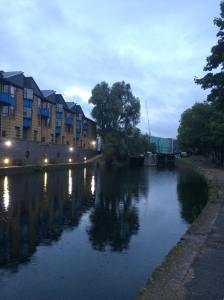 SLS Day 2 commenced after a pretty poor night’s sleep. It needed to be good. Day one set the bar pretty high (oops, already used that pun on Twitter yesterday – can I get away with it twice given that it’s not quite as obvious a pun unless you read the tweet and/or my account of yesterday?). Anyway poor night’s sleep – The usual London dilemma – I had to choose between being too hot or it being too noisy. I am such a country girl, I just can’t deal with the city noise, it just really gets to me so – too hot it was. I gave up trying to sleep at 5.30am and sat up sleepily and sweaty. Given that I was already sweaty I thought I didn’t really have an excuse to not go for a run. I pulled my gear on and headed out and had a lovely little 2.5 ish mile trot out along the Regents Canal.
Breakfast was a bit meh so on the way to the first session I bought a coffee that actually looked, smelled and tasted like coffee. The first session was my random session. I always have at least one at every big conference I go to. For this one I chose the Legal History Stream which started with a paper by Ann Lyon (Plymouth) talking about ‘It Wasn’t Just About the Suffragettes. The Representation of the People Act 1918 and the Realities of Voting in the 1918 Election. I loved this paper because it combined an analysis of the Act set in its historical context with personal stories from Ann’s family. It was a lovely example of being able to touch history through those lovely family connections and thinking through what the 1918 Act would have meant for those family members. That paper was followed by one from Judith Bourne with a great presentation on Bertha Cave who applied to join Gray’s Inn in 1903. I was struck by how little we know about her as a woman and Judith pointed out how she has sort of been decontextualised and isolated from her environment with a dehumansing effect. She is known as an unsuccessful almost first woman lawyer. I found the analysis of the reasons for prohibiting women from joining the legal professions interesting too and I don’t think that these been consigned to history. The culture at the bar is one of tradition and order and strict rules based on the English class system and a specific form of masculinity. Allowing anyone from the  ‘wrong’ background in threatens that order. First women, then working class folk, where will it end… Somehow this doesn’t sounds like we’re talking 100 years ago. Outsiders are indeed a little troubling, aren’t they. The third paper was by Janet Weston who looked at the history if measuring mental capacity. I was still wrapped up in the first two papers that I lost focus through this one. It was a great paper with lovely stories of those involved in mental capacity cases and I was struck by how often a lack of mental capacity had nothing to do with the person whose capacity was supposedly in question but was about protecting women from others who might take advantage of them… I wish I had kept more focused because there was so much good stuff in there.
As I walked back to the publisher exhibition area and, importantly, coffee I was reflecting on the on how fabulous it was to be able to go to random sessions and listen to things that are slightly out of my area of expertise. It allows me to think about things in a slightly different way and prompts ideas about my own work. Conferences are actually really important to improve thinking. I had a quick coffee, picked up a couple of publisher’s lists with discount codes and then headed back over to the Law building for a  Practice, Profession and Ethics session. I must walk round with my eyes shut or lost in deep thought most of the time because it was on this walk over that I registered that the ‘square’ I’d now walked past at least 6 times was in fact a graveyard. I like graveyards. I wished I could linger and explore it more but the session called. For those interested it is the Novo Cemetery, a jewish cemetery and you can read all about it here. It’s somehow quite moving. On my way back after the session I looked at it from the windows of each floor of the building as I came down the stairs. It has quite a powerful pull and somehow triggered an emotional reaction before I knew anything at all about it.
The first paper in that session was presented by Caroline Gibby (co-authored with Amanda Newby and Lisa Down) and was on Integrating Professional and Ethical Contexts. There was some great stuff here about the need to keep discussions about ethics and codes of conduct separate and about the value and pitfalls of narrative pedagogy. I like the idea of teaching ethics by stealth and there are lots of ways this can possibly be done throughout the legal curriculum and in professional/clinic settings. I wonder whether we actually need to start with thinking through what sort of ethics and values teaching we do through the explict as well as the hidden curriculum and then  maybe make that more explicit. I like the notion of supporting students to become confident independent thinkers. I think this might be the key to lots of things. I need to think about this more though.
Next up was Richard Collier talking about wellbeing in the legal community and focusing on the group least is known about: us; legal academics. There is so much in his paper that resonates and that links to many themes I have been thinking about. I don’t want to steal his thunder and I hope the paper is published soon but here is a very brief summary of the argument followed by some thoughts:
- The literature points to lawyers (as in practitioners) just getting by – I think this sounds familiar in terms of the academy
- We still actually know very little about the private life of university law schools but we do know some things about other areas of the academy and law schools, while possibly unique in terms of being able to withstand some of the pressures facing Higher Education generally ( and I am not that convinced that they are all that different from other disciplines), law schools are not immune to those factors
- Metrics, hyper performance and acceleration are coming together to create a menta health crisis in the (legal) academy
- There are pockets of resistance – we need to slow the university down!
- And we need to be crtical of the wellbeing movement – challenge the narrative of resilience and also of the hapiness industry.
Thoughts: I agree wholeheartedly with every single word Richard said. The marketised university creates an environment and setting where good mental health is almost impossible but where the responsibility of having and maintaining good mental health is put solely on us and when we inevitably fail on that we do so because we are not resilient enough (in my case probably because I haven’t completed my online resilience training). But resilience should surely be about crisis or particular difficulties. Resilience is not about getting through normal every day life. The problem is that we have normalised overwork, perfomance metrics and all that other crap. There were links in the paper to my work on excellence and on academic indentity and the paper also raised questions for me about what, as educators, we role model for our students. My brain is still working on this and thoughts pop in and out my head.
Lunch was, like breakfast, a bit meh. Hot food just doens’t work for these sorts of things – do decent wraps, sarnies, salad etc. Much better. Then, rather ambitiously I think, the organisers put two plenaries in the afternoon. The first was Access to Justice in Troubled Times chaired by Mr Justice Robert Knowles with contributions from Mrs Justice Maura McGowan, Dame Hazel Genn and Professor John Fitzpatrick. The rather depressing message from that session was the our justice system is falling apart, access to justice is basically non-existent for many and that law schools are not only providing invaluable service to individuals who seek advice and support in university law clinics but are basically also propping up the system, a system which Maura likened to the NHS – the  bulk of the work and the most emotive work is being done by those judges working in the most difficult conditions. As Maura said in response to one of the questions- ‘in an ideal world you would not have UG students providing legal advice… but because we’re in the state we’re in, it has to work’. There may be some hope with a move to more of the work being moved online but like Hazel I am a little sceptical and like Hazel I hope the powers that be will collect or allow the collection of data that will allow the research community to fully evaluate the changes being made. We have to do better.
While the speakers were interesting I found the panel overall odd. Too much ‘men in suits talking’ at the end and the Chair was directing the questions/conversation in an odd way and limiting the audience participation which made it slightly uncmfortable to watch. I was in need of coffee. As I was walking over somone I only know from Twitter caught up with me and said hi so it was great to meet properly and we chatted over coffee and then headed to the second plenary of the afternoon. The Rule of Law in troubled times. I was flagging a little and my brain was quite full but I enjoyed all three papers even if they all over ran leaving almost no time for questions or comments at the end. I liked Renata Uits’s point that there is a key difference between Rule of Law and Rule by Law but that the line between the two is really only easy to draw with hindsight. She was talking mostly about the Polish and Hungarian context and attacks on judicial independence, a theme which Murray Hunt returned to. I think she is right in saying that the rule of law is vulnerable to abuse because it is an abstract concept that lawyers talk about and it is difficult to translate into practice, it easily slips into rule by law and constitutional engineering the like of which we are currently seeing across the world – Murray gave examples in addition to the central and eastern European examples but I have now forgotten them.
Thom Brooks spoke about the rule of law in the US and there were really no surprises there. Trump talks about support for the rule of law but only really in terms of immigration and walls and what he really means is strict law enforcement (but not against him or his friends). He quoted Bob Dreyfuss saying ‘Never before … has a president so openly challenged the legitimacy of the entire justice system’.
Throughout the plenary I was struck that this was such a legal panel. I missed the political science discussions on this which I have been able to dip into more recently attending political science events. I missed the more critical approach to terms like populism and democracy and also rule of law actually. I felt a little alien in my own discipline because I realised that we’re using the same words but mean slightly different things, or understand them differently, but that the political science meaning is more familiar to me, and more meaningful, because those are the debates I have engaged in. Maybe I’ll make a half decent politcal scientist yet.
So that was that. My brain is full. I am not going to the conference dinner (something about dinner at the Inns makes me feel deeply uncomfortable and I’m not paying a small fortune to feel deeply uncomfortable) so a quick trip to the Co-op later and I have provisions for the evening and vague ideas about just chilling out doing nothing at all – or maybe catching up on things I never get round to like sorting out this blog a bit, filing some stuff (electronically) or just reading a few of those articles I have been meaning to read for ages.
More tomorrow!
 My Conversations