
100 Days of Wonder – #60

Today I want to pause to celebrate my students past and present. They’re all absolute stars. Yep that’s the link to the picture. Sorry. But actually there’s more of a link. I didn’t really ‘get’ the importance and value of celebrating success and being told you’re doing or have done a good job. I found the mostly American culture of ‘good job for existing’ level of praise and affirmation quite jarring and irritating the first time I really witnessed it properly during the first Disney trip in 2006. Yep well done, you are an adult and you managed breathe all day today. I thought it was all a bit pathetic really.
But of course that first Disney trip was before I had any genuine sense that just existing could be so fucking hard. I have u-turned on this. Give yourself and others all the praise, love and affirmation you can. Over the last 20 years I have seen over and over again the power that believing in someone can have, the power that saying ‘good job’ or ‘Well done’ can have and I remember so vividly the impact it had on me when life got hard. So you, yep you who struggled to get out of bed today – you’re awesome. And you who spent all day hiding and crying because life is shit right now, well done for getting through today. You who fought your bastard demons today – I see you and I’m proud of you. And for those of you who are happy today, those who had a great day and for whom things are really good. I am genuinely happy and excited for you. (I mean that genuinely but however I write this it always seems to sound sarcastic – not meant to)
So celebrating students. I have finished teaching for this semester and assessment season is upon us and somehow we are collectively making a mess of this in higher education . The anxiety we create is unreal! Assessment should not be this stressful! Sure, nerves are normal but wow society and the education system pile on the pressure. What are we doing? Assessment should be the celebration of learning. It should be a chance to show off the journey and demonstrate mastery of new knowledge and skills. Over the last couple of weeks I have read genuinely insightful work, watched brilliant presentations and had really deep and sometimes heartbreaking conversations. All my students are juggling life in ways that many of us in our privileged academic bubbles can barely imagine and yet they jump through our anxiety inducing hoops and come out fighting for a better world. I am so unbelievably proud of all of them. The kids are alright, you know and I’m never going to stop telling them that.
#BlackLivesMatter
I have been thinking about whether to write and if I do what to write for days. I don’t know what to say. All of this is out of my comfort zone and that in itself makes me uncomfortable. Part of me feels I have nothing to add, nothing to say that matters in any way at all. But staying silent is worse. Staying silent is not really an option. Yesterday I saw the following tweet by Tahir, a researchers at Leeds Uni and the SLSA postgrad rep (who pops up in my time line so frequently I didn’t realise until today that I didn’t actually follow him) and I think that captures some of why not writing a post is not an option.

But what can I possibly say? The Association of Law Teachers tweeted
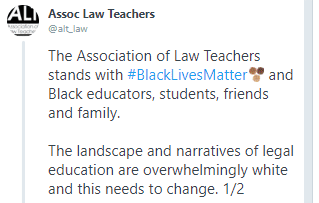
The landscape and narratives of legal education are indeed overwhelmingly white. My own history, my own education was overwhelmingly white, my world is in so many ways overwhelmingly white. So where to start. Of course I would like to think I am not racist and I would hope that in many ways I am anti-racist but I am also a white relatively privileged woman and therefore so much part of a global system and lots of national and local systems that are fundamentally racist. There are so many things here that I could write about and I know very little about all of them. As the #BlackLivesMatter protests continue and calls for white people to educate ourselves and do better increase, I think it is really important that we don’t all suddenly start pretending we know about race. It’s our time (and well overdue!) to shut up, listen and learn. So here I want to reflect on what all of this might mean for me as a law teacher. And by ‘all of this’ I mean, my emotional reaction to the murder of George Floyd and the protests which have followed, the call to learn more, the call for solidarity that is more meaningful than a building lit in purple for one night and a call for action which genuinely supports black and brown people in their protests and struggles, which amplifies their voices and helps to make them heard.
So before I start, I know very little, I have read not nearly enough and I have not engaged sufficiently with the question of race in the legal classroom. What I have engaged with is different ways of teaching law, treating all students as human beings rather than student numbers and building relationships with students. As part of that I have always been keen to listen to my students and learn from them. I remember listening to a student asking whether she could leave her research on abortion law in my office as she wouldn’t be able to take it home in case her parents saw it. I remember talking about language use in the classroom and whether teachers being excluded through the use of languages other than English was problematic. I remember conversations in class about intersections of law, race and religion and instinctively recognising them as important even when they appeared to be off topic and I remember a powerful and moving student presentation of a review of the book ‘Learning the Law’ (Glanville Williams) which was entirely focused on the discriminatory and colonial undertones of the word ‘the’ in the title.
I remember thinking about race and particularly religion a lot as Head of School – how do we design a legal curriculum that is meaningful for what was actually the majority of our students and which does the experience and realities of all of our students justice, which listens, which empowers and which does not simply re-tell the legal and historical narrative of white privileged men? The thinking here was framed by the Bradford context of course, it was about a Muslim, Pakistani and often economically poor cohort of students. I hope that I created a safe space in which to talk about some of the issues, but I also know that I did not centre race generally or even the specific concerns of the majority of our students. What we taught for the most was still a white curriculum, even if we added some questioning of it.
Since moving institutions I have done worse in some ways. I am not in a management role, I don’t have influence over our curriculum which, from what I can see is pretty traditional in many ways. I have made some changes but, perhaps obviously, these have been centred on things I know about. The Public Law reading list now contains some female authors where there were previously none (!) and I created a new module to make space for critical thought around legal education and aspects of law. While that module contains some discussion of race, it is focused on feminist and queer critiques of law and legal education. I hope it created space for thinking about law differently, for challenging our approach, my approach, to legal education and to teaching law and helped to amplify some voices not otherwise heard but I am not sure this is enough.
So what is enough? I don’t know. I need your help here. Tell me what you need from me, what would help, how can help? I wonder whether first recongising that we don’t know anything or very much is helpful. There are people out there who have been researching race in various context for years, decades. The expertise is theirs. It might be helpful to read some things outside of the current mainstream and when working out what that is, let’s talk to each other, let’s help each other. Let’s not laugh at someone for not having read or thought about something. Let’s be firm – we must do better – but gentle – we have to start somewhere and your somewhere will be different from mine and that’s ok – but we must start. Adding one or two things to the reading list to include some black and brown authors ain’t gonna do it though. In many cases doing something and starting somewhere means challenging the established and accepted curriculum in a given area, doing things differently, leaving out or re-framing things that we feel confident with and have always ‘known’ should be there. It won’t be comfortable. But I also don’t think we have to do this alone. Talking about what we are doing and why with our students is also really important. Creating space to challenge the orthodoxy, to hear other voices, to listen, I mean really listen, to our students, particularly our black and brown students is part of creating an inclusive legal curriculum which begins to challenge the dominant white narratives.
So as I think about my teaching I am partly confident that I can begin to make changes and partly totally lost. In Perspectives on Law and Society I will start with discussions on race in legal education and law. This section of the module used to come at the end, this year I will put it up front because I want to create a space where we can talk about recent events and think about how they impact on us and on how we think about law, social justice and legal education. That module is relatively easy because it’s not about legal rules or content and because it is not a traditional legal module so it is not weighed down by tradition or a textbook. The same is true for my Law in Literature and the Arts module which also allows for lots of opportunities to talk about race and racism and challenge the traditional stories. I feel ok about these modules, I feel like I can do something with them which is meaningful for all my students and which can help us all learn. I feel like in these modules I can say ‘I don’t know, I understand that sometimes I am part of the problem, help me be better’. I feel like with those modules I can make a start.
Then there is Public Law. Thinking about Public Law really highlights just how ingrained the dominant white narrative of our legal history is. I find myself sitting with a blank piece of paper staring at it. How do I make this module anti-racist? And I have to admit that I don’t know where to start. How can it be that in a module about the relationship between the State and its citizens I cannot think about how to logically frame an anti-racist curriculum. This should be easy. And yet, every time I put pen to paper to map out what the module should look like I end up with something that is so remarkably like the module I took over, the textbooks, hell, even the module I was taught. Adding women to the reading list and using their writings in seminars etc was easy, it didn’t challenge much. This though is much harder.
I am not an expert on race – either in specific fields of law or in legal education – but that’s no excuse to perpetuate racism in the curriculum and classroom. So what do I do? I teach Public Law to first year law students. I have a powerful platform which can help set the tone for students’ legal education and the way they see their place within the Law School and the wider world. It’s a platform which I can use to highlight that the dominant narrative of legal education, or Public Law specifically, is white but that there are stories missing and that the stories usually told have been whitewashed. I can point to alternatives and draw on the work of those with expertise and most of all I hope I can create space for genuine discussion and learning. So for now that Public Law outline is staying blank while I go and seek out the other stories and the missing bits in the stories I have always been told and that I have re-told. It stays blank while I deliberately go and seek out the things which make me uncomfortable, have conversations which highlight the whiteness of our Constitutional set up or the colonial assumptions which sit behind human rights frameworks for example. It will stay blank until I have thought about what is really important about Public Law as a thing – until I am clearer in my head what it should be – maybe if I can begin with a conversation about what public law should do, together we can work out what stories we need to tell about it.
So is there a point to this rambling? Well yes, sort of. My emotional reaction to the protests has been quite strong. I have felt angry and helpless and paralysed and motivated to facilitate change all at once. At the same time as thinking there was nothing I could do, feeling part of the problem with little power to make any difference I also remembered that I do have a powerful platform from which to start discussion and from which to hear and amplify voices. I am able to encourage real dialogue and learning. That’s where I can help make a difference – probably mostly to my own understanding and maybe that is more important than I often think. But mostly I hope that my students read this and see it as a genuine invitation to talk to me about race and your experience of it in law, in the classroom and in life. I hope that it is clear that I know that sometimes I have been part of the problem, and maybe always will be and that this has never been intentional. I hope that it is clear that I am listening and that I will, where I can, help you find your voices and amplify them. I hope you feel safe enough to get in touch, tell me what you think I should read/watch/listen to, tell me what’s important to you and help me to learn to be a much much better anti-racist educator.
Dear Student…
Academic Year 18/19 is here. Properly. The students have arrived. For some freshers’ week starts Monday, for some it’s just been and ‘proper’ teaching starts. Of course some courses (and therefore colleagues) have been ‘back’ a while on courses that don’t fit the traditional undergraduate timetable. I love and hate this time of year in equal measures. I love the buzz it creates on campus and at the same time find the busy-ness tiring and sometimes stressful. I like the promise that every new academic years hold – the promise of inspiring and being inspired. The promise of me keeping on top of emails and filing (ok that’s a promise I have long learned not to believe) and of deadlines not yet missed. This time of year signals the start of that all too fleeting time we have to try and engage and inspire, to share our knowledge and to learn from our students, to share a tiny part of their journey and to not fuck it up.
I think about the first year students arriving. In a couple of weeks I will have literally hundreds of them sitting in a lecture theatre in front of me. How do explain to them that the structures that we work in are far from ideal, that there are too many of them and not enough of us, that we all do the best we can but that that often isn’t good enough because it can’t be because, well just because. How do I explain that we are exhausted before term has even started because our jobs get ever more ridiculous every year. How in all of that do I make clear the most important thing of all – that all of them matter, not as student numbers that generate income, but as individuals who will change the world? I can’t wait to meet them but there is also something niggling. What would I say to them if I could reach each one of them individually? I think maybe this:
Dear Student,
I may not know your name because I have over 300 new names to try and learn and I’m not good with names. Sometimes I may not recognise you as one of my students as I rush across campus to get to the next class or meeting because I wouldn’t notice my own mother in that moment – my mind is on what comes next not on the right now and once term starts I am perpetually late. It might take me longer than it should to reply to your email because I get too many every day and try as I might my inbox isn’t controllable. I may forget to call you back or I might miss your voicemail because, if I’m really honest, I don’t like the phone and I’m avoiding the phone, not you. I will get frustrated at your lack of preparation, because I will have spent hours preparing and thinking about how to best help you understand and think about the issues we’re dealing with and I’ll be frustrated with myself for not having been able to hold your attention and interest. I will get annoyed when you push me for the right answer (which doesn’t exist) and ask me what’s being assessed and what isn’t – but its not anger at you, it’s at a system that has created a culture where almost everything is about the test result and almost nothing is about the pure pleasure of learning. I want to say sorry for all of those things now and I want you to know this: I see you, each one of you, in that sea of faces in the lecture theatre. You are not a student number, you’re you and I wish there was the time to get to know each of you as you. I want you to know that it’s a privilege to be part of your journey and if I can contribute just a little bit to that journey being a successful one then this job, insane as it is, continues to be worth doing.
I also want you to know that you’re enough. University can be an amazing, exciting, wonderful place but it can also be lonely, dark, scary and it can be easy to get lost in that sea of faces around you. Make it a place to find, not lose, yourself. Please don’t ever presume I’m too busy to care, please never be worried about emailing me or coming to see me, never be scared to ask for help. I am where I am because I always had help, at every step of the way. I now have the privilege of being able to pay that forward.
Now go be whoever you want to be and change the world
Jess (or Dr Guth if you must, but not Miss, never Miss)
 My Conversations