
A week of writing, reading and being

I have once again been thinking about whether to bin or re-launch the blog. Given that I have just spent a week away predominantly for writing and writing is definitely a habit that gets easier the more you do it, I am going to try and stick with it and see what happens! Just excuse the outdated stuff while I get organised.
I have had great success with writing retreats of various forms in the past. But they have always been either half a day or a day and it has been a very very long time since I have had the luxury of concentrated writing time. In order to ensure I can actually do the DBA, I negotiated a week per academic year in addition to my annual leave to take off specifically for working on the thesis. I did of course have all sorts of plans of being way further ahead when I booked the week. I had plans of mapping out empirical work and refining already drafted chapters… but I think it still worked out really well.
Before going I had done no real work on the thesis. I had submitted my final assignment which was the research proposal but I haven’t had my mark and feedback yet so I have not been able to complete the transfer to thesis paperwork or have supervisors assigned. In some ways I am therefore working a little blind. Before going, I had spent a little bit of time searching for relevant literature with a particular focus on the theoretical framework and I saved a whole load of journal articles and links and obviously some of the work had already been done for the proposal. That was the extent of my preparation. Just before leaving I picked up some key edited collections on legal education from my book shelves and crammed them in my bag.
You can see how the week went in a bit of silly fun reflection here. But in essence, I spent day 1 travelling there and settling in, days 2-4 working on stuff and day 5 packing up and heading home and being a bit grumpy and tired. The plan for the week had been to get the context chapter as written as possible and then spend time on the literature review with a focus on the theoretical framework sections. I wanted to work in roughly 45 minute bursts with alternating short and longer breaks. The shorter breaks were going to be little 10 minute yoga flows, a quick hot tub dip or just a cup of tea outside and the longer ones were to be longer hot tub or yoga breaks, walks, other exercise or just chatting with Kath. I was also intending to go for a run most mornings if not all.
True to recent form I did not manage to be awake enough to run first thing. It used to be pretty much the only time I could run and now I just can’t seem to get going. So running before anything else didn’t actually work. I did get out for 2 runs though and I am actually pretty happy with that given how much I have struggled with running recently. The rest worked pretty well. 45 minutes is a good time for a concentrated session and the breaks worked well. I didn’t set an alarm. It wasn’t that sort of week. My wake up times were dramatically different. So one day I didn’t start working until 9ish and another day I’d done yoga and has breakfast by 6.30. I also didn’t have a clear set finish time in mind. On day 1 and 4 we booked the pool for a swim at 7pm and on day 1 I did a little more after that and on day 4 I wanted to spend the last evening there with Kath so I didn’t log back on.
On reflection I think I actually did quite a lot. I finished a first draft of my context chapter – focused on policy contexts of legal education and social justice. It’s too long at the moment – I think some of what I included actually belongs in the literature review and other bits are too historical and probably not relevant for the thesis in the end. I feel like it is a solid first draft that can sit until I have a clearer idea of where the empirical work is taking me and can adjust for relevance and focus then. This chapter came to me fairly easily. It’s mostly stuff I am familiar with, have read lots about and which is so part of my day to day work that it really didn’t feel too difficult to get about 7000 words down quickly. Once I had that where I felt like I could leave it, I turned my attention to the literature review.
I quickly realised that I was not going to focus on the theoretical framework like I had planned. While I had all the literature there with me, saved on my computer, I hadn’t printed any of it and I just wasn’t up for reading on screen. So instead I spent a bit of time mapping the various sections of the literature review and trying to work out what would go in each section and what order they would work in. Then I turned my attention to the books I had brought with me. In total I read about 15 book chapters that I deemed relevant to the literature review headings. I used sticky tabs and a highlighter (yes, I highlight in my books and I understand the anxiety this will cause some of you – sorry) and then spent the afternoon and evening of Day 4 adding in key points and some nice quotes under the various headings and getting some of my immediate thoughts down. All in all I ended up with around 10000 words written – made up of a complete context chapter and a fairly well mapped our literature review with some initial thoughts.
It was an interesting week and I would definitely recommend that sort of away time for thinking and writing. I was surprised at how quickly I settled in. I definitely write better and am more focused in the morning and later in the evening. Quite frankly I should not be left unsupervised in the afternoon – I don’t function well at all. In the morning or last thing, the 45 minute sessions overran – not by much but I just wasn’t clock watching at all. In the afternoon I would lose concentration much more quickly and had to force myself to keep working. In fact by Day 4 I gave up any pretence of really trying and moved from the dining table to the sofa. In the morning I also kept the breaks between the 45 minutes very short, even 10 minute yoga felt almost too long (but was definitely good for a brain re-fresh) but in the afternoon I was more prone to lingering and ‘just another minute’.
Next time I do anything like this I will try and prep better and make sure I print anything I want to read, otherwise I just won’t. I will also make sure I have jobs like formatting, basic editing and sorting out references etc to do in the afternoon. That way I can do really useful work and feel good about it but not have to do the heavy thinking and writing when I’m more like the bear of very little brain than anything else. We got a lot of things right during the week, healthy but easy to prepare food as well as some treats like ginger nut biscuits to dunk in tea, taking our yoga mats and running gear, not setting alarms, not having major plans and spending less time doing, and more time just being. I think we got the balance right. Part of me wonders what would happen if we did a Friday to Friday or Monday to Monday and how much difference the extra days might make. What sort of rhythm would I settle into then? But I was tired on Friday. Productivity dropped and working on the thesis switched from being fun and exciting and something for me to something that felt like a chore, another thing that has to be done. So I think maybe the Monday to Friday cabin is actually just right for keeping the fun and excitement of the research as well as getting stuff done or a longer stint but with some deliberate half days or a full day off in the middle might also work.
Now for keeping the momentum going – watch this space.
SLS Day 2
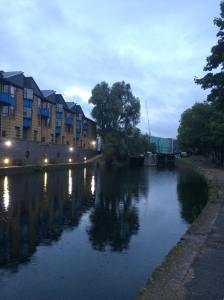 SLS Day 2 commenced after a pretty poor night’s sleep. It needed to be good. Day one set the bar pretty high (oops, already used that pun on Twitter yesterday – can I get away with it twice given that it’s not quite as obvious a pun unless you read the tweet and/or my account of yesterday?). Anyway poor night’s sleep – The usual London dilemma – I had to choose between being too hot or it being too noisy. I am such a country girl, I just can’t deal with the city noise, it just really gets to me so – too hot it was. I gave up trying to sleep at 5.30am and sat up sleepily and sweaty. Given that I was already sweaty I thought I didn’t really have an excuse to not go for a run. I pulled my gear on and headed out and had a lovely little 2.5 ish mile trot out along the Regents Canal.
Breakfast was a bit meh so on the way to the first session I bought a coffee that actually looked, smelled and tasted like coffee. The first session was my random session. I always have at least one at every big conference I go to. For this one I chose the Legal History Stream which started with a paper by Ann Lyon (Plymouth) talking about ‘It Wasn’t Just About the Suffragettes. The Representation of the People Act 1918 and the Realities of Voting in the 1918 Election. I loved this paper because it combined an analysis of the Act set in its historical context with personal stories from Ann’s family. It was a lovely example of being able to touch history through those lovely family connections and thinking through what the 1918 Act would have meant for those family members. That paper was followed by one from Judith Bourne with a great presentation on Bertha Cave who applied to join Gray’s Inn in 1903. I was struck by how little we know about her as a woman and Judith pointed out how she has sort of been decontextualised and isolated from her environment with a dehumansing effect. She is known as an unsuccessful almost first woman lawyer. I found the analysis of the reasons for prohibiting women from joining the legal professions interesting too and I don’t think that these been consigned to history. The culture at the bar is one of tradition and order and strict rules based on the English class system and a specific form of masculinity. Allowing anyone from the  ‘wrong’ background in threatens that order. First women, then working class folk, where will it end… Somehow this doesn’t sounds like we’re talking 100 years ago. Outsiders are indeed a little troubling, aren’t they. The third paper was by Janet Weston who looked at the history if measuring mental capacity. I was still wrapped up in the first two papers that I lost focus through this one. It was a great paper with lovely stories of those involved in mental capacity cases and I was struck by how often a lack of mental capacity had nothing to do with the person whose capacity was supposedly in question but was about protecting women from others who might take advantage of them… I wish I had kept more focused because there was so much good stuff in there.
As I walked back to the publisher exhibition area and, importantly, coffee I was reflecting on the on how fabulous it was to be able to go to random sessions and listen to things that are slightly out of my area of expertise. It allows me to think about things in a slightly different way and prompts ideas about my own work. Conferences are actually really important to improve thinking. I had a quick coffee, picked up a couple of publisher’s lists with discount codes and then headed back over to the Law building for a  Practice, Profession and Ethics session. I must walk round with my eyes shut or lost in deep thought most of the time because it was on this walk over that I registered that the ‘square’ I’d now walked past at least 6 times was in fact a graveyard. I like graveyards. I wished I could linger and explore it more but the session called. For those interested it is the Novo Cemetery, a jewish cemetery and you can read all about it here. It’s somehow quite moving. On my way back after the session I looked at it from the windows of each floor of the building as I came down the stairs. It has quite a powerful pull and somehow triggered an emotional reaction before I knew anything at all about it.
The first paper in that session was presented by Caroline Gibby (co-authored with Amanda Newby and Lisa Down) and was on Integrating Professional and Ethical Contexts. There was some great stuff here about the need to keep discussions about ethics and codes of conduct separate and about the value and pitfalls of narrative pedagogy. I like the idea of teaching ethics by stealth and there are lots of ways this can possibly be done throughout the legal curriculum and in professional/clinic settings. I wonder whether we actually need to start with thinking through what sort of ethics and values teaching we do through the explict as well as the hidden curriculum and then  maybe make that more explicit. I like the notion of supporting students to become confident independent thinkers. I think this might be the key to lots of things. I need to think about this more though.
Next up was Richard Collier talking about wellbeing in the legal community and focusing on the group least is known about: us; legal academics. There is so much in his paper that resonates and that links to many themes I have been thinking about. I don’t want to steal his thunder and I hope the paper is published soon but here is a very brief summary of the argument followed by some thoughts:
- The literature points to lawyers (as in practitioners) just getting by – I think this sounds familiar in terms of the academy
- We still actually know very little about the private life of university law schools but we do know some things about other areas of the academy and law schools, while possibly unique in terms of being able to withstand some of the pressures facing Higher Education generally ( and I am not that convinced that they are all that different from other disciplines), law schools are not immune to those factors
- Metrics, hyper performance and acceleration are coming together to create a menta health crisis in the (legal) academy
- There are pockets of resistance – we need to slow the university down!
- And we need to be crtical of the wellbeing movement – challenge the narrative of resilience and also of the hapiness industry.
Thoughts: I agree wholeheartedly with every single word Richard said. The marketised university creates an environment and setting where good mental health is almost impossible but where the responsibility of having and maintaining good mental health is put solely on us and when we inevitably fail on that we do so because we are not resilient enough (in my case probably because I haven’t completed my online resilience training). But resilience should surely be about crisis or particular difficulties. Resilience is not about getting through normal every day life. The problem is that we have normalised overwork, perfomance metrics and all that other crap. There were links in the paper to my work on excellence and on academic indentity and the paper also raised questions for me about what, as educators, we role model for our students. My brain is still working on this and thoughts pop in and out my head.
Lunch was, like breakfast, a bit meh. Hot food just doens’t work for these sorts of things – do decent wraps, sarnies, salad etc. Much better. Then, rather ambitiously I think, the organisers put two plenaries in the afternoon. The first was Access to Justice in Troubled Times chaired by Mr Justice Robert Knowles with contributions from Mrs Justice Maura McGowan, Dame Hazel Genn and Professor John Fitzpatrick. The rather depressing message from that session was the our justice system is falling apart, access to justice is basically non-existent for many and that law schools are not only providing invaluable service to individuals who seek advice and support in university law clinics but are basically also propping up the system, a system which Maura likened to the NHS – the  bulk of the work and the most emotive work is being done by those judges working in the most difficult conditions. As Maura said in response to one of the questions- ‘in an ideal world you would not have UG students providing legal advice… but because we’re in the state we’re in, it has to work’. There may be some hope with a move to more of the work being moved online but like Hazel I am a little sceptical and like Hazel I hope the powers that be will collect or allow the collection of data that will allow the research community to fully evaluate the changes being made. We have to do better.
While the speakers were interesting I found the panel overall odd. Too much ‘men in suits talking’ at the end and the Chair was directing the questions/conversation in an odd way and limiting the audience participation which made it slightly uncmfortable to watch. I was in need of coffee. As I was walking over somone I only know from Twitter caught up with me and said hi so it was great to meet properly and we chatted over coffee and then headed to the second plenary of the afternoon. The Rule of Law in troubled times. I was flagging a little and my brain was quite full but I enjoyed all three papers even if they all over ran leaving almost no time for questions or comments at the end. I liked Renata Uits’s point that there is a key difference between Rule of Law and Rule by Law but that the line between the two is really only easy to draw with hindsight. She was talking mostly about the Polish and Hungarian context and attacks on judicial independence, a theme which Murray Hunt returned to. I think she is right in saying that the rule of law is vulnerable to abuse because it is an abstract concept that lawyers talk about and it is difficult to translate into practice, it easily slips into rule by law and constitutional engineering the like of which we are currently seeing across the world – Murray gave examples in addition to the central and eastern European examples but I have now forgotten them.
Thom Brooks spoke about the rule of law in the US and there were really no surprises there. Trump talks about support for the rule of law but only really in terms of immigration and walls and what he really means is strict law enforcement (but not against him or his friends). He quoted Bob Dreyfuss saying ‘Never before … has a president so openly challenged the legitimacy of the entire justice system’.
Throughout the plenary I was struck that this was such a legal panel. I missed the political science discussions on this which I have been able to dip into more recently attending political science events. I missed the more critical approach to terms like populism and democracy and also rule of law actually. I felt a little alien in my own discipline because I realised that we’re using the same words but mean slightly different things, or understand them differently, but that the political science meaning is more familiar to me, and more meaningful, because those are the debates I have engaged in. Maybe I’ll make a half decent politcal scientist yet.
So that was that. My brain is full. I am not going to the conference dinner (something about dinner at the Inns makes me feel deeply uncomfortable and I’m not paying a small fortune to feel deeply uncomfortable) so a quick trip to the Co-op later and I have provisions for the evening and vague ideas about just chilling out doing nothing at all – or maybe catching up on things I never get round to like sorting out this blog a bit, filing some stuff (electronically) or just reading a few of those articles I have been meaning to read for ages.
More tomorrow!
Society of Legal Scholars (SLS) conference Day 1
 I have not been to a Society of Legal Scholars conference for some time. I was looking forward to it. I was particularly excited to be able to go to all of the conference rather than just the half in which my paper was scheduled. I am doing 2 papers in the Legal Education section – more on those another time.
Travel to London was uneventful. I like uneventful. I got a fair bit of work done on the train in spite of the supposed quiet coach being the noisiest coach I have been in for a long time. Is it the thing where you’re told you’re not allowed to do something and therefore immediately want to do it? I got the tube out to Mile End and found the campus and even the right building very quickly. I also managed to get a ticket for the dinner at the end of day 1. I hadn’t booked because I wasn’t going to go but then the opportunity for a catch up with Richard C arose so I really wanted to go.
I had arrived in time for lunch – a rather ordinary pasta with a veggie sauce (I think there was a chicken one too) and then I headed to the first session. The first paper was great. I expected it to be. It was a paper by Marc Mason (Westminster) and Steven Vaughan (UCL) reporting on their research with LGBT+ barristers in England and Wales. Bonus points if you ‘get’ the title ‘Going to the Gay Bar, Gay Bar, Gay Bar…’ (if you do, your taste in music is as horrendous as mine!). The paper was fascinating and sort of heartbreaking and a little puzzling…. For a start the survey Marc and Steven did shows quite clearly that the Bar Standards Board statistics on sexuality at the Bar are hugely underestimating the number of LGBT+ barristers across the levels. That in itself means that there is something going on there because some are clearly happy to take part in surveys and interviews for research purposes but are not happy to declare their sexuality as part of the BSB statistics reporting. I wonder why that is. The paper’s sections on homophobia and on the performance of being out were fascinating. The data shows that homophobia is quite common but also that barristers play it down as nothing serious and no big deal. I’m really interested in this lack of advocating for themselves. Where does this come from. Is this a professional thing? Do they advocate for each other? This is fascinating and I’m not sure how we’d get to the bottom of this fully. I’ll ponder this.
I loved the notion that came up in one of the quotes about challenging or disrupting the ‘normal rule of engagements’. So men (mostly) finding it difficult to work out what exactly is going on when faced with a powerful lesbian QC, knowing something is slightly ‘off’ and not being able to work out what the rules of engagement now are. I like that. The section on performance of being out (or not) was depressing because there was lots of evidence of concealing sexuality and lying and because clearly there is a huge amount of the ‘bleached professional’ going on. Where barristers are ‘out’ they are often out in relation to their partners only – so they build their professional gay identity around having a same sex partner rather than on being gay – playing the ‘good gay’ game and performing heteronormativity albeit within a same sex relationship.
The second paper was by Ben Waters (Canterbury Christ Church) on ADR and Civil Justice. I also enjoyed this paper although it’s not really my thing and I was still reflecting on the previous one so drifted in and out.
Anyway it was a fabulous start to the conference. Next I was going to hear more legal education/legal profession stuff and listen to Nigel Duncan (City) on teaching legal ethics but over coffee I realised that I was really flagging. I decided to check into the accommodation and have a little power nap so that’s what I did. Then I headed back to the publisher exhibition area and spent a lovely half hour looking at books (sooooooooo many books, so little time to read….) and then people started filtering in from the sessions for the drinks reception. At the reception I met up with Richard C and we spent the evening talking about well being and anxiety in the legal academy and it was lovely. I left dinner when Richard did and then I went to bed early and fell asleep almost immediately. A good day and a sensible one! I have a blog post started over a year ago on conference self care and I think maybe now is a good time to look at that draft and finish it. I’ll see if I get to it today.
 My Conversations