
Call for Papers: LETR 5 years on
I am really excited that my institution is hosting a one day event next June (25th June) to celebrate (if that’s the right word? Maybe ‘mark’ is better) 5 years since the publication of the Legal Education and Training Review. It’s going to be a great event. We already have representatives from the professional bodies as well as most of the original research team confirmed as speakers. In addition Professor Anthony Bradney has agreed to give the closing keynote. I can’t wait. The call for papers is ready but of course all distribution and membership lists have closed down for the Christmas break, getting anything on the Law school website might not happen until January either and getting the call out there is just really difficult at this time of year.
We are however working to relatively tight deadlines with abstracts due by the 29th January and this might be the one week where academics have just that little bit of time to think about abstracts and papers (who am I kidding, most of us are too tired to function!). So here it is:
LETR 5 Years on – call for papers
And for those of you who (like me) find clicking on a link too much like hard work as you reach for another mince pie, here’s what you need to know:
We now invite submission of abstracts for papers which explore any aspect of the LETR and subsequent developments. Topics might include but are not limited to
- Who are tomorrow’s lawyers and who should be educating/training them?
- What are Law Degrees for?
- Routes to qualification for solicitors, barristers and legal executives
- Education and training for paralegals
- The value of a liberal legal education
- The impact of LETR and subsequent developments on specific substantive areas
- Impact of the LETR and subsequent developments on Law Schools
- International comparisons
- The Futures of Legal Education and Training
- …
Please submit your abstract of no more than 500 words to Dr Jessica Guth by email (j.guth@leedsbeckett.ac.uk) stating 3-5 keywords which will help us group related papers together. The deadline for submission is 5pm on Monday 29th January 2018. We will make decisions on the abstracts and put together a preliminary programme by Friday 9th February.
It’s going to be a great day and I look forward to seeing your abstracts. If you want to come but don’t want to present anything, booking for the event will open in February and we will keep the cost of the event to a minimum. Watch this space!
Equality and Diversity in Legal Education 3
And here’s the third and final part of my reflections on the workshop on Equality and Diversity in Legal Education. Part 1 can be found here and part 2 here.
After lunch we had another set of parallel sessions and I chaired Session 2B. The first paper picked up the theme of ‘polish’ and helping students to assimilate. Dominic De Saulles took a pragmatic view that the legal culture at the Bar is what it is and then considered our responsibilities and duties to those of our students aspiring to the bar.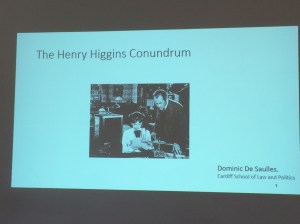
He noted the significant ethical challenges we face in helping or even encouraging students to join that legal culture which might mean they have to ascribe to values they find unpalatable and lose some of their sense of self in doing so. I wasn’t entirely convinced by the Kantian ethics justification for helping students learn to pass as barristers but I need to think about this a bit more. It seems to me that what would be more valuable is to talk about resistance and how things might be changed but I also accept that for that to be possible these non-authentic lawyers need to get into the professions otherwise there is little hope of a revolution from within! Dominic had some lovely pictures on his slides and one of my favourites was this one which shows  a court room with lots of people doing things they shouldn’t be – the defendant is pleading guilty thus depriving lawyers of income, one advocate has lost the plot and is showing emotion, another id ducking rather than standing up for his client….
The second paper was given by Elisabeth Griffiths and grappled with hierarchies of rights and protection under the Equality Act 2010 and how this might play out in employer networks. She had some really interesting data on networks (or lack of networks) and we had an interesting discussion about how effective those networks might be and how much they are just for show or for ticking boxes.
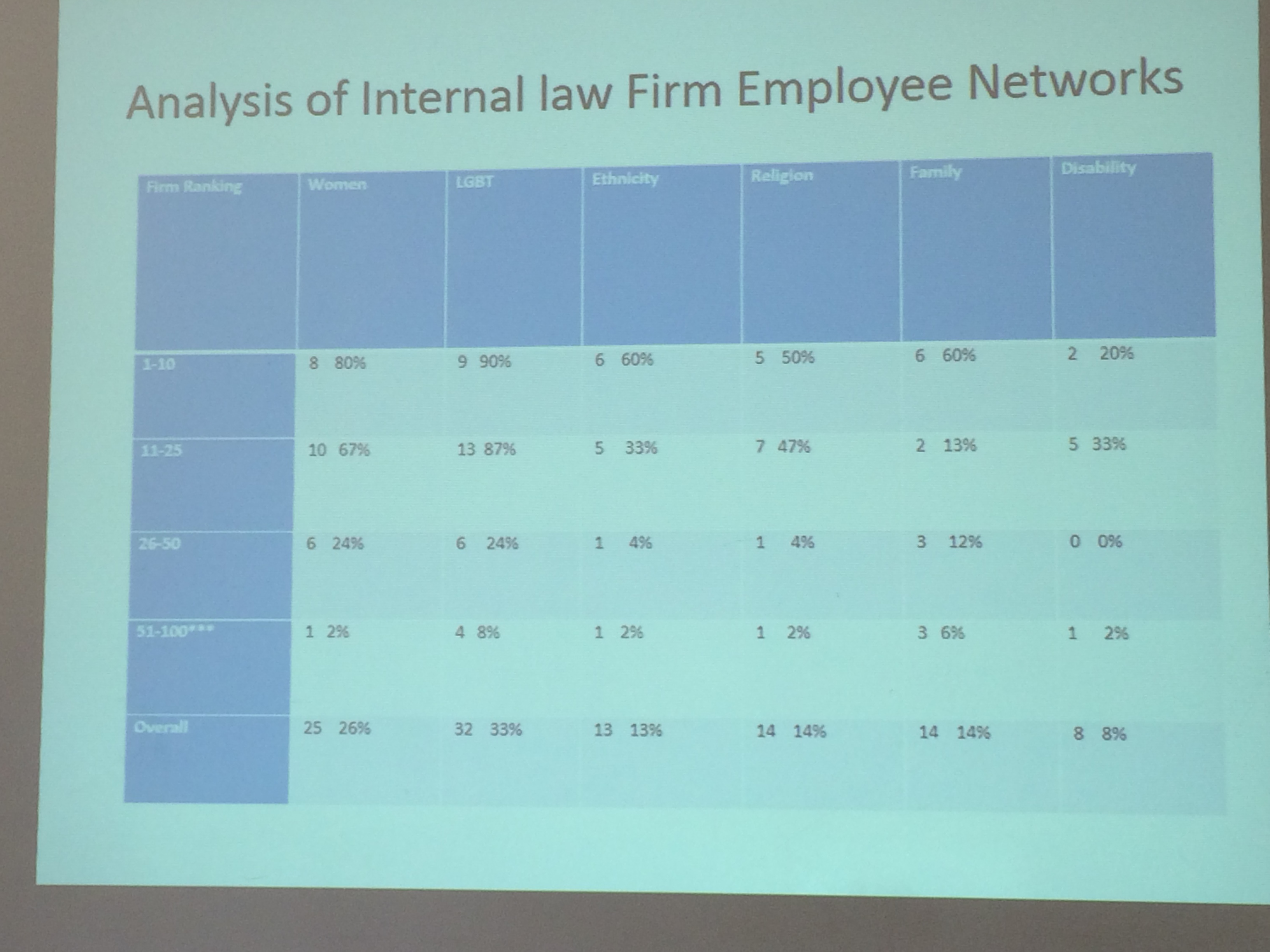
I was also interested in Elisabeth’s comments about how doing this research has impacted on her teaching and is leading her to be less doctrinal in her approach. I do think what and how we research can have an impact on how we teach certain topics. I guess this is an argument for having people teaching in areas where they are also research active but I think it probably also says something about the relationship between research and teaching more generally. I have weekend brain though so I’ll wait to think about that a bit more until I am back on working day brain!
The day finished with a roundtable with Pat Leighton asking what is special about researching equality and diversity; Charlotte O’Brien offering comments on teaching equality and diversity in the very contested Brexit context and Debra Malpass of the SRA providing some information about a call for statistical analysis and a data workshop coming up shortly (sorry I tuned out on the project call because I can’t do stats). The roundtable touched on many of the thoughts I’d had throughout the day – we need more and better information about how inequalities are playing out across legal education and training and in the professions. We need longitudinal data, we need data that is richer and deeper than a questionnaire will offer, we need high quality qualitative empirical data and we need high quality clear and comprehensive quantitative data and we need to keep talking – to each other, to our students, to those in the profession and to anyone who will listen – and, perhaps more importantly than all of those – to those who don’t want to listen. Yes, most of all we need to be talking to them!
Equality and Diversity in Legal Education 2
Here’s part 2 of my reflections on the University of Sheffield School of Law and LERN co-hosted worksop on equality and diversity in legal education.
The day continued with a parallel session where I listened to 3 papers which were all interesting and which all triggered different but related thoughts and ideas. The first was about how we can achieve more inclusive legal education in the context of disability and it engaged with both the lack of visibility or presence of disability in the legal curriculum and problems of access to legal education for disabled students.  The idea of what a good lawyer is again came up. If a good lawyer is the person who can stand the heat in the kitchen then any notion of weakness means you can never be a good lawyer. Declaring a disability or asking for an adjustment therefore becomes impossible. Hidden disabilities in particular are then easily construed as a deficit. For example you cannot be a good lawyer if you are dyslexic because law is text based and you need to read things quickly…Surely it can’t be beyond us to think about these skills differently.
The second paper was about how we can actually build a curriculum around the students in the classroom and start from their experiences. Jenny Gibbons from York Univeristy explained how she did this for her employment law module. I like this idea. You talk to your students about their experiences and knowledge and build on that – this means the content of the module has to be fluid and flexible and about developing skills and constructing knowledge, not about learning or acquiring knowledge. That can be challenging to do in an institutional context which is keen on measuring very specific learning outcomes and ensuring the equivalence of experience for all students. It is also a challenge to traditional teaching orthodoxy because the classroom experience for the teacher is less structured, less safe and less planned. That can be scary. In fact, it is scary. It’s daunting walking into a classroom not being quite sure what is going to come up, what you’re going to be discussing and where the discussions might take you. Of course it is easier to simply set some questions and go through the answers… it’s also more boring, less rewarding and less likely to actually engage the students and encourage deep learning. So there – I’m all for asking questions you don’t know the answer to and to being open to learning from our students.
The third paper was about globalized legal education and the benefits this might bring and it got me thinking about what truly globalized legal education might be. We also talked about whether globalized legal education and/or exchange programmes could help students build the all important cultural capital (and start to develop some of the sort of professionalism required – See post 1 in this series). I’m afraid I missed some of this paper because I got sidetracked thinking about what globalised legal education would really mean. Not that I have got very far with this but I was thinking about the tensions between law being jurisdiction specific and the (perceived?) need to teach legal rules which will mostly be set in the national context and the idea of global legal education.
So by lunch time my head was already full of thoughts and ideas. I was beginning to make connections to some of the things I have been thinking about for a while and which I will pick up again soon – questions around academic identity and how that plays out in law schools and what impact that may have on students too. Watch this space – it’s currently all swirling round in my brain and I need to wait for it to settle before I manfully articulate this.
After lunch I chaired a session with two excellent papers which you can read about in part 3 and if you missed my thoughts on the keynote, have a look at part 1.
 My Conversations