
SLS Day 2
 SLS Day 2 commenced after a pretty poor night’s sleep. It needed to be good. Day one set the bar pretty high (oops, already used that pun on Twitter yesterday – can I get away with it twice given that it’s not quite as obvious a pun unless you read the tweet and/or my account of yesterday?). Anyway poor night’s sleep – The usual London dilemma – I had to choose between being too hot or it being too noisy. I am such a country girl, I just can’t deal with the city noise, it just really gets to me so – too hot it was. I gave up trying to sleep at 5.30am and sat up sleepily and sweaty. Given that I was already sweaty I thought I didn’t really have an excuse to not go for a run. I pulled my gear on and headed out and had a lovely little 2.5 ish mile trot out along the Regents Canal.
Breakfast was a bit meh so on the way to the first session I bought a coffee that actually looked, smelled and tasted like coffee. The first session was my random session. I always have at least one at every big conference I go to. For this one I chose the Legal History Stream which started with a paper by Ann Lyon (Plymouth) talking about ‘It Wasn’t Just About the Suffragettes. The Representation of the People Act 1918 and the Realities of Voting in the 1918 Election. I loved this paper because it combined an analysis of the Act set in its historical context with personal stories from Ann’s family. It was a lovely example of being able to touch history through those lovely family connections and thinking through what the 1918 Act would have meant for those family members. That paper was followed by one from Judith Bourne with a great presentation on Bertha Cave who applied to join Gray’s Inn in 1903. I was struck by how little we know about her as a woman and Judith pointed out how she has sort of been decontextualised and isolated from her environment with a dehumansing effect. She is known as an unsuccessful almost first woman lawyer. I found the analysis of the reasons for prohibiting women from joining the legal professions interesting too and I don’t think that these been consigned to history. The culture at the bar is one of tradition and order and strict rules based on the English class system and a specific form of masculinity. Allowing anyone from the  ‘wrong’ background in threatens that order. First women, then working class folk, where will it end… Somehow this doesn’t sounds like we’re talking 100 years ago. Outsiders are indeed a little troubling, aren’t they. The third paper was by Janet Weston who looked at the history if measuring mental capacity. I was still wrapped up in the first two papers that I lost focus through this one. It was a great paper with lovely stories of those involved in mental capacity cases and I was struck by how often a lack of mental capacity had nothing to do with the person whose capacity was supposedly in question but was about protecting women from others who might take advantage of them… I wish I had kept more focused because there was so much good stuff in there.
As I walked back to the publisher exhibition area and, importantly, coffee I was reflecting on the on how fabulous it was to be able to go to random sessions and listen to things that are slightly out of my area of expertise. It allows me to think about things in a slightly different way and prompts ideas about my own work. Conferences are actually really important to improve thinking. I had a quick coffee, picked up a couple of publisher’s lists with discount codes and then headed back over to the Law building for a  Practice, Profession and Ethics session. I must walk round with my eyes shut or lost in deep thought most of the time because it was on this walk over that I registered that the ‘square’ I’d now walked past at least 6 times was in fact a graveyard. I like graveyards. I wished I could linger and explore it more but the session called. For those interested it is the Novo Cemetery, a jewish cemetery and you can read all about it here. It’s somehow quite moving. On my way back after the session I looked at it from the windows of each floor of the building as I came down the stairs. It has quite a powerful pull and somehow triggered an emotional reaction before I knew anything at all about it.
The first paper in that session was presented by Caroline Gibby (co-authored with Amanda Newby and Lisa Down) and was on Integrating Professional and Ethical Contexts. There was some great stuff here about the need to keep discussions about ethics and codes of conduct separate and about the value and pitfalls of narrative pedagogy. I like the idea of teaching ethics by stealth and there are lots of ways this can possibly be done throughout the legal curriculum and in professional/clinic settings. I wonder whether we actually need to start with thinking through what sort of ethics and values teaching we do through the explict as well as the hidden curriculum and then 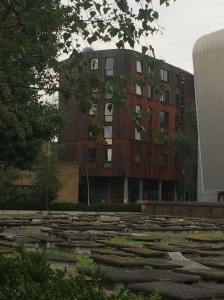 maybe make that more explicit. I like the notion of supporting students to become confident independent thinkers. I think this might be the key to lots of things. I need to think about this more though.
Next up was Richard Collier talking about wellbeing in the legal community and focusing on the group least is known about: us; legal academics. There is so much in his paper that resonates and that links to many themes I have been thinking about. I don’t want to steal his thunder and I hope the paper is published soon but here is a very brief summary of the argument followed by some thoughts:
- The literature points to lawyers (as in practitioners) just getting by – I think this sounds familiar in terms of the academy
- We still actually know very little about the private life of university law schools but we do know some things about other areas of the academy and law schools, while possibly unique in terms of being able to withstand some of the pressures facing Higher Education generally ( and I am not that convinced that they are all that different from other disciplines), law schools are not immune to those factors
- Metrics, hyper performance and acceleration are coming together to create a menta health crisis in the (legal) academy
- There are pockets of resistance – we need to slow the university down!
- And we need to be crtical of the wellbeing movement – challenge the narrative of resilience and also of the hapiness industry.
Thoughts: I agree wholeheartedly with every single word Richard said. The marketised university creates an environment and setting where good mental health is almost impossible but where the responsibility of having and maintaining good mental health is put solely on us and when we inevitably fail on that we do so because we are not resilient enough (in my case probably because I haven’t completed my online resilience training). But resilience should surely be about crisis or particular difficulties. Resilience is not about getting through normal every day life. The problem is that we have normalised overwork, perfomance metrics and all that other crap. There were links in the paper to my work on excellence and on academic indentity and the paper also raised questions for me about what, as educators, we role model for our students. My brain is still working on this and thoughts pop in and out my head.
Lunch was, like breakfast, a bit meh. Hot food just doens’t work for these sorts of things – do decent wraps, sarnies, salad etc. Much better. Then, rather ambitiously I think, the organisers put two plenaries in the afternoon. The first was Access to Justice in Troubled Times chaired by Mr Justice Robert Knowles with contributions from Mrs Justice Maura McGowan, Dame Hazel Genn and Professor John Fitzpatrick. The rather depressing message from that session was the our justice system is falling apart, access to justice is basically non-existent for many and that law schools are not only providing invaluable service to individuals who seek advice and support in university law clinics but are basically also propping up the system, a system which Maura likened to the NHS – the 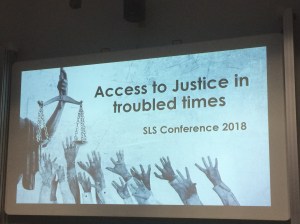 bulk of the work and the most emotive work is being done by those judges working in the most difficult conditions. As Maura said in response to one of the questions- ‘in an ideal world you would not have UG students providing legal advice… but because we’re in the state we’re in, it has to work’. There may be some hope with a move to more of the work being moved online but like Hazel I am a little sceptical and like Hazel I hope the powers that be will collect or allow the collection of data that will allow the research community to fully evaluate the changes being made. We have to do better.
While the speakers were interesting I found the panel overall odd. Too much ‘men in suits talking’ at the end and the Chair was directing the questions/conversation in an odd way and limiting the audience participation which made it slightly uncmfortable to watch. I was in need of coffee. As I was walking over somone I only know from Twitter caught up with me and said hi so it was great to meet properly and we chatted over coffee and then headed to the second plenary of the afternoon. The Rule of Law in troubled times. I was flagging a little and my brain was quite full but I enjoyed all three papers even if they all over ran leaving almost no time for questions or comments at the end. I liked Renata Uits’s point that there is a key difference between Rule of Law and Rule by Law but that the line between the two is really only easy to draw with hindsight. She was talking mostly about the Polish and Hungarian context and attacks on judicial independence, a theme which Murray Hunt returned to. I think she is right in saying that the rule of law is vulnerable to abuse because it is an abstract concept that lawyers talk about and it is difficult to translate into practice, it easily slips into rule by law and constitutional engineering the like of which we are currently seeing across the world – Murray gave examples in addition to the central and eastern European examples but I have now forgotten them.
Thom Brooks spoke about the rule of law in the US and there were really no surprises there. Trump talks about support for the rule of law but only really in terms of immigration and walls and what he really means is strict law enforcement (but not against him or his friends). He quoted Bob Dreyfuss saying ‘Never before … has a president so openly challenged the legitimacy of the entire justice system’.
Throughout the plenary I was struck that this was such a legal panel. I missed the political science discussions on this which I have been able to dip into more recently attending political science events. I missed the more critical approach to terms like populism and democracy and also rule of law actually. I felt a little alien in my own discipline because I realised that we’re using the same words but mean slightly different things, or understand them differently, but that the political science meaning is more familiar to me, and more meaningful, because those are the debates I have engaged in. Maybe I’ll make a half decent politcal scientist yet.
So that was that. My brain is full. I am not going to the conference dinner (something about dinner at the Inns makes me feel deeply uncomfortable and I’m not paying a small fortune to feel deeply uncomfortable) so a quick trip to the Co-op later and I have provisions for the evening and vague ideas about just chilling out doing nothing at all – or maybe catching up on things I never get round to like sorting out this blog a bit, filing some stuff (electronically) or just reading a few of those articles I have been meaning to read for ages.
More tomorrow!
Society of Legal Scholars (SLS) conference Day 1
 I have not been to a Society of Legal Scholars conference for some time. I was looking forward to it. I was particularly excited to be able to go to all of the conference rather than just the half in which my paper was scheduled. I am doing 2 papers in the Legal Education section – more on those another time.
Travel to London was uneventful. I like uneventful. I got a fair bit of work done on the train in spite of the supposed quiet coach being the noisiest coach I have been in for a long time. Is it the thing where you’re told you’re not allowed to do something and therefore immediately want to do it? I got the tube out to Mile End and found the campus and even the right building very quickly. I also managed to get a ticket for the dinner at the end of day 1. I hadn’t booked because I wasn’t going to go but then the opportunity for a catch up with Richard C arose so I really wanted to go.
I had arrived in time for lunch – a rather ordinary pasta with a veggie sauce (I think there was a chicken one too) and then I headed to the first session. The first paper was great. I expected it to be. It was a paper by Marc Mason (Westminster) and Steven Vaughan (UCL) reporting on their research with LGBT+ barristers in England and Wales. Bonus points if you ‘get’ the title ‘Going to the Gay Bar, Gay Bar, Gay Bar…’ (if you do, your taste in music is as horrendous as mine!). The paper was fascinating and sort of heartbreaking and a little puzzling…. For a start the survey Marc and Steven did shows quite clearly that the Bar Standards Board statistics on sexuality at the Bar are hugely underestimating the number of LGBT+ barristers across the levels. That in itself means that there is something going on there because some are clearly happy to take part in surveys and interviews for research purposes but are not happy to declare their sexuality as part of the BSB statistics reporting. I wonder why that is. The paper’s sections on homophobia and on the performance of being out were fascinating. The data shows that homophobia is quite common but also that barristers play it down as nothing serious and no big deal. I’m really interested in this lack of advocating for themselves. Where does this come from. Is this a professional thing? Do they advocate for each other? This is fascinating and I’m not sure how we’d get to the bottom of this fully. I’ll ponder this.
I loved the notion that came up in one of the quotes about challenging or disrupting the ‘normal rule of engagements’. So men (mostly) finding it difficult to work out what exactly is going on when faced with a powerful lesbian QC, knowing something is slightly ‘off’ and not being able to work out what the rules of engagement now are. I like that. The section on performance of being out (or not) was depressing because there was lots of evidence of concealing sexuality and lying and because clearly there is a huge amount of the ‘bleached professional’ going on. Where barristers are ‘out’ they are often out in relation to their partners only – so they build their professional gay identity around having a same sex partner rather than on being gay – playing the ‘good gay’ game and performing heteronormativity albeit within a same sex relationship.
The second paper was by Ben Waters (Canterbury Christ Church) on ADR and Civil Justice. I also enjoyed this paper although it’s not really my thing and I was still reflecting on the previous one so drifted in and out.
Anyway it was a fabulous start to the conference. Next I was going to hear more legal education/legal profession stuff and listen to Nigel Duncan (City) on teaching legal ethics but over coffee I realised that I was really flagging. I decided to check into the accommodation and have a little power nap so that’s what I did. Then I headed back to the publisher exhibition area and spent a lovely half hour looking at books (sooooooooo many books, so little time to read….) and then people started filtering in from the sessions for the drinks reception. At the reception I met up with Richard C and we spent the evening talking about well being and anxiety in the legal academy and it was lovely. I left dinner when Richard did and then I went to bed early and fell asleep almost immediately. A good day and a sensible one! I have a blog post started over a year ago on conference self care and I think maybe now is a good time to look at that draft and finish it. I’ll see if I get to it today.
The one where city firms are good at diversity and the SQE is a good thing
‘A parallel universe is a hypothetical self-contained reality co-existing with one’s own’ – says Wikipedia. Well today I found myself in one. The escalator from the ground floor to the basement of Kings Place in London is a portal between universes. That really is the only explanation for what happened today – at least the only one that makes any real sense.
I was at the Legal Cheek event: The Future of Legal Education and Training Conference. I was already irritated by the 8.30am start and the fact that all the breaks were termed ‘networking breaks’. I can’t get to London for an 8.30 networking breakfast. I got there and sat down just in time for the intro from Alex from Legal Cheek who really just plugged their exclusive survey saying that students are skeptical of the SQE and want more law tech included in their programmes. Well, from the brief bits he presented I doubt it’s that simple. Who exactly was asked what exactly and did they really understand what they were being asked? Some of the answers reported suggest that perhaps they did not. In fact a lot of what was said today suggests that the people who really ought to understand it (like the people invited to talk about it) don’t understand it. I could go through presentation by presentation and summarise it all for you but I value my mental health and my heart rate profile for today is quite erratic enough so let’s do this thematically. Here are the things that jumped out at me
- There were important voices missing. What we saw and heard today was a particular vision of law and lawyering which is not the law or the legal services that most of us (and certainly not most of the general public) engage in or come in contact with. It is rich mans law, it’s corporate, commercial and fundamentally about making already filthy rich clients more money. It is not about justice, it’s not about people, not about the social or the political, not about making the world a better place, not about harnessing the power (symbolic or otherwise) of law and lawyers to solve the big problems of the world. It was everything that makes people hate lawyers. I think it is what caused that flicker of disappointment in my mum’s face when I told her I wanted to study law and become a solicitor. It’s everything so many students think they should want even when they don’t.
- The SQE or at least the impact it is already having on universities and will certainly have on legal education is really poorly understood. Let me be clear. The SQE is an exam. It is not a programme, course or anything of that nature. It’s an exam. It therefore cannot deliver, in its own right, things like greater innovation, incorporation of tech, greater variety, cognitive diversity, any sort of diversity, thinking skills, improved written communication skills, resilience, creativity, project management and self management skills or commerciality. The only thing the SQE can do is test someones ability to pass the SQE. The preparation for the SQE might attempt to encourage some of those things but of course only if they are part of the SQE – which they are not. Many speakers made the assumption that legal knowledge would still be gained through law degrees and conversion courses – but why would that be the case? No law degree is required and many law schools will be under huge pressure to provide an SQE focused degree for fear of not recruiting students otherwise.
- There is a fundamental mismatch between what employers appear to want and say solicitors need (what they say they want – I’m not always convinced that they know what they mean when they say these things though) and what the SQE tests. There was much talk of creativity, thinking critically and differently, problem solving, managing yourself and learning how to fail and being more resilient. The SQE cannot test those things and other than for a small number of elite and very brave non-elite institutions the SQE means a move away from those things and towards learning to pass the multiple choice tests
- In spite of all the work done by the learned associations, all the SQE rhetoric is still operating on the assumption that what we do in universities is somehow not relevant to practice, can’t be quality assured and is not to be trusted. Varying pass rates, different curricula, different approaches and different assessments are presumed to mean that standards cannot be guaranteed. The problem about fitness to practice which is what regulation ought to be concerned is avoided and instead turned into a fundamental distrust of academics. But I agree with Richard Moorhead on this – the problem is more likely to be at the work place training end. The ridiculous consistency of people passing their training contracts is far more worrying than different institutions having different pass rates at LLB and LPC to me.
- There are apparently still people who think the SQE can deliver equality, diversity and inclusion benefits. There’s no evidence of this. If it reduced the cost of qualifying dramatically, maybe, but it can’t do this – you still need a degree, you’ll have to pay for the test, you’ll have to prepare for the test, you may fail the test and have to do it again… This cannot be significantly cheaper than degree plus LPC and funding option may disappear (for example the availability of loans for Masters degrees means that many LPCs are available in LLM versions so funding is available). The type of assessment has diversity implications and I just don’t see the SRA taking this seriously. They say they will fully test and analyse the statistics including by protected characteristics… but the fact still is that if you can pay to practice repeatedly then you are more likely to be successful. AND THAT IS NOT NEUTRAL
- Obviously we did not really talk about the ghettoisation of legal service provision and how the SQE might widen the gap between magic circle and high street. I can’t help thinking about the careers adviser I had at my school. When she saw my choice of A-levels and what I wanted to do with my life she said, well you won’t get into vet school – why not be a vet nurse? I said that I wanted to go to uni though and she asked me what for and why I’d want to waste my time doing a degree if I could get a job. I wonder what she will be telling kids at that school about becoming a solicitor, whether she understands the differences between solicitors and different firms and that the cheapest, most obvious route via an SQE ready degree might look great for these kids but is likely to funnel them into dead end paralegal jobs. I can’t help thinking about the girl at that same school who wanted to be a human rights lawyer but didn’t think she would be accepted anywhere because she came from the council estate down the road. Her teachers were telling her to stay local because she’d fit in better. I told her to be bold, that it would be awful at times, that it was a different world but that as much as I love working for the sort of institutions that I have worked for and now work for, they are sometimes just not good enough – she went to an elite uni- hated it but got to where she wanted to be. I can’t help thinking about the countless conversations with students about what they want to do, about repeatedly having to say – great – but you will have to do more and be better than those at Russel Group institutions, you will have to work harder and you will have to be lucky. And that’s without creating a real division in types of programmes. With the introduction of the SQE those who need the rigorous academic degrees most to help them to get to where they want to be are even less likely to access them. I feel utterly defeated by this.
- Of the lawyers or former lawyers who spoke, all totally normalised long hours. There was talk of 90 hour weeks and it was framed in terms of work ethic and being ambitious. I’m sorry but working 90 hours a week is not ambitious, it’s not having a good work ethic, it’s, pardon the language, fucking stupid! Maybe the perceived competency problem and consumer complaints are actually problems of exhaustion and not being able to function and of burn out and having been ground down. This is insanity! And no resilience is not about learning to deal with that shit. That’s not resilience. You have not failed if you can’t work those hours – you are human. Oh and maternity leave – it’s for baby things (what do I know!) and having coffee with your friends etc – it is not for re-training, setting up your business, working yourself to death… and if you take a part time job 4 days a week you don’t have the other 3 days to work on your business. Just stop. THIS IS NOT NORMAL.
- There are people who see the SQE as a massive opportunity and apparently think that it will free law schools from the shackles of regulation to be free to innovate. No no no just no. This is just so naive. The SQE will have a huge impact and makes it more difficult to innovate not easier. The SQE can actually only deliver on some of its promises if law schools take on the role of training students for it. The SRA is banking on this happening. (I say let them bank on it and screw them, let’s just collectively decide we’re not doing that and instead uphold the integrity and rigour of our programmes). So what happens to in depth teaching of legal subjects? Family Law? Social Welfare Law? International Law? Anything Socio-legal? The underlying assumption here is also really problematic. We’re not sitting around in our ivory towers happily doing what has always been done. We are constantly thinking about how we can change things, teach differently, engage our students, help them achieve those light bulb moments…
- Who chose who was invited to speak? Why weren’t the learned associations asked? Why not those who actually research these issues? With one or two notable exceptions is was an impressive line up of non-experts, people sort of wheeled out as representing something when in fact legal services weren’t represented well, law schools weren’t and in spite of Alex’s insistence that the student voice was really important to Legal Cheek there wasn’t a single student speaker.
I could probably go on and on and on but this gives you a flavour. I’m still a bit confused by it all. And I’m exhausted from trying to understand, from trying to work out what it is I’m missing, from forcing myself to have the confidence to know I’m right on this because the thing that perhaps took me by surprise the most is how easily my confidence in what I know and believe can be rocked by a bunch of men in suits spouting utter nonsense. After all, what could a girl from a small town in West Yorkshire possibly know about this? It took a two mile people and cyclist dodging run to clear my head and restore some sanity.
This conversation is going to continue and I’ll be back to participate but for now please do chat amongst yourselves while I re-charge.
 My Conversations