
Roundtable on the SRA’s Superexam.
The Solicitors Regulation Authority held a roundtable to discuss the latest news on the Solicitors Qualifying Examination (SQE). Conveniently it was held at Leeds Beckett University so I didn’t have to go anywhere. Julie Brannan, Director of Education and Training at the SRA and Dr Eileen Fry, Director of the SQE at Kaplan who have been appointed to run the SQE ran the session.
I was hoping we might have a few more answers and I was hoping, against all hope I know, that things might not be as bad as I think they are. Hm. Anyway, let’s see if I can just tell you about it without actually raising my blood pressure. So Julie went first and outlined the SQE. There was nothing really new there. The usual 4 requirements come together in a puzzle, degree, SQE 1 and 2, character requirement and qualifying work experience. Julie confirmed that the requirements are not chronological. I’ve been thinking about this and while it might be true in terms of the regulation, logically they sort of are – or the logic of the SQE falls apart. If the degree or equivalent isn’t to come first then why have it at all? What would the point be of passing the SQE and doing the work experience and then do a degree… it’s odd. We also know that SQE 1 has to be taken before SQE 2. While the SRA say that the work experience can come at any point, they also say that the work experience only has to offer the opportunity to develop the skills required to be a solicitor because the SQE2 tests those skills. So logically then the chronology has to be degree, SQE1, Work experience, SQE 2 and the good character confirmation. Because if the work experience comes after SQE2 what’s the point of it given that the skills it is supposed to help develop have already been tested? I suppose what I am getting at is that the SRA talks about this being a really flexible pathway and you choose your own way through but in reality there are few pathways that make logical sense and when you start moving the order around the internal logic of the process falls apart.
So here’s where the blood pressure just won’t stay low:
Julie suggested that law firms currently use A-level grades to select candidates because they are the last reliable standardized test people take (She did say this was problematic because they were, at the time of application, old. This of course won’t change as A-levels are a way to filter out candidates and reduce the number of CVs an actual human has to look at – I have spoken several regional firms who use computer systems to filter out people so if you haven’t got three As your application will never actually be seen by a human… and if the SQE is pass/fail only then firms will still want to all back on something to rank them). So that’s a little annoying. There is the QAA Benchmark statement, we have external examiners, universities don’t just make it up as they go along, that’s before we look at the quite detailed rules about the LPC. That wasn’t the only worrying thing Julie said. She also said that the changes provided opportunities for education providers to ‘use their expertise to train their students for the SQE’. In other words the SRA is relying on university law schools to prepare students for an exam none of us really wanted in the first place.
So, about the exam itself – I was hoping for more information but really there was very little. Currently the thinking is that there will be 6 tests with 120 question each and the average time to answer the question was suggested to be about 1.8 minutes. That’s even worse than the 3 minutes previously talked about. Kaplan has paired up with Pearson to administer the test – there are lots of test centres across the country – apparently one within 40 miles of everyone. But that only applies to the written tests. The SQE2 tests will take place in far fewer centres because otherwise it’s too difficult to assure standardization and consistency.
I think the most shocking statement of the day was a response to a question about candidates with disabilities. Dr Fry said ‘You timetable for the bulk and then sort out the others’. So if you have a disability which might prevent you from taking all the tests within the usual timetable, don’t worry, Kaplan will sort you out – nothing like making you feel like the profession is welcoming to all. I do wonder whether they’ve ever heard of inclusive assessment design. It was a throwaway comment but I can’t stop thinking about it.
But anyway, it’s ok because Kaplan staff are solicitors who therefore understand legal education and practice – yes the cause and effect was implied in that way. Of course being a solicitor means that you know everything there is to know about legal education. I’m sure there are some extremely well qualified people at Kaplan but these flippant imprecise comments don’t help! Kaplan have of course been running the Qualified Lawyers Transfer Test (QLTS) since 2011 and that’s part of the problem. The sample questions they shared with us on the day were clearly QLTS questions – they must have been because they had the passrate data from them. But the SQE is not the QLTS and even if it were a similar kind of thing, we seem to have forgotten that the QLTS is hugely problematic and that anecdotal evidence suggests it’s incredibly stressful and a fairly awful experience. Kaplan were keen to stress the expertise on their advisory board – drawn from people who have Bar exam experience as well as experience from medical education but again we’re not comparing like with like. I am sure there are things that can be learned from those contexts but we need to acknowledge that the SQE context is different.
Dr Fry spent some time talking about Validity, Reliability and Accuracy which is all good but the validity of the SQE seemed to completely undermined by another of her throw away remarks. If the SQE is supposed to test what solicitors need to know and be able to do on day one then we presumably need to know what solicitors do on day one – except we don’t and Dr Fry commented that one day we might do a survey to find out. So the SQE cannot test what it is supposed to test because we don’t know what solicitors do on day 1. It’s all a bit silly.
The other thing that struck me was that there is this presumption that law schools will offer preparation and that many many legal professionals still misunderstand the SQE as a new programme rather than as an assessment. This baffles me and I need to think carefully about what this means. There will of course be providers who will offer courses to prepare for the SQE. The courses will be unregulated and many won’t be that good and we will be leaving those least equipped to navigate that market to take a huge a risk.
Anyway, actually there’s nothing new! It’s the same old same old and we’re just waiting for the SRA to figure out fees, transition period, exact format of the SQE and anything else they think we might need to know. Lovely.
SLS Day 4
![IMG_2246[1]](https://jessguth.com/wp-content/uploads/2018/09/img_22461.jpg?w=225&h=300) SLS Day 4. Day 4! I have been conferencing for 4 days (as I write this I am waiting for the final plenary to begin) and I feel fine. I have probably overdone the caffeine so far today so if anyone sees me with coffee take it off me. I slept quite well until 4.45am and then I was absolutely, totally and annoyingly awake. Ideas about my paper, yes more ideas but sadly not more coherent ideas, were swirling in my head and I thought I’d get up and do some work on it. I sat up and and felt decidedly creaky. I stood up and just stood for a while and then turned my head to look out of the window and realised I was essentially doing yoga. I kept going for a bit doing as much stretching as was possible in the space. Then I decided I should run. I didn’t really feel like it but I wanted to have a last little trot out before the Great North Run on Sunday. I didn’t go far but it was nice to be out in the early morning sunshine. By 7am I was showered dressed and tucking into scrambled eggs on toast while scribbling notes based on where my brain had got to with my paper.
SLS Day 4. Day 4! I have been conferencing for 4 days (as I write this I am waiting for the final plenary to begin) and I feel fine. I have probably overdone the caffeine so far today so if anyone sees me with coffee take it off me. I slept quite well until 4.45am and then I was absolutely, totally and annoyingly awake. Ideas about my paper, yes more ideas but sadly not more coherent ideas, were swirling in my head and I thought I’d get up and do some work on it. I sat up and and felt decidedly creaky. I stood up and just stood for a while and then turned my head to look out of the window and realised I was essentially doing yoga. I kept going for a bit doing as much stretching as was possible in the space. Then I decided I should run. I didn’t really feel like it but I wanted to have a last little trot out before the Great North Run on Sunday. I didn’t go far but it was nice to be out in the early morning sunshine. By 7am I was showered dressed and tucking into scrambled eggs on toast while scribbling notes based on where my brain had got to with my paper.
Then I packed my bag, checked out and headed to the Legal Education Stream room. My two papers were first. My first paper was a paper on Excellence – it’s a version of the paper I talked about here. It has grown in complexity, breadth and depth and as a result is completely unwieldy. The comments and questions were really helpful but possibly added to the complexity. Tony Bradney however asked whether the question actually ![IMG_2252[1]](https://jessguth.com/wp-content/uploads/2018/09/img_22521.jpg?w=225&h=300) becomes if excellence is an intellectually useful concept to think about and try and ‘find’. I think maybe this is the question around which the paper can be structured
becomes if excellence is an intellectually useful concept to think about and try and ‘find’. I think maybe this is the question around which the paper can be structured
The second paper was really Caroline’s and she did a fabulous job, this was her first conference paper. We reported on a project about critical thinking in law schools. I won’t say too much on this now because we’re still gathering data but basically it seems law teachers agree it’s important, struggle to define it, can talk about the barriers to teaching critical thinking well and run out of ideas when pressed on how we do it better. If you are an undergraduate law teacher and fancy an hour or so chat about critical thinking, get in touch and we’ll set something up.
The final paper in that session was about Law Students, Lawyers, Wellbeing and Vulnerability by Graham Ferris. It addressed many of the issues I struggle with in the wellness debate. It tackled the victim blaming inherent in the resilience discourse (you can’t cope so it is your fault). Drawing on Martha Fineman Graham suggested that thinking about vulnerability as universal yet particular to each person and resilience as the other side of the same coin helps us avoid those conceptual traps the wellness discourse so often falls into. Good paper and a nice reminder that I have a pile of Martha Fineman literature to read.
The second session kicked off with Hélène Tyrrell and Josh Jowitt who gave an updated ![IMG_2256[1]](https://jessguth.com/wp-content/uploads/2018/09/img_22561.jpg?w=300&h=225) version of the paper which won the Stan Marsh best paper prize at the ALT conference this year. They are using cases in teaching in a way that puts them front and centre and encourages students to see them rather than the textbooks as the key reading. They are having great successes with their approach and it is great to see it being used beyond their summer school and in the Judicial Review section of their first year public law teaching. Some of my public law re-write for this coming term is based on some of the techniques and the thinking behind them. They also had the best concluding slide ever! Hélène and Josh were followed by Rachel Nir and Tina McKee who shared their research on attendance which tried to grapple with the why students don’t attend question. They have some really interesting data but I think probably need to link it more to the existing literature which might give some context to what they have found. There is lots in the literature about transition to HE which I think would help and this is my reminder to email them.
version of the paper which won the Stan Marsh best paper prize at the ALT conference this year. They are using cases in teaching in a way that puts them front and centre and encourages students to see them rather than the textbooks as the key reading. They are having great successes with their approach and it is great to see it being used beyond their summer school and in the Judicial Review section of their first year public law teaching. Some of my public law re-write for this coming term is based on some of the techniques and the thinking behind them. They also had the best concluding slide ever! Hélène and Josh were followed by Rachel Nir and Tina McKee who shared their research on attendance which tried to grapple with the why students don’t attend question. They have some really interesting data but I think probably need to link it more to the existing literature which might give some context to what they have found. There is lots in the literature about transition to HE which I think would help and this is my reminder to email them.
![IMG_2255[1]](https://jessguth.com/wp-content/uploads/2018/09/img_22551.jpg?w=300&h=225) The final paper was, I think, about teaching ethics in New Zealand law schools. I was tired and I stopped listening. Sorry. I was really starting to get to overload and I was tempted to duck out but I was well and truly boxed in in the middle of a row. So I sat it out and then headed for lunch. I had to work quite hard to not freak out, it seemed noisy and busy. I sat in a relatively quiet corner next to Peter Alldridge, current (outgoing) president of the SLS who then asked me to draw the prize for a voucher and books from the completed publisher bingo cards. Great, potential spot light, just what I needed. Anyway, somehow I felt better after that. Then I went to talk to Emma Tyce at Routledge and she gave my some fliers for mine and Sanna Elfving’s book and we chatted about ideas for future work. It was lovely and it is really nice and reassuring to have a supportive publisher.
The final paper was, I think, about teaching ethics in New Zealand law schools. I was tired and I stopped listening. Sorry. I was really starting to get to overload and I was tempted to duck out but I was well and truly boxed in in the middle of a row. So I sat it out and then headed for lunch. I had to work quite hard to not freak out, it seemed noisy and busy. I sat in a relatively quiet corner next to Peter Alldridge, current (outgoing) president of the SLS who then asked me to draw the prize for a voucher and books from the completed publisher bingo cards. Great, potential spot light, just what I needed. Anyway, somehow I felt better after that. Then I went to talk to Emma Tyce at Routledge and she gave my some fliers for mine and Sanna Elfving’s book and we chatted about ideas for future work. It was lovely and it is really nice and reassuring to have a supportive publisher.
![IMG_2261[1]](https://jessguth.com/wp-content/uploads/2018/09/img_22611.jpg?w=300&h=225)
Finally I went to the panel on Brexit. A rather depressing way to end a conference I suppose but there we are. First we heard from Catherine Barnard on the future – it was pretty much doom and gloom but that’s because it is! I have been vaguely thinking about the Brexit transition period and how it will work but Catherine is right, the transition period is not as much of a problem as what happens after because it seems clear that a trade deal of any description will take longer than the transition period to negotiate. So what happens in between? Catherine notes that legally there is only a very weak base for 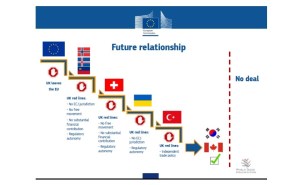 transition in the first place and none for extending it. I have seen Barnier’s steps of doom before but having Catherine’s clear explanation of the reasoning behind suggesting the Canadian type relationship is the only viable option.
![IMG_2265[1]](https://jessguth.com/wp-content/uploads/2018/09/img_22651.jpg?w=150&h=113) Daniel Wincott then spoke about devolution which I also very much enjoyed but realised I don’t know enough about and then Sionaidh Douglas-Scott took a look back to show how the Brexit issues are actually issues that have mostly come up before. I enjoyed that paper and once again thought that doing some historical work would be really nice. I always meant to do something joint with my colleague Fran and we often said we’d do it sometime but for her ‘sometime’ didn’t come so maybe I just need to get on with it.
Daniel Wincott then spoke about devolution which I also very much enjoyed but realised I don’t know enough about and then Sionaidh Douglas-Scott took a look back to show how the Brexit issues are actually issues that have mostly come up before. I enjoyed that paper and once again thought that doing some historical work would be really nice. I always meant to do something joint with my colleague Fran and we often said we’d do it sometime but for her ‘sometime’ didn’t come so maybe I just need to get on with it.
So that’s me done and now on the train home editing and doing the links on a painfully slow wifi connection. It has been a good conference, a really good conference. I was pleased to see so much interest in the Legal Education Stream and on the whole really good quality papers presented in every session I attended. I will leave you with a slide from Fiona Cownie’s presentation on Day 3 and the clear sense that we have moved beyond the sentiment expressed within it:
SLS Day 3
 Day three started with me being lazy! I couldn’t be bothered to go out and run. It looked quite lovely outside but I had ideas swirling round in my head and wanted to play with them and have a slower morning. A cup of tea would have been nice but in student accommodation you just can’t have everything. I played with ideas for a while – I have too much going on in my paper and I know it all fits together somehow but I can’t quite articulate it. Then I vaguely considered running after all and joining the fun run but remembered just in time that I actually don’t like running with people. I spoke to Kath and then went for breakfast and continued playing with ideas but didn’t really get anywhere. I bought myself a cafe mocha and headed back to the room, finished the self care blog post and then headed for the AGM.
The AGM was efficient and smooth and included the election of a new Vice President. I was a little disappointed that the choice was between three white men and spent some time reflecting on diversity at the conference. It doesn’t feel as dominated by white old men as I remember previous conferences but there is still a little too much white men in suits talking to white men in suits going on – though that might just be me not being quite ready to admit that maybe the SLS is not as stuffy as I thought it was. As part of the AGM/Council Meeting session Joanne Conaghan gave a presentation on the REF. There wasn’t much there I didn’t already know but I think the key message (which I agree with) was this: Get yourself REF literate! And if you don’t know where to start with that, have a look here.
I headed straight for the Legal Education stream then which began with a keynote from Fiona Cownie. It’s no secret that she is one of my greatest role models, has been a fantastic mentor and has taught me so much about navigating the, shall we say challenges, of university life. I love listening to her speak. For a start it vaguely takes me back to being an undergrad student and I often chuckle at how much of my large group teaching style is modeled on how I remember hers; then her presentations are always told as a sort of story which is easy to follow, logical, coherent, thought through properly and fun. Today she was taking a look at the history of legal education research. I thoroughly enjoyed the presentation and am pleased to report that I am in fact a political scientist after all:

The next paper was by Lydia Bleasdale and Sarah Humphreys and focused on trigger warnings. I have heard Lydia talk about her resilience research before and the full report is worth taking a look at. This paper focused on a couple of questions the students were asked and I think it really highlighted that most of what we know about trigger warnings is fake news. There is, as they argued, a moral panic around this and that is probably fueled by misconceptions about what trigger warnings are. I actually haven’t given trigger warnings much thought – at least not in the sense of actually calling them that. I do think it is useful for students to know what topics will be discussed/considered so that they can choose how to engage with material they know might have a negative impact on them. To me giving information that helps students better prepare on an emotional and intellectual level for an academic discussion of issues can only be a good thing. What is clear is that much more research is needed here and that the trigger warning stories perpetuated in the media provide lovely teaching materials for the importance of checking your sources properly.
Rossana Deplano then presented her experience from an action research project looking at using concept maps in Public Law teaching. A number of things struck me – Leicester have 6-8 students in tutorials. Wow. Oh my goodness that’s a different universe. I mean that’s how I remember it at Leicester but I presumed it would have changed and the groups would now be bigger. I was also struck by how many of the things Rossana was describing she did in her tutorials that used concept maps are things I often do instinctively in the classroom. I often end up drawing diagrams to try and show links

This could so easily have been my session
between ideas and principles and to work through theoretical ideas and practical problems. I encourage students to do the same and I used to capture may of our joint efforts and share them with other groups on the VLE – I haven’t done that for a while but it’s powerful because it often demonstrates variety of equally valid approaches to the same question, issue or idea. Any way, I’m off to read a bit more about concept maps.
I chatted with lovely people over lunch and then went for coffee with Lisa Webley, another fabulously generous lovely woman who has given up her time again and again to help me figure out how this crazy world of higher education operates. Talking to her was just brilliant and I now have a much clearer picture of quite a few things in my head. Sometimes it really does help hearing someone else articulate what you do really already know but can’t quite grasp hold of. Thank you!
After Lunch Avrom Sherr asked whether legal education research was really about legal education and concluded that legal education was a never ending debate. It was a whistle stop tour through lots of contested questions and issues in legal education and it was kind of fun.


The next presentation was perhaps the one that fit least into the broader discussions we were having about legal education. It was all a bit too business-y and employability-ish and bit ‘yay cash prize’ etc for me. I stopped really listening although I think there could have been some really interesting stuff in there about the nature of learning.
The final paper was by Caroline Gibby on Liminality and morphogenesis and I really really wish this hadn’t been the last paper of the day because I was flagging a little. This stuff is messy in a good way and thinking about the transformation of (legal) educators is interesting and important and I do think what Caroline was getting at is probably right (if I understand her correctly that is) – some legal educators feel locked into narrow roles where opportunities for development are minimal and thus limit the overall progression or evolution of a particular context. I need to go back over the notes I took, her abstract and look at some of the literature Caroline cited to help me think about this some more but I think there are answers to some of my tricky questions in there somewhere.
After the session I went for food with my ALT vice Chair Caroline Strevens to talk about
some ALT stuff and now I am back in my little room and really not far off going to bed (It’s about 9.30pm). I am beginning to have a sense of what I want to say tomorrow and I think sleep and a morning run will do far more good than trying to finalise it completely now.
Day three was good, day three has, it occurred to me walking back to my room through the London drizzle, been genuinely good for the soul.
 My Conversations