
Equality and Diversity in Legal Education 3
And here’s the third and final part of my reflections on the workshop on Equality and Diversity in Legal Education. Part 1 can be found here and part 2 here.
After lunch we had another set of parallel sessions and I chaired Session 2B. The first paper picked up the theme of ‘polish’ and helping students to assimilate. Dominic De Saulles took a pragmatic view that the legal culture at the Bar is what it is and then considered our responsibilities and duties to those of our students aspiring to the bar.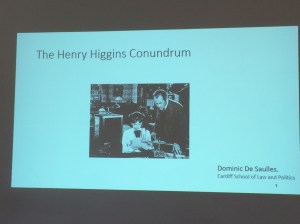
He noted the significant ethical challenges we face in helping or even encouraging students to join that legal culture which might mean they have to ascribe to values they find unpalatable and lose some of their sense of self in doing so. I wasn’t entirely convinced by the Kantian ethics justification for helping students learn to pass as barristers but I need to think about this a bit more. It seems to me that what would be more valuable is to talk about resistance and how things might be changed but I also accept that for that to be possible these non-authentic lawyers need to get into the professions otherwise there is little hope of a revolution from within! Dominic had some lovely pictures on his slides and one of my favourites was this one which shows  a court room with lots of people doing things they shouldn’t be – the defendant is pleading guilty thus depriving lawyers of income, one advocate has lost the plot and is showing emotion, another id ducking rather than standing up for his client….
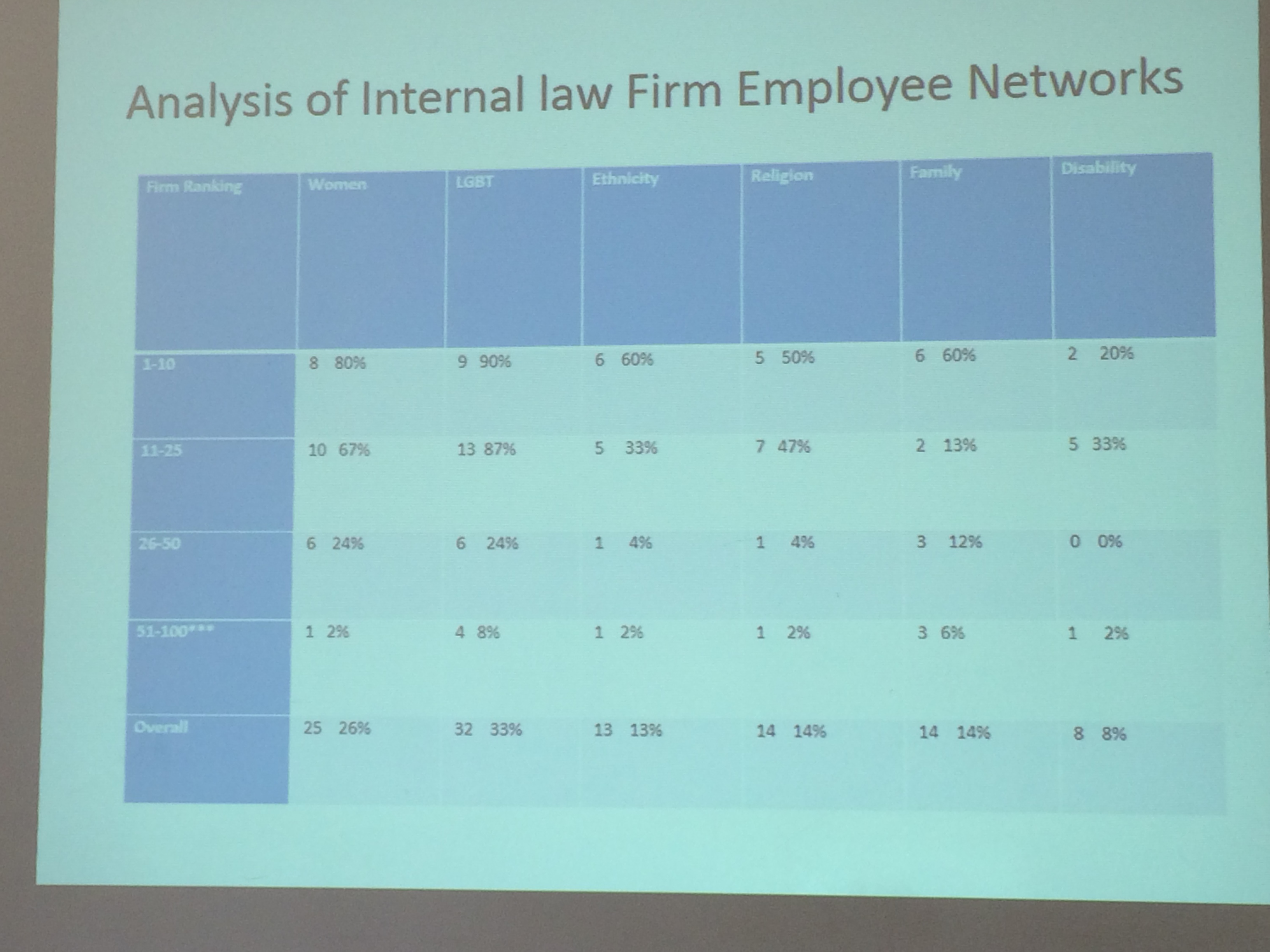
The second paper was given by Elisabeth Griffiths and grappled with hierarchies of rights and protection under the Equality Act 2010 and how this might play out in employer networks. She had some really interesting data on networks (or lack of networks) and we had an interesting discussion about how effective those networks might be and how much they are just for show or for ticking boxes.
I was also interested in Elisabeth’s comments about how doing this research has impacted on her teaching and is leading her to be less doctrinal in her approach. I do think what and how we research can have an impact on how we teach certain topics. I guess this is an argument for having people teaching in areas where they are also research active but I think it probably also says something about the relationship between research and teaching more generally. I have weekend brain though so I’ll wait to think about that a bit more until I am back on working day brain!
The day finished with a roundtable with Pat Leighton asking what is special about researching equality and diversity; Charlotte O’Brien offering comments on teaching equality and diversity in the very contested Brexit context and Debra Malpass of the SRA providing some information about a call for statistical analysis and a data workshop coming up shortly (sorry I tuned out on the project call because I can’t do stats). The roundtable touched on many of the thoughts I’d had throughout the day – we need more and better information about how inequalities are playing out across legal education and training and in the professions. We need longitudinal data, we need data that is richer and deeper than a questionnaire will offer, we need high quality qualitative empirical data and we need high quality clear and comprehensive quantitative data and we need to keep talking – to each other, to our students, to those in the profession and to anyone who will listen – and, perhaps more importantly than all of those – to those who don’t want to listen. Yes, most of all we need to be talking to them!
Equality and Diversity in Legal Education 2
Here’s part 2 of my reflections on the University of Sheffield School of Law and LERN co-hosted worksop on equality and diversity in legal education.
The day continued with a parallel session where I listened to 3 papers which were all interesting and which all triggered different but related thoughts and ideas. The first was about how we can achieve more inclusive legal education in the context of disability and it engaged with both the lack of visibility or presence of disability in the legal curriculum and problems of access to legal education for disabled students.  The idea of what a good lawyer is again came up. If a good lawyer is the person who can stand the heat in the kitchen then any notion of weakness means you can never be a good lawyer. Declaring a disability or asking for an adjustment therefore becomes impossible. Hidden disabilities in particular are then easily construed as a deficit. For example you cannot be a good lawyer if you are dyslexic because law is text based and you need to read things quickly…Surely it can’t be beyond us to think about these skills differently.
The second paper was about how we can actually build a curriculum around the students in the classroom and start from their experiences. Jenny Gibbons from York Univeristy explained how she did this for her employment law module. I like this idea. You talk to your students about their experiences and knowledge and build on that – this means the content of the module has to be fluid and flexible and about developing skills and constructing knowledge, not about learning or acquiring knowledge. That can be challenging to do in an institutional context which is keen on measuring very specific learning outcomes and ensuring the equivalence of experience for all students. It is also a challenge to traditional teaching orthodoxy because the classroom experience for the teacher is less structured, less safe and less planned. That can be scary. In fact, it is scary. It’s daunting walking into a classroom not being quite sure what is going to come up, what you’re going to be discussing and where the discussions might take you. Of course it is easier to simply set some questions and go through the answers… it’s also more boring, less rewarding and less likely to actually engage the students and encourage deep learning. So there – I’m all for asking questions you don’t know the answer to and to being open to learning from our students.
The third paper was about globalized legal education and the benefits this might bring and it got me thinking about what truly globalized legal education might be. We also talked about whether globalized legal education and/or exchange programmes could help students build the all important cultural capital (and start to develop some of the sort of professionalism required – See post 1 in this series). I’m afraid I missed some of this paper because I got sidetracked thinking about what globalised legal education would really mean. Not that I have got very far with this but I was thinking about the tensions between law being jurisdiction specific and the (perceived?) need to teach legal rules which will mostly be set in the national context and the idea of global legal education.
So by lunch time my head was already full of thoughts and ideas. I was beginning to make connections to some of the things I have been thinking about for a while and which I will pick up again soon – questions around academic identity and how that plays out in law schools and what impact that may have on students too. Watch this space – it’s currently all swirling round in my brain and I need to wait for it to settle before I manfully articulate this.
After lunch I chaired a session with two excellent papers which you can read about in part 3 and if you missed my thoughts on the keynote, have a look at part 1.
Equality and Diversity in Legal Education 1
Yesterday I attended a brilliant workshop hosted by the University of Sheffield School of Law and the Legal Education Research Network (LERN). A big thanks to Tammy Hervey for urging me to register and for reassuring me that I could come along and just be. This workshop was advertised at a time when I couldn’t even begin to imagine wanting to be in a room full of academics, never mind think about stuff. In the end I did, as Tammy predicted, have a fantastic day and enjoyed chairing a session, too.
The day kicked off with a slightly depressing and thought provoking key note by Professor Hilary Sommerlad. Depressing because research seems to be indicating that things are getting worse in the legal profession rather than better; thought provoking because there are so many barriers to equality and diversity and yet they seem to me to always come back to how we think about what a ‘good lawyer’ is. If we don’t reconceptualise that, we’ll never make any real progress. Why is it that we can’t get past this? Why is it so difficult to remove some of these barriers even where the solution appears to be blindingly obvious?
Hilary talked about two of her projects in particular. The first study is roughly 10 years old now and looked at how LPC students saw the legal field. As part of her focus groups participants drew pictures of lawyers as they saw them/imagined them and the pictures she shared were all quite similar – white, male, middle class lawyers working long hours being paid lots. Interestingly Hilary pointed out that when talking to her participants and highlighting that they were painting a picture of people that were (in many cases anyway) very different to themselves and not very sympathetic, some participants said that this was part of the appeal. Others were also keenly aware of their otherness and the fact that they’d never fit in. It reminded me of the meal I attended at a very posh restaurant in Leicester at the beginning of my second year as a law student. I had come in the top 6 students in my year and a well known City Law Firm took us out for tea. I didn’t wear a dress, I wore trousers and a shirt. I didn’t tone down my Yorkshire accent, I didn’t hide the fact I came from a single parent family and I didn’t hide the fact I hadn’t gone to a grammar school. I ordered the wrong wine and probably the wrong thing off the menu. I chatted, happily, with the people from the firm about the privilege of going to university, the fact that I had enjoyed Tort more than Contract and that I was looking forward to spending Christmas at my Gran’s in the deepest depth of West Yorkshire. I didn’t know that this was not how you played the game – nobody had told me the rules. I didn’t know there were rules! I wish I had known. If I had I might have played better. Not because I wanted desperately to get a training contract with that firm but because if I know what the rules are I can challenge them, break them, laugh at them. I think everyone else at that dinner was invited for an interview – I never heard from them again.
Anyway, I digress. The second project Hilary talked about is a study recently published about how recruiters see talent and merit. I wasn’t surprised to hear that merit equals academic achievement. I have spoken to people responsible for recruitment who, after a glass of wine or two and a lot of nudging admitted that they want to recruit people who look different but otherwise are identical because it allows them to hit diversity statistics without actually doing anything different or risk ‘alienating clients’. It’s disappointing and slightly sickening to see how little progress has been made in the legal profession.
The key point from the key note for me was the fact that clearly so many people self-select themselves out of a career in law or out of particular sectors within the legal professions because they don’t see themselves as fitting in. I wonder how many more select themselves out of studying law because they think it’s not for them? We need to talk about this, unpack it and challenge it. People should never have to make a decision about whether or not to follow their dreams based on having the wrong accent, the wrong parents, the wrong background, the wrong whatever it may be.
So what do we do to change things? Do we try and help our students achieve that particular type of professionalism that Professor Sommerlad talks about? Do we help polish them? This doesn’t sit comfortably with me. If we teach them to pass in that world, to assimilate we change nothing about the culture and we might well make them really quite miserable! Leaving aside the fact that I never could teach someone how to speak properly, dress to impress and talk about the right sort of things, I don’t think we should be suggesting to students that they should be doing this. However, I do think we should tell it as it is. We can’t raise aspirations without being honest about what that might mean and what students might have to deal with to get into the professions, stay there and progress. Part of our job then has to be to teach students about the sort of professionalism that is expected, about the behaviour that is expected and the sort of things some people in the professions will take for granted and that which will go unquestioned and unchallenged. I also strongly believe that teaching critical thinking skills and encouraging students to question and challenge everything is more important than ever. To go back to one of my favourite books on legal education – we need to empower students to have their own conversations, make their own choices and take their own chances (See Anthony Bradney).
The key note made me think again about what lawyering is and what it means to be a good lawyer. How do we model this in the class room? What assumptions do we make and are they justified? What messages are we sending by what we say and do in the classroom and elsewhere when engaging with students? What are we telling students about lawyers and being a lawyer? What are we not telling them? How much difference does what we say make given that they get their messages from all sorts of sources including TV series and films as well as society generally? What is our role in the identity formation of our students and what is our responsibility in all of this?
As usual I have far more questions than answers for now! For part 2 of my reflections see the next blog post and for part three, the one after that.
 My Conversations