
Conference Self Care
Ah yes conferences, the playgrounds of academics. You laugh but actually conferences have in my experience at least been exactly that. They have been spaces where academics work hard and play hard. Good conferences offer great papers and discussions, too much coffee and sugar and then too much rich food and alcohol to top it all off. Late nights, early mornings, not enough exercise… it is of course a recipe for disaster. Increasingly I am distancing myself from the work hard play hard thing. Don’t do anything hard! Conferences are fabulous. They offer opportunities for catching up with colleagues and friends, for lively and sometimes heated discussions, for quiet reflection on new ideas or new thoughts on old ideas. They’re an escape from the daily grind of the office. The coffee and lunch breaks as well as the evening social activities are often as much part of that, if not in some ways more important in renewing connections and helping ideas form. So yes it’s work and yes it’s play and I am not by any stretch of the imagination advocating being a saint.
However, there is also a darker side to conferences and conferencing. The crippling anxiety some academic feel before and during their paper presentations, the pure horror at having to be with other people for a significant amount of time, the pressure of being on the ball and on your game all the time, the pretense of hyper performance and the glorification of busy. Saying ‘actually I achieved everything I wanted to this summer because I decided I wanted to do fuck all and just have a proper rest’ somehow sounds and feels less acceptable than the frantic, but oh so familiar ‘oh my god I can’t believe the summer’s over, I haven’t even really started on my to do list yet’. This is bonkers.
I used to attend pretty much every session and all socials at all conferences I went to. I was often last woman standing and first woman up. I used to be able to function feeling pretty crap and hungover and usually didn’t even really notice until I got home. I don’t actually know if I can still do that but the reality is that I don’t want to. There are better ways to do the conferencing thing and get a lot out of it but also preserve sanity and health. I started editing this post yesterday. I’d actually started writing it at the conference in Mexico last year (June 2017 archive for the posts from the conference if anyone wants to have a look) but I think I have always tried to be too generic – to give advice that works for everyone and it just sounds vague and unhelpful. So I have re-written the thoughts below to focus on what it is I do, don’t do, should do, wish I did…
- We all have different conference tolerance levels that probably also change over time. Very few people can take in every session – particularly if they are packed in. Tuesday I went to one session and then had a power nap. I was sad to miss the session I missed but that’s life. It is always possible to ask for the paper or have a conversation with the presenter at a later date. Yesterday I felt pretty good so I went to all sessions – however…
- … I had too much coffee. This is a real thing at conferences for me. It is so easy to
 just keep drinking the stuff at every break and before you know it you had some at breakfast, before the session, after the sessions, at lunch, after the afternoon session… and I didn’t drink anywhere near enough water because I forgot my water bottle in my room. I need t carry a water bottle or I just don’t drink – possibly because I’m an idiot.
 - That links nicely to food – you don’t move much if you are attending several sessions. I have liked walking from building to building at the SLS conference this week. There is something nice about those few minutes of fresh air but often you have to work much harder to achieve that. In Mexico for example everything was in the hotel and I had to make a conscious effort to go outside, breathe, make sure I actually saw some natural light. Oh hang on I was going to talk about food – yes well even though you might not move much, your brain is working bloody hard, or at least mine finds it hard! So you need fuel but you don’t need a full English breakfast, pastries, cookies, a huge plate full of sandwiches, wraps, cake, a 4 course meal….. I love a little conference indulgence and I am currently sitting in my room with a Cafe Mocha which I almost never have at home but which just feels lush on this sunny but cool morning. A little indulgence isn’t a bad thing. I now usually have whatever sweet thing is offered with morning coffee because the afternoon version is usually bigger, heavier and more likely for me to induce a complete afternoon sugar crash. Yesterday I had both and had the most awful sugar headache through the final plenary session.
- Social events – I’m not a fan of people so these used to be pretty awful unless I already knew people in which case they were marginally less awful. Now I just don’t go unless there is a specific reason to. So Tuesday night there was a dinner which I hadn’t booked for but then last minute I had the chance to catch up with a wonderful academic and friend so I got a ticket and we spent the evening hovering at the edge of the drinks reception and at dinner creating our bubble around our conversation and then I left early. I did not go to the conference dinner last night. I have a low people tolerance level. People exhaust me so conferencing all day and then playing in the evening is a huge ask and I need time out, serious time out, half an hour isn’t going to do it. There are some conferences where social events are really part of the deal or where my role requires me to be there. I adjust accordingly during the day and I make sure I know who is going
- Sleep – well I stopped writing at about 10pm last night and went to bed. That is a late night for me in general terms. I am usually ready for bed, tucked up and probably asleep by 10pm. For a conference it’s an exceptionally early night. Sleep is important but I often don’t get enough. I was wide awake at 5.30am this morning and yesterday. If I need a powernap I’ll have one
- Exercise. Like I said, its easy to hardly move at all. I like exploring places with a little run and recently I have run regularly at conferences. In Mexico I even joined the organised fun run. Not the greatest experience so today I have not joined the SLS conference fun run. I did my own thing yesterday and quite honestly, this morning I just could not be bothered. Instead I got up and played with some ideas on my paper. I may go at lunch time though but I have also learned not to see this as another thing I have to somehow squeeze in while I’m at a conference. I will do it if, and only if, I really want to
- That brings me to the last and possibly most important point – conferences can be really anxiety inducing. They can push all my buttons – the ‘am I good enough’ buttons, the lack of sleep buttons, the too much caffeine buttons, the I don’t belong here buttons, the alcohol buttons, the sugar buttons, the ‘oh my good people are hideous’ buttons, the noise buttons, the ‘here’s another bloke in a suit explaining the world to me’ buttons, the ‘I feel really stupid’ buttons and the ‘there’s all this other work I should be doing’ buttons… there are more I’m sure, I have a lot of buttons. So more and more I am learning to listen to myself and take note of rather than dismiss the early warning signs. Yep, I can function perfectly well through high levels of anxiety and even minor panic attacks. Unless you know me very well you would never know but it’s not actually much fun, or healthy. Sometimes that means doing less at a conference and missing sessions, sometimes it means being very selective about the people I spend time with and sometimes being borderline rude (sorry) and walking away. It means choosing sessions as much by who else will be in the room as by topic, it means being ok about not asking questions or making a contribution. Perhaps counter intuitively I have become quieter and am less likely to ask questions as I have become more confident in what I know and don’t know. I am ok with giving my brain more time to process and I am ok with emailing someone later if something does occur to me that I really want to talk about.
So in short, my conference self care for me is about drinking less caffeine (rubbish at it) and alcohol (pretty good at this lately and this time not drinking at all given the Great North Run at the weekend), getting enough sleep (not great at it), eating well including some conference indulgences but as with running – eat to fuel (mostly good), drinking enough water (ok as long as I remember my bottle), being aware of when I am getting to capacity and dipping in and out of things (good) and allowing time, space and activity for the adrenaline that will inevitably build up when I have to spend time with people in a work environment like this to dissipate or be burned off (pretty good).
I should also say though that actually going to conferences is a form of academic self care for me. It allows me to connect with people across the discipline(s) I work in. It gives me a check on where I am with my research and what else is going on and how what I do fits into the bigger picture. The discussions, whether formal or informal, are good for the soul and for perspective. I often find them challenging from a sanity perspective but not attending and sharing my work and listening to others would be far far worse.
Excellence in HE Conference 2017
A little earlier this year something possessed me to think it might be a good idea to present something at the Excellence in HE conference that Leeds Beckett hosts annually. It’s run by the quality team so goodness knows what I was thinking. I either wasn’t or I was feeling disruptive and a bit naughty.
I have some poorly thought through thoughts on Excellence in HE and have spent some time doing a few bits of research that speak to the issue. I’ll come back to that in a moment. When the day came and I stood at Crossflatts station in the rain I was cursing myself. A day, a WHOLE DAY, away from writing my book and having to engage with people who can say ‘Excellence in HE’ with a straight face.
I actually had a great day. After the usual welcome we heard from Ant of WonkHE who told us all about TEF and how it tells us nothing about teaching (or excellence) and how the results are totally meaningless but there is some quite interesting data we should all go away and look at – because it tells us something – even if that something isn’t about teaching. I’m ok with that. The day had started with something that made sense. Then came the second keynote on the role of governing bodies in HE. I’m afraid I tuned out. I heard ‘accountant’, ‘leadership foundation’ and ‘committee of university chairs’ (or something) and saw white slides with lots of black text and I was gone – I spent a delightful 40 minutes in my own head – sorry. My bad, I’m sure.
Then we had coffee and split into groups. I’d really wanted to go to the session on Research Informed Teaching but I couldn’t – I had to be in the Learning from Research session to give my talk. The first presentation was great – about dissertation bootcamps and a field trip to Malham youth hostel to walk, think, write. How awesome is that. Such a great opportunity to engage properly with students and treat them as humans rather than numbers. What a great way to foster individual excellence and to inspire and be inspired. Then I was up. Not using a powerpoint confused the organisers for a minute or two but then I was off. The paper after mine was also interesting – matrix learning and resilience in a number of disciplines. The last paper I didn’t really ‘get’ (and I heard it twice because it was repeated in the afternoon) – it was about Dance education and university students going into schools to teach dance (I think, but I sort of tuned out. I needed more coffee and was getting hungry).
After lunch the sessions were repeated so the Dance paper was first up and then it was me again and then my colleague Teresa told us about her work on transition from 6th form to university and how we can’t really expect students to be independent learners overnight. Then we had coffee and finished with a plenary summarising all sessions. It had been an unexpectedly good day.
So what were my thoughts on Excellence in HE. Well I’m interested in the rhetoric around excellence. And I think it’s all wrong. Excellence is a buzzword – it’ll fall out of favour soon enough and we’ll all be talking about something else. It’s hard to define and we all see it differently. But because it is hard to define we struggle to measure excellence so we measure a proxy or rather lots of proxies instead and pretend that they tell us something about excellence but usually they don’t – they tell us how many students got jobs or how much they earn or what grades they came and left with. Excellent teaching is measured in module evaluation scores covering all sorts of proxies. But when, through my research and informally, I talk to people about excellence it is rare for tangible things that can be ticked off lists to be mentioned – usually it is about the emotion of a situation or context, about how a teacher made us feel, how a research paper made us think, how a well timed and well constructed question by a teacher made us see something in a different light altogether. Excellence is not always (or even often) synonymous with a good student experience of being happy and getting what you want – students I spoke to often talked about excellent teaching making them deeply uncomfortable and being very challenging.
I’m also interested in how universities present ‘Excellence’ claims and mostly on the websites I studied they don’t unpick their assertions at all. Some (guess which ones) claim they are excellent teaching facilities and offer excellent student experience because they are highly ranked research institutions. Others claim to offer excellent teaching because their staff all (or mostly) hold teaching qualifications and others claim that excellence because their staff hold professional (industry) qualifications. None of those claims are justified or explored further. Anyway, I rambled on about all of this for a while but my thinking sort of got to this: We need to move away from thinking about excellence as something that can be achieved, measured or even really articulated and accept that it means different things to different people – as such we can all be excellent to some people (students, colleagues, managers, funders….) some of the time but we can never be excellent to everyone or even to some all of the time (and for me that means choosing who is my priority – some things that make it more likely that students get an excellent learning experience might be in conflict with what management expectations of my excellence are – guess who wins). Also, because excellence means different things we can and should take a more personal approach to excellence and remember that our students are not numbers, they are people, people who all have the potential to be excellent some of the time. I think, and this was prompted by one of the comments in the plenary, that we need to shift our focus away from what good or excellent teaching is because that isn’t getting us anywhere and instead think about what conditions we need to create to allow for excellent learning. I said in the first iteration of my paper that inspirational teaching might be excellent teaching and that was picked up in the plenary with a throwaway remark that I had possibly just come up with that on the day or ‘maybe she had thought about it before’. I wasn’t quite in punching distance to the bloke who said that (of course it was a bloke) but I thought that was a bit rude and I wondered whether he would have said it about a bloke. He also didn’t use my title when he referred to me but he did use the title when he referred to one of the blokes. Every day sexism for you but that’s not the point of this post…
I’ll keep thinking about this stuff. There’s something about the way we talk about excellence in HE that is fascinating.
Equality and Diversity in Legal Education 3
And here’s the third and final part of my reflections on the workshop on Equality and Diversity in Legal Education. Part 1 can be found here and part 2 here.
After lunch we had another set of parallel sessions and I chaired Session 2B. The first paper picked up the theme of ‘polish’ and helping students to assimilate. Dominic De Saulles took a pragmatic view that the legal culture at the Bar is what it is and then considered our responsibilities and duties to those of our students aspiring to the bar.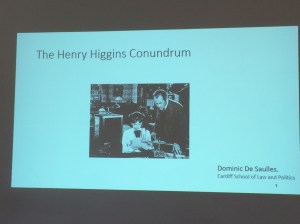
He noted the significant ethical challenges we face in helping or even encouraging students to join that legal culture which might mean they have to ascribe to values they find unpalatable and lose some of their sense of self in doing so. I wasn’t entirely convinced by the Kantian ethics justification for helping students learn to pass as barristers but I need to think about this a bit more. It seems to me that what would be more valuable is to talk about resistance and how things might be changed but I also accept that for that to be possible these non-authentic lawyers need to get into the professions otherwise there is little hope of a revolution from within! Dominic had some lovely pictures on his slides and one of my favourites was this one which shows 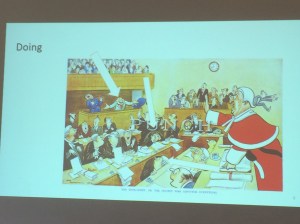 a court room with lots of people doing things they shouldn’t be – the defendant is pleading guilty thus depriving lawyers of income, one advocate has lost the plot and is showing emotion, another id ducking rather than standing up for his client….
The second paper was given by Elisabeth Griffiths and grappled with hierarchies of rights and protection under the Equality Act 2010 and how this might play out in employer networks. She had some really interesting data on networks (or lack of networks) and we had an interesting discussion about how effective those networks might be and how much they are just for show or for ticking boxes.
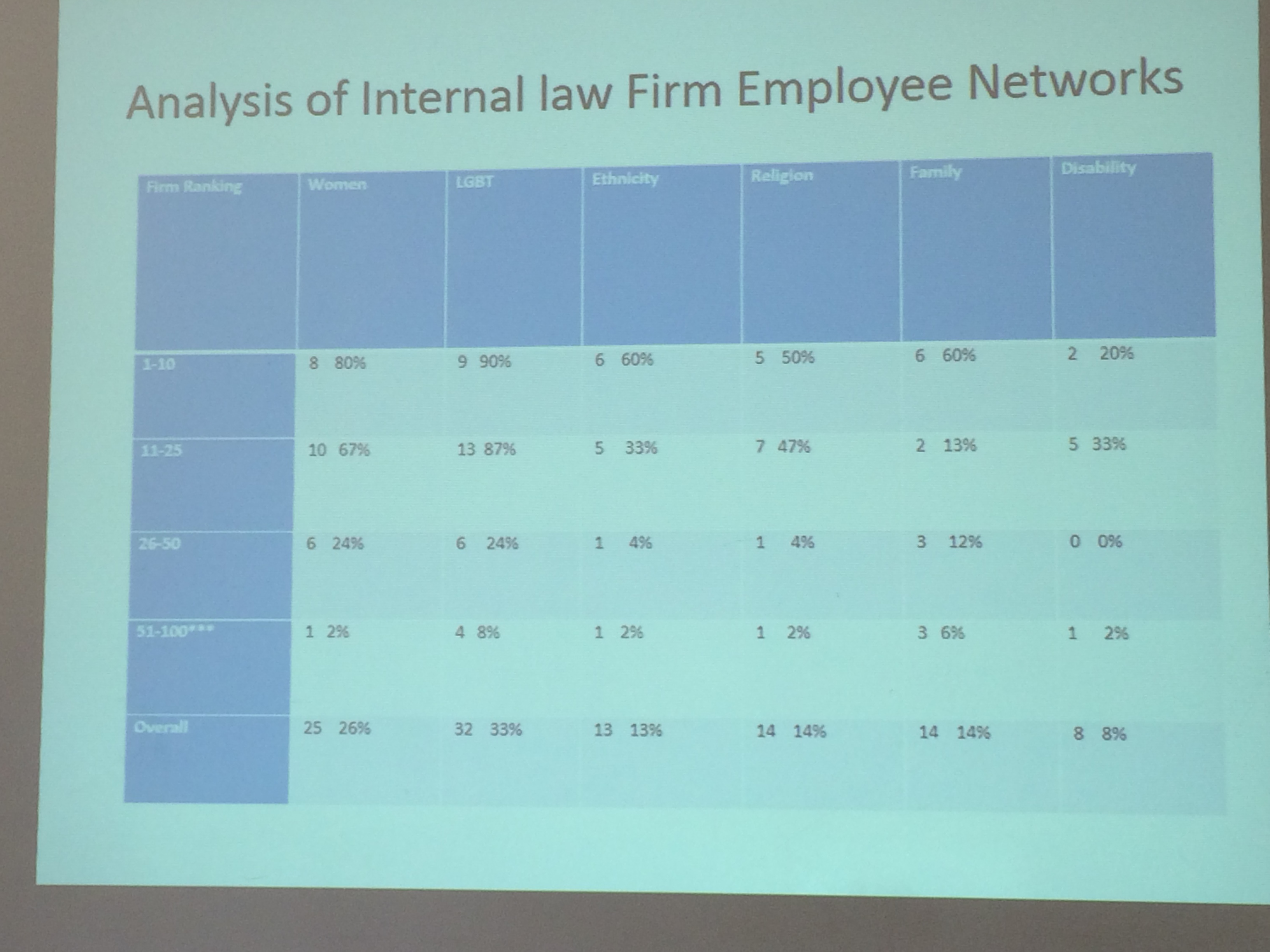
I was also interested in Elisabeth’s comments about how doing this research has impacted on her teaching and is leading her to be less doctrinal in her approach. I do think what and how we research can have an impact on how we teach certain topics. I guess this is an argument for having people teaching in areas where they are also research active but I think it probably also says something about the relationship between research and teaching more generally. I have weekend brain though so I’ll wait to think about that a bit more until I am back on working day brain!
The day finished with a roundtable with Pat Leighton asking what is special about researching equality and diversity; Charlotte O’Brien offering comments on teaching equality and diversity in the very contested Brexit context and Debra Malpass of the SRA providing some information about a call for statistical analysis and a data workshop coming up shortly (sorry I tuned out on the project call because I can’t do stats). The roundtable touched on many of the thoughts I’d had throughout the day – we need more and better information about how inequalities are playing out across legal education and training and in the professions. We need longitudinal data, we need data that is richer and deeper than a questionnaire will offer, we need high quality qualitative empirical data and we need high quality clear and comprehensive quantitative data and we need to keep talking – to each other, to our students, to those in the profession and to anyone who will listen – and, perhaps more importantly than all of those – to those who don’t want to listen. Yes, most of all we need to be talking to them!
 My Conversations