
Feeling seen, feeling the history and feeling the possibilities
I have lost count of the number of Law Schools I have walked into over the years. I have obviously studied in and worked at several. I have visited many many more. But I can count the number of Law Schools I have walked into where the walls have been dominated by portraits or photos of women. Until earlier this month that number was precisely zero. One of my more famous (read public) tantrums came in one of my previous roles where, in a staff meeting, we had agreed that we should brighten up the hallways in the Law School with some law relevant pictures. A week or so after that meeting I arrived at work and pictures of long dead white men adorned the walls and I lost the plot. It was not one of my finest moments but I do think I was right. I am not suggesting that we erase history or that we should ban Law Schools from putting images of dead white men on their walls, I am saying that we should be mindful of whose history we are portraying, who we are championing and what it means if you can or rather if you can’t see yourself reflected in the imagery that the place you are working or studying in chooses to put on the walls.
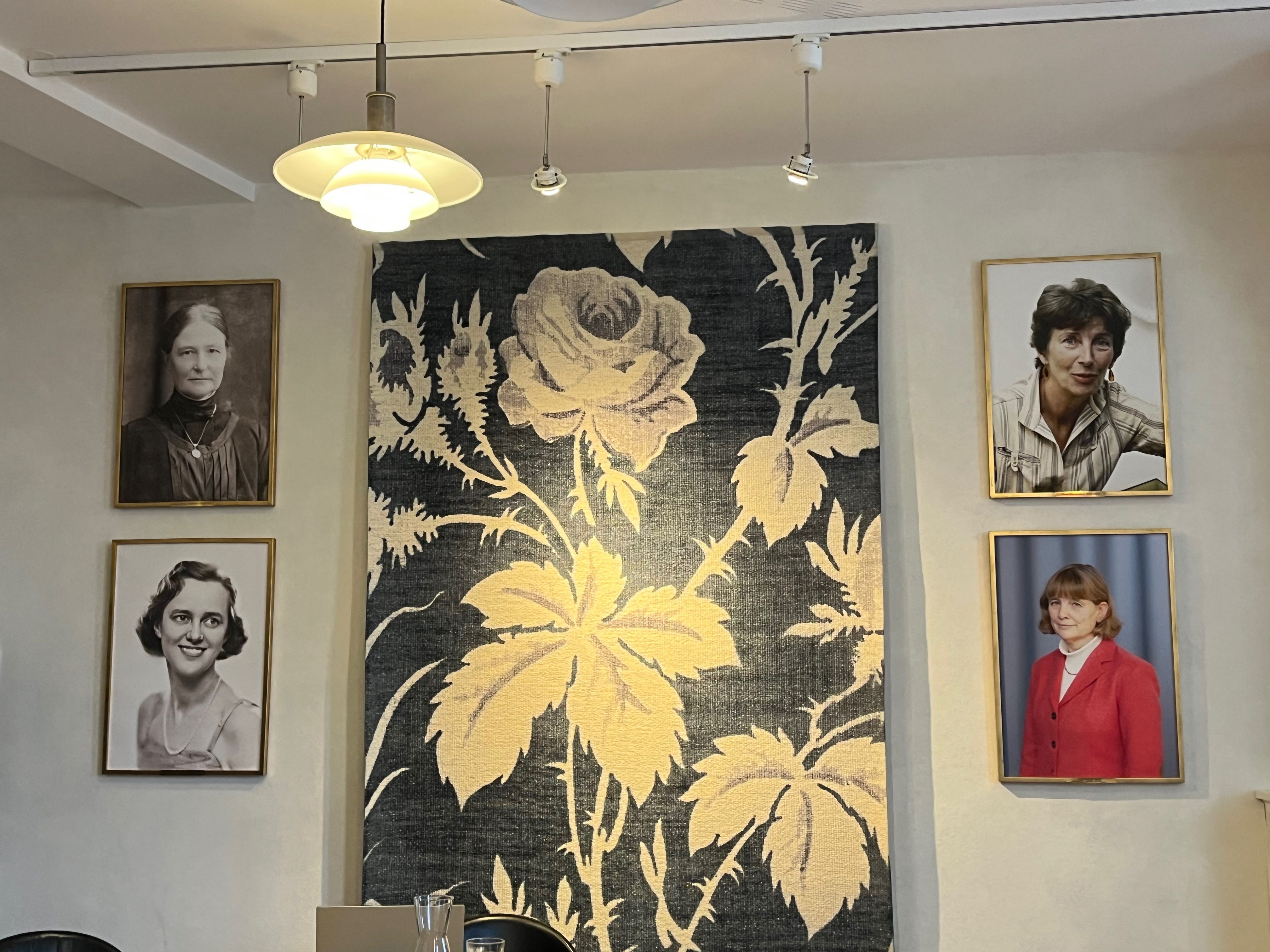
So when, on the 12th February, I was ushered into a smallish room in the Law Faculty of Lund University alongside a group of academics working on various aspects of EU Law, Policy and Politics for our 2 day workshop, my breath was literally taken away. As I made my way down a few steps, I was facing pictures of 4 women. I had no idea who they were at this point but the impact felt almost physical. The room screamed ‘you belong here’. There we were, mostly female academics being encouraged by those who went before us, those who made us being here possible. The 4 women are Anna Bugge Wicksell (1862-1928), Gunvor Mallin (1911-2010), Anna Christensen (1936 – 2001) and Christina Moëll (1959 -) and they are important and impressive figures in the Swedish legal world. Look them up! The Svenskt kvinnobiografiskt lexikon which has biographies of important Swedish Women is a good place to start.
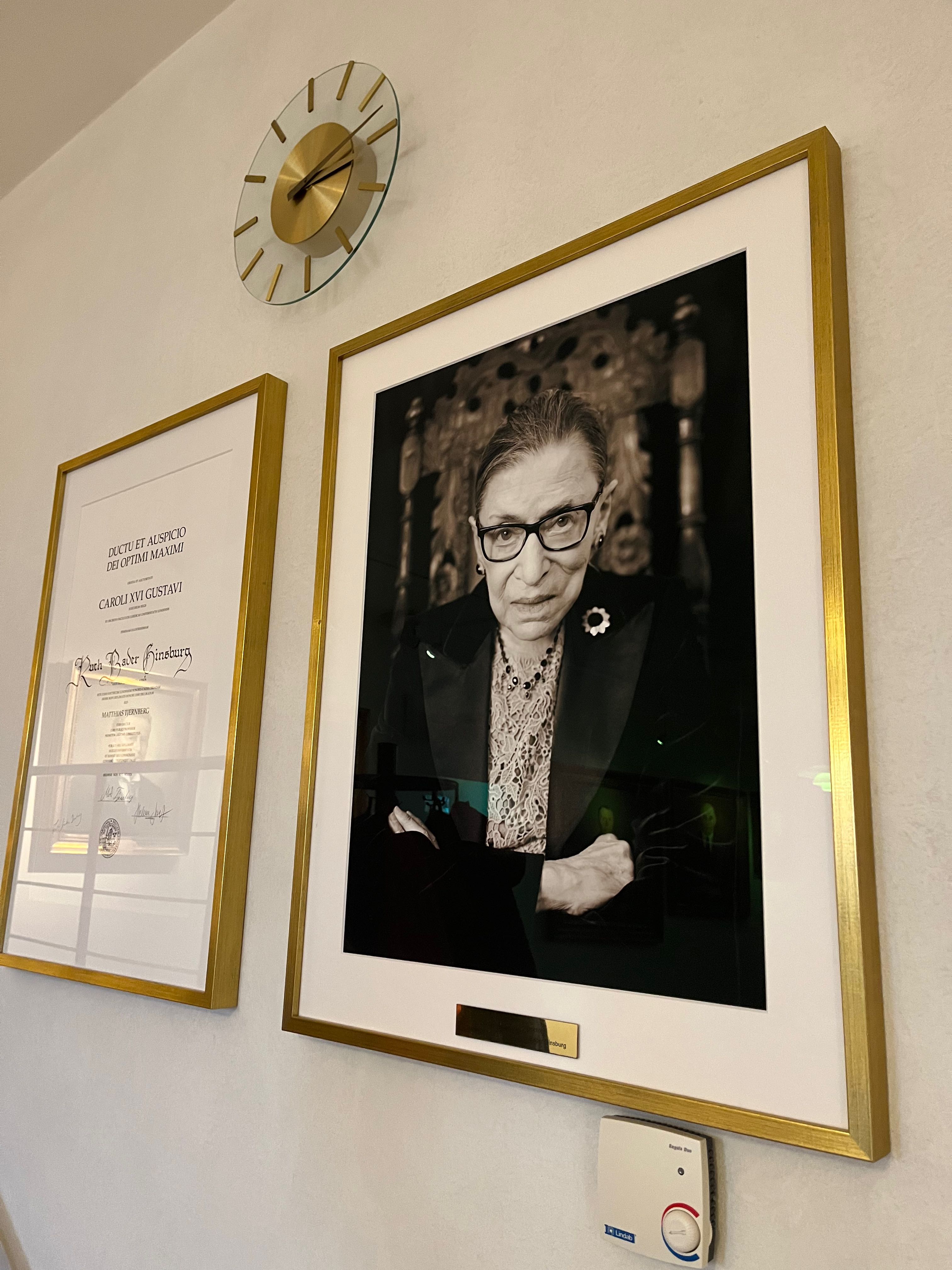
As I took my seat and looked back at the door I had just come through, I noticed a further picture. And this time I did know who the woman looking back at me from inside the frame was: Ruth Bader Ginsburg. I think I just stared. As it turns out RBG received an honorary jubilee doctorate from Lund University and the document is framed next to her picture. It was vaguely intimidating to give a paper with such a legal heavyweight, such a trailblazer, such a brilliant woman looking down at me with that iconic look but I hope she would have been proud of us and interested in our discussions.
Having the women on the walls made a difference. It is hard to explain why. Apart from immediately making me feel like I belonged in that room, genuinely. Apart from being in a room with pictures of important people on the walls and for once not having to roll my eyes about the choice of who is important and apart from the complete novelty of it, I don’t know why it made such a difference. It just did. It was nice and over the two days I think we all commented on it.
It made me think about the importance of representation which I have been thinking about lots lately but also about how far we have come since we saw the first female law graduates, the first female lawyers, first female professors, Deans of School… and how far we still have to go. There are still female firsts to be had and that’s before we even start thinking about intersections with other characteristics. But thinking about how much work there is still to do seemed less heavy with the 5 watching over our conversations. There they were, evidence of change and progress, evidence that we belong, that we are capable and important. I like how they are all different, the pictures chosen are not all the same style and they are not super formal either. They somehow felt more real and their roles and positions somehow more attainable. Ok, perhaps not RBG because, you know, she was RBG – but the others were just women doing their thing – just like we were in that workshop. It felt like by being there and by discussing work that had a focus on gender, we were honouring the work they had done, the way they had paved. It felt good to be seen, to see, to begin to understand our histories and think about the possibilities.
Turns out there were also some paintings of men on the walls – they were behind me throughout, I don’t know who they were, I didn’t bother to check. They just didn’t seem important over those two days. They probably are important, but not in this story and not today.
100 Days of Wonder – #5
When I was a child it never occurred to me that there might be something I couldn’t do or be because I was a girl. Gendered toys and activities just weren’t consciously a part of my life and the idea of women being disadvantaged and the implications of living in a patriarchy hit me much much later, embarrassingly later, like in my very late teens later. I had wonderful strong women around me in real life and in the books I devoured. Although the last point might not be true. Maybe the heroes of my books weren’t girls or women, or at least not often, maybe I just didn’t care or really notice. Maybe in my fantasy world it really didn’t matter and in my imagination I could be whoever I wanted to me in whatever story I was in. But that was my imagination, encouraged by those around me to run wild without constraints of being told that something wasn’t for me. Seeing strong, flawed, complex, real female characters on screen gives me joy, (and I am not saying Marvel characters always have all of that) but not necessarily just because representation is important for those whose imagination isn’t allowed to run wild. It gives me joy because I can close my eyes, give a nod to the 7 year old me and tell her ‘The world catches up with what you already know eventually – everyone can be a superhero’.

The one where city firms are good at diversity and the SQE is a good thing
‘A parallel universe is a hypothetical self-contained reality co-existing with one’s own’ – says Wikipedia. Well today I found myself in one. The escalator from the ground floor to the basement of Kings Place in London is a portal between universes. That really is the only explanation for what happened today – at least the only one that makes any real sense.
I was at the Legal Cheek event: The Future of Legal Education and Training Conference. I was already irritated by the 8.30am start and the fact that all the breaks were termed ‘networking breaks’. I can’t get to London for an 8.30 networking breakfast. I got there and sat down just in time for the intro from Alex from Legal Cheek who really just plugged their exclusive survey saying that students are skeptical of the SQE and want more law tech included in their programmes. Well, from the brief bits he presented I doubt it’s that simple. Who exactly was asked what exactly and did they really understand what they were being asked? Some of the answers reported suggest that perhaps they did not. In fact a lot of what was said today suggests that the people who really ought to understand it (like the people invited to talk about it) don’t understand it. I could go through presentation by presentation and summarise it all for you but I value my mental health and my heart rate profile for today is quite erratic enough so let’s do this thematically. Here are the things that jumped out at me
- There were important voices missing. What we saw and heard today was a particular vision of law and lawyering which is not the law or the legal services that most of us (and certainly not most of the general public) engage in or come in contact with. It is rich mans law, it’s corporate, commercial and fundamentally about making already filthy rich clients more money. It is not about justice, it’s not about people, not about the social or the political, not about making the world a better place, not about harnessing the power (symbolic or otherwise) of law and lawyers to solve the big problems of the world. It was everything that makes people hate lawyers. I think it is what caused that flicker of disappointment in my mum’s face when I told her I wanted to study law and become a solicitor. It’s everything so many students think they should want even when they don’t.
- The SQE or at least the impact it is already having on universities and will certainly have on legal education is really poorly understood. Let me be clear. The SQE is an exam. It is not a programme, course or anything of that nature. It’s an exam. It therefore cannot deliver, in its own right, things like greater innovation, incorporation of tech, greater variety, cognitive diversity, any sort of diversity, thinking skills, improved written communication skills, resilience, creativity, project management and self management skills or commerciality. The only thing the SQE can do is test someones ability to pass the SQE. The preparation for the SQE might attempt to encourage some of those things but of course only if they are part of the SQE – which they are not. Many speakers made the assumption that legal knowledge would still be gained through law degrees and conversion courses – but why would that be the case? No law degree is required and many law schools will be under huge pressure to provide an SQE focused degree for fear of not recruiting students otherwise.
- There is a fundamental mismatch between what employers appear to want and say solicitors need (what they say they want – I’m not always convinced that they know what they mean when they say these things though) and what the SQE tests. There was much talk of creativity, thinking critically and differently, problem solving, managing yourself and learning how to fail and being more resilient. The SQE cannot test those things and other than for a small number of elite and very brave non-elite institutions the SQE means a move away from those things and towards learning to pass the multiple choice tests
- In spite of all the work done by the learned associations, all the SQE rhetoric is still operating on the assumption that what we do in universities is somehow not relevant to practice, can’t be quality assured and is not to be trusted. Varying pass rates, different curricula, different approaches and different assessments are presumed to mean that standards cannot be guaranteed. The problem about fitness to practice which is what regulation ought to be concerned is avoided and instead turned into a fundamental distrust of academics. But I agree with Richard Moorhead on this – the problem is more likely to be at the work place training end. The ridiculous consistency of people passing their training contracts is far more worrying than different institutions having different pass rates at LLB and LPC to me.
- There are apparently still people who think the SQE can deliver equality, diversity and inclusion benefits. There’s no evidence of this. If it reduced the cost of qualifying dramatically, maybe, but it can’t do this – you still need a degree, you’ll have to pay for the test, you’ll have to prepare for the test, you may fail the test and have to do it again… This cannot be significantly cheaper than degree plus LPC and funding option may disappear (for example the availability of loans for Masters degrees means that many LPCs are available in LLM versions so funding is available). The type of assessment has diversity implications and I just don’t see the SRA taking this seriously. They say they will fully test and analyse the statistics including by protected characteristics… but the fact still is that if you can pay to practice repeatedly then you are more likely to be successful. AND THAT IS NOT NEUTRAL
- Obviously we did not really talk about the ghettoisation of legal service provision and how the SQE might widen the gap between magic circle and high street. I can’t help thinking about the careers adviser I had at my school. When she saw my choice of A-levels and what I wanted to do with my life she said, well you won’t get into vet school – why not be a vet nurse? I said that I wanted to go to uni though and she asked me what for and why I’d want to waste my time doing a degree if I could get a job. I wonder what she will be telling kids at that school about becoming a solicitor, whether she understands the differences between solicitors and different firms and that the cheapest, most obvious route via an SQE ready degree might look great for these kids but is likely to funnel them into dead end paralegal jobs. I can’t help thinking about the girl at that same school who wanted to be a human rights lawyer but didn’t think she would be accepted anywhere because she came from the council estate down the road. Her teachers were telling her to stay local because she’d fit in better. I told her to be bold, that it would be awful at times, that it was a different world but that as much as I love working for the sort of institutions that I have worked for and now work for, they are sometimes just not good enough – she went to an elite uni- hated it but got to where she wanted to be. I can’t help thinking about the countless conversations with students about what they want to do, about repeatedly having to say – great – but you will have to do more and be better than those at Russel Group institutions, you will have to work harder and you will have to be lucky. And that’s without creating a real division in types of programmes. With the introduction of the SQE those who need the rigorous academic degrees most to help them to get to where they want to be are even less likely to access them. I feel utterly defeated by this.
- Of the lawyers or former lawyers who spoke, all totally normalised long hours. There was talk of 90 hour weeks and it was framed in terms of work ethic and being ambitious. I’m sorry but working 90 hours a week is not ambitious, it’s not having a good work ethic, it’s, pardon the language, fucking stupid! Maybe the perceived competency problem and consumer complaints are actually problems of exhaustion and not being able to function and of burn out and having been ground down. This is insanity! And no resilience is not about learning to deal with that shit. That’s not resilience. You have not failed if you can’t work those hours – you are human. Oh and maternity leave – it’s for baby things (what do I know!) and having coffee with your friends etc – it is not for re-training, setting up your business, working yourself to death… and if you take a part time job 4 days a week you don’t have the other 3 days to work on your business. Just stop. THIS IS NOT NORMAL.
- There are people who see the SQE as a massive opportunity and apparently think that it will free law schools from the shackles of regulation to be free to innovate. No no no just no. This is just so naive. The SQE will have a huge impact and makes it more difficult to innovate not easier. The SQE can actually only deliver on some of its promises if law schools take on the role of training students for it. The SRA is banking on this happening. (I say let them bank on it and screw them, let’s just collectively decide we’re not doing that and instead uphold the integrity and rigour of our programmes). So what happens to in depth teaching of legal subjects? Family Law? Social Welfare Law? International Law? Anything Socio-legal? The underlying assumption here is also really problematic. We’re not sitting around in our ivory towers happily doing what has always been done. We are constantly thinking about how we can change things, teach differently, engage our students, help them achieve those light bulb moments…
- Who chose who was invited to speak? Why weren’t the learned associations asked? Why not those who actually research these issues? With one or two notable exceptions is was an impressive line up of non-experts, people sort of wheeled out as representing something when in fact legal services weren’t represented well, law schools weren’t and in spite of Alex’s insistence that the student voice was really important to Legal Cheek there wasn’t a single student speaker.
I could probably go on and on and on but this gives you a flavour. I’m still a bit confused by it all. And I’m exhausted from trying to understand, from trying to work out what it is I’m missing, from forcing myself to have the confidence to know I’m right on this because the thing that perhaps took me by surprise the most is how easily my confidence in what I know and believe can be rocked by a bunch of men in suits spouting utter nonsense. After all, what could a girl from a small town in West Yorkshire possibly know about this? It took a two mile people and cyclist dodging run to clear my head and restore some sanity.
This conversation is going to continue and I’ll be back to participate but for now please do chat amongst yourselves while I re-charge.
 My Conversations