
The Law Teacher:…
…The International Journal of Legal Education and now also the British and Irish Association of Law Librarians (BIALL) Law Journal of the Year for 2015. How exciting is that!?! It is a real honour and pleasure to be part of the team that makes this possible. The journal’s editor is the wonderful Chris Ashford (Northumbria Uni) and I am the deputy editor. Neither of us could go to the dinner where the award was given so our consultant editor Nigel Duncan (City University) went. This seemed absolutely perfect as Nigel was the editor before Chris and really the journal’s success is down to his work. Chris and I ( well Chris mostly) have been lucky enough to be able to build on that foundation. Nigel sent this picture from the dinner (thank you Nigel!):
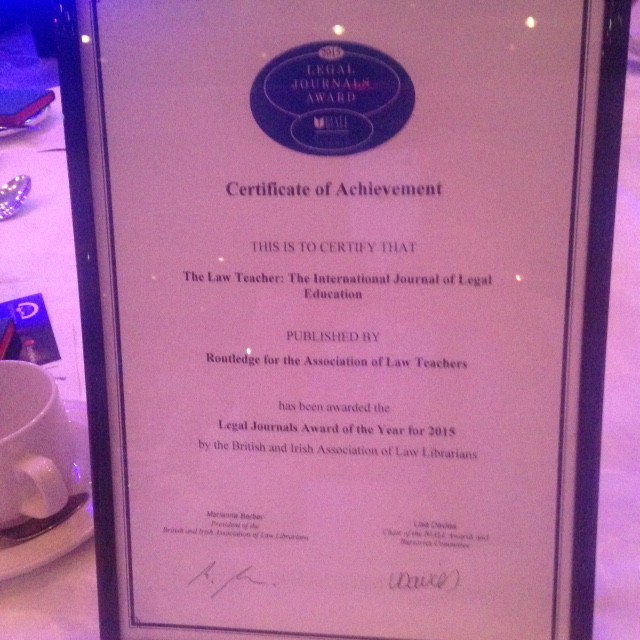 The journal is published by Routledge and they have been fantastically supportive and really do help us produce 3 fantastic issues every year. So if you teach law, whether in a university , college or school I think The Law Teacher is worth a look. I know this sounds like a shameless plug for a journal I am involved with and in a way it is. But it is a shameless plug for a great journal that I enjoy reading and which makes a genuine contribution to my teaching and therefore my students. So if I haven’t convinced you to take a look, maybe the contents of Issue 2 of 2015 will. Take a look here and judge for yourself whether the journal makes your list of top journals. It is certainly on mine.
Thank you BIALL!
Being Head of School
I have been Head of the School of Law at the Unviversity of Bradford for nearly a year now. I have on and off thought about blogging about that and have started one or two drafts and then deleted them again. Now though, it seems to me, is a good opportunity to reflect on the last year. Being Head of School was never part of my Master Plan (as far as I have one). I always saw myself, and still do, as an academic, not as an academic manager. I applied for the interim post out of necessity rather than because I really wanted the job. If it hadn’t been me it would have been someone external and I don’t think at the time that would have been the right thing for us.
So, what’s being Head of School like? Hm, it’s bloody hard work, that’s what it is. It is frustrating on so many levels. There’s so so much pointless admin; there’s the impossibility of herding academic cats (says the worst anti-hearding academic cat ever); there is meeting after meeting with no time between meetings to follow up on things discussed in meetings; there’s only really seeing students for the wrong reasons – for plagiarism, for behaviour issues or when they have serious problems… there’s other people not doing their jobs (or my perception of them not doing their jobs, let’s try and be fair) and then there’s people doing their jobs perfectly well but just not doing things my way (yep, control freak).
Being Head of School is also rewarding on all sorts of levels. There’s something really amazing about shaping the School, it’s programmes, its research and in a way there is also something amazing (if insanely infuriating) about having to justify, explain and fight for that vision. A visison which is so common sense to me and so alien to almost everyone else in the Faculty/Institution: That of a liberal legal education that is focused on learning, skills and personal growth not employability, labour markets and making money. A vision that has thinking about social justice on all sorts of levels, well actually that has thinking – full stop – at its heart. It’s a battle, every day is a battle to try and keep true to some key principles – people and their academic freedom are the most critical thing in a Law School. Freedom to shapre their careers, do their learning and research, interact with each other and learn from each other (I mean both students and staff here) – freedom to not be constrained by corporate PowerPoint slides and uniform VLEs, freedom to think and challenge and freedom to be wrong. This might sound great but then the realitiy of day to day and disengaged students and overworked colleagues hits and dumbing down, not questioning templates and processes etc is just easier. Not fighting every singly idiocy (and there are many) is easier. Not forcing your students to think is easier. Add that a lot of this goes against current university policy – Corporate PowerPoints are a must – and you can perhaps understand that I have very mixed feelings about the last year and the future.
If I am going to be Head of School for any longer (shortlisting for the post takes place Monday) I need to think really carefully about which principles are red lines and I need to think really carefully about how I can protect colleagues and students from the far too prevalent neo-liberal crap we are spoonfed daily and I need to think really carefully about how I look after myself. Because this is personal, this is about everything I believe in as an academic and a law teacher and as such, I can’t just leave it on my desk on a Friday to come back to on Monday; I can’t just stop thinking about it so I have to find a way to deal with all the crap that I will inevitably take home with me… I don’t know whether I want the job for any longer but I do feel like it’s a job I have to keep doing for a Law School I passionately believe in, for students who are for the most part amazing and for colleagues, academic and administrative, who are an inspiration every day
 My Conversations