
Heated Rivalry: What if nobody knows you are their person?
I was going to stay away from writing more about Heated Rivalry. Let’s be honest, the internet – and social media in particular – is full of Heated Rivalry analysis. I haven’t properly read any of it. I have scanned some and some pops up on on my feeds and I note it as I scroll through. Some of it seems like good analysis raising interesting points, some of it seems completely unhinged and some if it so sort of dumb that I wondered whether the authors watched the series with the volume turned right down and their eyes closed. I don’t have the knowledge or skills to provide an academic analysis of the writing, the cinematography, the acting, the technical aspects… not my field. I also still don’t understand why the show has had such an emotional impact on me and why that impact lingers. That may be a therapy questions, I may just roll with it. I have watched Heated Rivalry a couple more times. I have read the books. I might at some point review the books as a whole – but then again, what would I say? They’re romance novels with some vaguely spicy sex scenes in them. So I probably won’t review them because actually romance novels aren’t generally my thing. I read the books because of the TV series. I preferred the TV series.
Anyway, there is one bit in the series that I wanted to explore further because it really hit me but it is also a scene where the reaction to it or experience of it seems to be very different for straight and queer people (using queer as a shorthand here because I prefer it to alphabet soup but you do you with labels). Or at leas that is what the online discourse suggests. I am talking about the scene where Shane gets knocked out cold on the ice and is taken to hospital and the hospital scene that follows. So for context, Shane and Ilya have, at this point been hooking up for years and their relationship is evolving and has become something more than just hook-ups – even if neither of them at this point know what that is or means or could be. But nobody knows. Not a single other person knows that they mean something to each other. From the comments online this seems to be the bit that hits so differently for queer people than it does for cishet people. I have seen lots of comments (the less unhinged ones) about how Ilya is obviously worried, how he has to wait until the morning to go see Shane in hospital, how sweet they are in the hospital scene… and all of that is true but I think for many of us who are queer, there is so much more there. Let me see if I can unpack this.
On the ice, before it is in any way clear how serious the injuries might be, my thoughts went straight to the realisation that if Shane dies (and the first time round watching, my brain was programmed that something terrible was going to happen – because it usually does to gay characters), then 2 things would happen – a huge part of Shane and who he was would be erased and Ilya would have to grieve alone without anyone ever knowing what he was to Shane and Shane to him. This big part of both of them would just cease to exist. Even if there was no death but maybe life changing injuries or injuries which would end Shane’s career, Ilya would no longer have access to Shane, everything changes. The Hockey world provides access to each other, trying to navigate their relationship outside of that context would be really difficult, particularly given their hyped up rivalry that means everyone assumes they hate each other. There would suddenly be gatekeepers and Ilya getting information about how Shane is, never mind getting to see him would seem really weird and impossible to navigate – it would likely force either coming out or retreat. Ilya needs to come up with a credible plan for the visit to the hospital. In a non closeted dating/hooking up scenario, he could just go and it wouldn’t be weird. In this case he has to assess whether others would see it as weird if he goes and is seen. He needs a justification for going that is not simply ‘I care about Shane’.
In the hospital scene, we see more than Ilya’s worry for Shane. I think we also see the pain of not being able to be there for Shane, to sit with him and hold his hand. We see the pain of not having been able to go to the hospital with him, to not be someone who might be called with updates – either directly or via family. It’s the pain of being treated as someone who is just on the periphery of Shane’s life, not central to it. While Shane clearly has Ilya at the forefront of his mind – concussion or not – the rest of the world doesn’t know and doesn’t really care and is in fact at best bemused by and at worst suspicious of Ilya’s hospital visit. The acting in these scenes is superb. The emotional depth breathtaking. Everything in the scenes suggests to me that the writers and actors were very aware if the implications of the relationship being a secret in this medical/injury context. It feels like Ilya carries the weight of how close they came to being erased from each others lives because he was the one who had to watch Shane being stretchered off, he was the one who didn’t get updates and couldn’t reach out to anyone for updates. He was the one who didn’t exist.
It feels like many straight people online missed the subtext of these scenes that had so many of us sobbing. So many of us know at least bits of that erasure. Being closeted doesn’t just mean sneaking around, it also means risking complete non-existence in the eyes of a world that doesn’t know what you mean to each other. It also entirely possible that I am just hyper aware of this narrative as we come up to the anniversary of my ex-girlfriend’s death. It’s 14 years since she died and we had not been together for a decade before her death but we were still really good friends (there’s a good lesbian stereotype for you). Just before she died she had started seeing someone new, I never got change to meet her but I wish I had. There were several former girlfriends at the funeral. I found the funeral really difficult. A couple of friends of hers/ours spoke or did a reading. The service was nice overall. But I didn’t recognise her in all the speeches and conversations. Because she never actually came out to her parents fully (they knew but preferred not to know), because some of our friends certainly took her being bisexual to mean she could just choose to be straight and should probably do that and because, while not closeted exactly, she kept her life compartmentalised, the stories that were told about her at her funeral were the stories that made her family feel comfortable. They didn’t include me or the 5 year relationship we had, they didn’t include the girlfriends that followed. They didn’t include this huge part of her. At the time I just remember keeping it together and justifying those choices because funerals are for those left behind, for the family… but we were left behind too and for a chunk of time, I was her family. We were important and central in her life too but those stories were erased, in the narrative of her life as it was told after her death, we did not exist. And it’s not that I’d forgotten that but it had become less important over time. And then I watched those scenes, and I remembered that feeling, felt that feeling.
I have other examples, far less serious ones, where even when we are out and open, the world can erase us. Sometimes it feels like being pushed back into a closet and being asked to be grateful that it is a walk-in closet rather than a tiny wardrobe. In 2008 I was in hospital with pancreatitis and Kath had to battle so hard to get information and be allowed to be with me. Now partly that was just crappy hospital processes and idiocy but partly it was also the fact that for one or two staff, including one consultant, positioning Kath as anything but my girlfriend was more comfortable. Even after he had been told our relationship status and I had given him an unfiltered mouthful (thanks pain meds), he still referred to Kath as my sister. We complained and got an apology from someone on his behalf but never from him. I always think I have been incredibly lucky to go through life with so little discrimination, hate and nonsense levelled at me but once I start thinking about it, I can give you a long list of micro- aggressions and attempts at erasing my reality for the comfort of others. While those things are annoying in every day life, when you experience them in a context that is more vulnerable like medical care, suddenly even little things can feel existential. What if I have to go to hospital for something, an emergency and the doctors refuse to give Kath updates about me? What if I am really struggling and they won’t allow her to see me. What if something happened to her and I have to deal with a homophobic arse before I can get to her? I don’t want to think about what that feels like when it is amplified by the fact that nobody knows. That for all the world, you have no business or right wanting to be with your person because nobody knows they are your person. Imagine being in a situation where nobody would call you, where information would not be released to you, where if you turned up, you might be sent away. I just can’t even. But I think we have to think about it. We have to get angry about this and channel that anger and talk about these things because things are not getting better for us. Things are getting worse. The closet is the only safe option for far too many and I hear a lot of stories about people having to retreat to that safety. I am not ok with that. I am not ok with any of it and I am acutely aware of the juxtaposition of a show like Heated Rivalry being on mainstream TV and streaming platforms across the world at the same time as queer lives feel very much under attack in so many places. I don’t know what that means but if elements of the show prompt me to share more of my experience and be open about it and try and explain what it feels like even in this incredibly privileged position, then maybe I can shine a tiny little light into the darkness while I figure out what I can actually do to make a difference.
The Law Teacher: The International Journal of Legal Education

Last month, Professor Chris Ashford and I stepped down as General Editors of The Law Teacher and handed over the journal to Dr Emma Jones. Honestly, it’s a funny feeling. The Law Teacher has given me so much over the course of my career, working with Chris has been such a joy and such a rich learning experience and in one way or the other I have always somehow worked on something related to the Law Teacher. I wasn’t going to write anything beyond a quick tweet to mark the occasion but since then, my time linked to the Law Teacher keeps popping into my head.
I published my first book review in the Law Teacher in Issue 1 of 2008, just a few months after starting my first lectureship. I published my first article in the Law Teacher in 2009 (Issue 2) – A Case for Timeturners. I look back on that paper now it and it is somehow completely naive and yet hopeful at the same time. I should maybe write an update. The Editorial of Issue 1 of 2010 welcomes me (and others) to the board and I had forgotten that Chris and I joined at the same time. Over the next few years I had a go at editing book reviews as well as the Policy and Educational Developments sections. Then in 2014, Chris took over as General Editor of the journal and I joined as his Deputy. I remember thinking that I really wasn’t quite sure how I had found myself in that position and hoped that nobody would notice that I didn’t really have a clue what I was doing. in 2018 I got the chance to edit my first special issue (a reflection on the Legal Education and Training Review and a great change to critique the thinking on the SQE as it was then).
We found our feet fairly quickly, we did battle with Editorial Manager, our new online submission system (and if it is possible for a system to actively dislike a person, EM hated me) and we sort of dealt with stuff that came up. We bounced ideas off each other, stepped in to support each other, sense checked each other and reminded each other that we’d also need other voices because we are too similar in our approach to most things. We expanded the editorial board, we established a peer review college, we drove up the quality of work submitted and published and we actively tried to support the legal education community through workshops and being available for conversations. We introduced social media editors to raise the profile of the journal…We did a lot. It’s hard to know now where the ideas came from, I would probably say Chris but actually maybe it was the combination that worked and we had a fantastic team who made the magic happen (and still do).
I think we’ve always care about our authors as much as our readers (because often they are the same!). We read submissions with care and encouraged our reviewers to do the same and respond with constructive kindness. Reading work submitted to a journal is a huge privilege, the author is trusting you with it, probably feels anxious about how it will be received, wants you to like it and in return you get to shape it a little, help make it better, sometimes encourage the re-think it needs to be amazing. We did all of this, mostly without major glitches and mostly just getting on with it – although we definitely had our moments… and then Covid hit.
Lots happened in that time that showcased the nasty side of academia but also the kindness of colleagues, friends and strangers and to cut a long, horrible and for most other people rather boring story short, I wasn’t well. I tried to keep functioning but I wasn’t. As is so often the case in situations like that, I tried to first resign from all the nice things, the things that actually made it possible for me to survive in academia. Chris and the Law Teacher Team encouraged me to stay on, just step back and take the time I needed. When I returned I returned as Co-General Editor alongside Chris with a strengthened and fabulous Editor Team. And now, 10 years after working on the first issue as General and Deputy Editor, we have delivered our final issue as Co-Editors. 10 years just flew by and now there is a Law Teacher shaped hole appearing in my working life – appearing slowly because I haven’t vanished from the journal. For a start both Chris and I stay on as Consultant Editors but I am also seeing through the articles that happened to still be assigned to me and I am also co-editing a Special Issue (more on that another time – it’s shaping up to be fabulous though). The journal is in safe hands with a brilliant team of editors now led by Emma so I am excited to see what the future holds for the Law Teacher and what it feels like to view it as just another academic interested in legal education.
Books I love – Round 1
 Ages ago my colleague and friend Sanna challenged me on facebook to post a book I love a day for ten days without explanations. I didn’t like the no explanations thing but eventually decided to play anyway and use the blog to add explanations – short ones, not full book reviews. I posted the books in random order, not ranked in any way. The first one I posted was Footnotes by Vybarr Cregan-Reid. Now I don’t really need to explain this one – I reviewed it here. I loved the writing and it all instinctively made sense to me. What is interesting is that I keep coming back to passages and it often pops into my head. It’s one of the few books that I have read relatively recently that is actually staying with me.
Book two was House of the Spirits by Isabelle Allende. It probably wasn’t but it feels like  it was the first ‘grown up’ book I read, certainly in English. I read it not long after the film came out (which I saw after) so I was 15 ish. I remember laughing and crying and being captivated by the story telling. I remember the affinity I felt with the strong but complicated women and the slightly unsettled feeling much of the story left me with. I also remember seeing the film and not really liking it that much. The characters weren’t what I had in my head. Clara in particular just wasn’t quite right in the film and Blanca wasn’t as complex as I wanted her to be. This book might well have been my first ‘stick to the book’ moment. I also realise now that I probably didn’t know anywhere near enough about Latin American and in particular Chilean history so some of the context will have been lost on me. I might re-read it. Although part of me wants to just remember how I felt reading it the first time round. This was also one of the first books that left me with that empty and not ready to re-join the world or start another book feeling that often leaves me aimlessly wandering the house trying to work out what to do with myself when I have finished a novel.
 Book three: Affinity by Sarah Waters. I can’t remember whether I saw or read Water’s Tipping the Velvet first. I was vaguely fascinated by a lesbian story line and impressed with the way Sarah Waters builds characters but I wasn’t gripped. Then I read Affinity and I couldn’t shake that novel off for weeks. I read it in one on a grey, cold, gloomy afternoon which probably helped it along nicely. I remember being transported into the novel, like I was there, watching. I remember holding my breath, biting my lower lip wanting desperately to know how the story unfolds but not wanting it to end. The sense of fear, desperation, darkness and other-worldliness was real. As I write this, I realise that I couldn’t tell you the story line in any detail, what I remember from reading Affinity is foreboding, a feeling of powerlessness and a sense of darkness that took a while to lift.
So book 4 – and now for something to completely different. Why We Sleep by Matthew 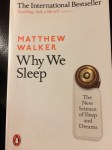 Walker. I’ve really only just finished this. I like it because it’s readable science. I’ve never really had problems sleeping and I have always known sleeping is good for me. I often sleep myself better and I really enjoyed reading more about what happens, scientifically, when we sleep. Intuitively the science described makes sense to me although I really don’t know enough to evaluate whether the studies cited to support the arguments are robust. Occasionally I had questions about methodology and how the things that were supposedly controlled for could have been but overall I thought the case for sleep was compelling – I knew that really but I enjoyed reading some of the evidence.
 And finally for this post, book 5. Ah this book. The Strange Alchemy of Life and Law by Albie Sachs. It is as close to perfect as a book can get. I read this book in a lovely little hotel in Capetown in January 2012 and I couldn’t put it down. It’s a special piece of judicial writing that is so very different from any other legal writing or judicial memoir. It is open and honest and doesn’t shy away from the difficulties of making the big (legal) decisions. It’s a stunning insight into how one of the best and most emotionally intelligent legal minds of our times thinks and worries about law and its application. It made me laugh and cry and it made me think. I love re-reading bits and I find new things to think about every time and I love using it in teaching because it’s accessible and readable and yet so intelligent and full of meaning. I think maybe I love this because it encapsulates everything I love about thinking about law.
More books in round two!
 My Conversations