
Society of Legal Scholars Day 1
I am trying the conference thing again. It’s probably better than spending the next week or so in the office with everyone around me trying to absorb the pressures of the start of term. Still I am conscious that depression has kept me on the sofa much more than I would like and that anxiety levels have been generally high. I am working on the re-set but it’s not easy. So when I set off yesterday it didn’t seem like a great idea to be heading into people and give a paper based mostly on personal experience and reflection.
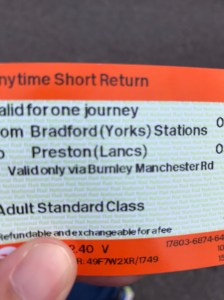 Travel was a bit irritating because the trains into Bradford and then back out to Preston didn’t match at all. I sat at Bradford interchange for 40 minutes watching the world go by…. that’s another story! Then I got on my little train and pootled towards Lancashire through the familiar northern landscape. It suddenly felt important to be staying in the north. Safer, less pressured, more familiar. I watched the hills and fields come and go and longed to be out there breathing the fresh air. I went over my paper. I stared into space and then a few blokes with dogs got on the the dogs were scary and I hoped they would get off at Preston so I didn’t have to go past. I was also suddenly very aware of my own privilege, of what having a job and a secure income at a level where worrying about money isn’t a thing really means; how rare that is in these northern towns I was passing through. I felt both lucky and powerless.
Preston. I walked from the station to the hotel to leave my bags and realised that some time out before people would be good. I found a Costa coffee and had a peppermint tea and bar of dark chocolate. I like Preston. It’s real. It’s a bit of a dump of course, there’s the university and there’s poverty and not much else but the people are real, they are friendly and welcoming and I couldn’t help smiling all the time. I belong in towns like Preston (or Keighley), it feels right. I slowly walked up to the university passing huge building sites and lost in my thoughts. I registered, I bought books, I chatted to one or two people and then it was time for session 1 and my paper.
The session started with Caroline Strevens (Portsmouth) ‘Challenging Assumptions:revisiting the Law Curriculum’ and her paper was packed full of fabulous ideas centred around self determination, motivation, mindsets and teamwork being the answer. I do think self determination theory is useful and it can tell us something about how universities get things wrong by undermining academics and their intrinsic motivation and how we get this wrong with our students too and basically force them to focus on extrinsic motivating factors… I am not sure about teamwork being the answer. I don’t know enough but as an introvert and someone who quite likes working alone and did as a student I wonder…
Then it was me. My paper reflects on two of my publications from 2008 and 2009 both written in the 2007/08 academic year and suggests that I was perhaps rather naive then and got some things wrong, not least arguing for a time turner to make the academic job doable. Instead, I suggest in this paper, we should make better use of an invisibility cloak and marauderers’ map (I do indeed solemnly swear that I am up to no good) to help us do things our way and defend against the dark arts (of neoliberalism, managerialism , marketisation, metrics, ranking, the glorification of busyness…) I am actually really looking forward to properly writing this one up.
The third paper in the session was be Steven Vaughan (UCL) and was, as always, a treat. I love the way Steven presents, it appears easy and effortless and pulls you in. The paper was one I had heard before but that didn’t matter. Steven told us about his work on the structure of LLB programmes and in particular the core subjects. I have often asked why the core is the core. In fact I ask my students and part of me loves the fact that we don’t really know, that it seems to be a historical accident and one which we can’t rally justify on pedagogical or legal grounds. The core is the core because it’s what was predominantly being taught when the core was decided but there were other subjects in contention too. What I find utterly fascinating though is that colleagues often find it impossible to imagine something else. That when you ask them to design a law degree starting with a blank page they start with what they now understand to be the core but they can’t articulate why.
I can write about what I would put in a law degree another time but for now let’s just say I’m not wedded to the core, I wouldn’t teach in the current modular silos and I am not sure I would make anything compulsory other than a sort of legal skills, methods etc course. I see logistical argument for first year compulsory modules but I am struggling for pedagogical and legal ones. But I digress.
I had coffee, there were too many people, I briefly considered going back to the hotel but then just went to the next legal education session instead. It wasn’t a great choice. The papers were just not really my thing. The first was by Roland Fletcher (OU) about apprenticeships and I think I was tired and stopped listening properly. The second was a panel on workplace focused law degrees and while what they were doing seemed quite interesting there is something about the focus of law programmes on providing legal experience to the exclusion of all others that annoys me. It perpetuates the myth that what we do is about our students becoming lawyers and that a degree is/should be about employability. Of course I am being unfair here, they might be doing all sorts and just sharing this particular aspect. I would have liked more on the literature and context though rather than just a ‘here’s what we are doing’ sort of thing.
I went back to the hotel, dumped my bag and checked in and then went back for drinks and dinner. They were fine, conversation was easy because I was with people I knew and people I was content to just listen to. The entertainment folk singing went on for a few songs longer than I felt happy with and I was glad for some air and me time on the walk back. I slept badly. I woke early. I wondered about going for a run but it was raining cats and dogs and the bed was comfy and I felt achey. I didn’t want a battle in my head, I wanted a slow morning. And that’s what I’ve had. Nearly time for SLS Day 2 now!

Getting it All Wrong! Legal Education and the SQE
Tony Bradney said (in his recent Law Teacher article): ‘Only if law schools choose to align their teaching with the new examination, if law degrees become degrees to become a solicitor, will the SQE have an influence on law schools’.
I’ve been thinking about this a lot because it is a really important point and one which seems to be getting lost somewhere. As I have been thinking about this anyway and the SQE madness has been whirring away at the back of my brain somewhere, I was delighted to accept an invitation to go and speak about it at the Law School at Newcastle University today. As usual I was utterly useless at following my notes and am now just as useless at remembering what I said but below is a brief outline of roughly the argument I was going to make. I am not sure what it adds to the things I have said elsewhere recently but maybe it is useful nonetheless
- What is the SQE?
Well this is relatively well rehearsed I think and yet I am always surprised that there are people who really should know, who do not. That wasn’t the case in the audience today so I didn’t have to explain. Let’s be clear though, the SQE is not a new course or qualification as such. It’s just an exam. It’s a 2 part exam with part 1 testing legal knowledge and its application in 3 MCQ tests and then some legal research and writing and part 2 testing some professional legal skills like advocacy, client interviewing, drafting etc. In order to qualify as a solicitor the SQE is one of 4 requirements, the others being a degree or equivalent level qualification, being of suitable character and a substantial period of work experience. The slides from a recent SRA event hosted by Coventry University are quite useful at providing an outline
- Why reform the route to qualification?
Excellent question. Maybe simply because there always seems to be someone who thinks something should change. Maybe simply because we have review after review after review after review of legal education and training. Maybe because someone somewhere in the SRA (or elsewhere) had an idea and nobody who heard it said ‘just hang on a sec, let’s think this through’ or maybe because the proposed changes fit a neo-liberal market driven and status quo protecting agenda. The original rationale appears to have been based on three main issues though: Widening access to the profession, protecting consumers of legal services and complaints about the quality of graduates and the varying standards across the education and training providers (see all the Training For Tomorrow consultation documents etc). I don’t find any of those points particularly convincing. The Legal Education and Training Review (LETR) didn’t find too much wrong with legal education and training. It rightly notes that the cost of qualification was high and thus a barrier to access. It made some other recommendations all of which had potential for good, bad or indifferent regulatory outcomes. Chris Ashford and I wrote about that in a 2014 paper published in the Law Teacher (give me a shout if you don’t have access). There is nothing in the LETR which suggests the need for SQE though so let’s look at the 3 points underpinning the rationale in a little more detail.
- Complaints about the quality of graduates
I find this irritating. The evidence is weak. The claim is based on pretty selective consultation and anecdotal evidence from a pretty narrow range of employers as far as I can tell. I am not aware of any systematic research which assesses the quality of graduates in any methodologically rigorous way. If it exists please point me in the right direction. Also what does quality of graduates mean? I think there are a number of things going on here. I think it is pretty clear that graduates now probably have a different relationship with knowledge and a different set of skills than I had when I graduated. Things have changed. Knowledge is easily accessed. Everything can be looked up quickly. As the ever wonderful and on point Becky Huxley-Binns once said: ,It’s not that our students don’t know shit, they just know different shit’. I agree and they can do different things too. So to some extent employers need to refocus and ask whether the knowledge and skills they are saying graduates don’t have might actually be knowledge and skills that, while valued by them, are actually pretty outdated. In addition it might be worth thinking about what we could and couldn’t do and did and didn’t know when we graduated. Were we really as perfect and fully formed as we now think we were or did we maybe have some of the same weaknesses we are now so critical of? A slightly different point relates to the extent to which the skills apparently absent are actually skills that graduates should already have – so are they skills we, as legal educators should be developing or are does the responsibility lie elsewhere? And finally, what exactly should our role be here – develop skills employers want now (and if so what are they), develop skills employers will want in the future (crystal ball anyone) or develop skills that are academic in nature and enable students to, in Nussbaum’s words ‘make their minds their own’? No prizes for guessing what my answer to that would be. In short I just don’t believe our graduates are as bad as some employers on some occasions like to make out and I certainly do not believe that this is a sector wide problem. I do think this is a fascinating area for research though!
- Consumer Protection
I have not (yet) unpicked the data here or even spent a huge amount of time working through it. Clearly the regulatory objective is to ensure that solicitors are safe to do their thing. Clearly complaints are one way we can look at whether or not solicitors are doing a good job (yes I know that doing a good job and being safe to practice are not the same thing). It’s not a complete measure and it leaves much unexamined. But one of the things the SRA did say early on in developing the SQE was that it will lead to greater consumer confidence and fewer complaints.
According to the SRA itself complaints centre on lack of communication, delay and not being kept informed. They are also concentrated in areas of Family Law, Wills and Probate and Conveyancing. I’m not yet really sure what that tells us (and aware of the very limited info given here) and it is of course true (as was pointed out in today’s seminar) that the lack of complaints about knowledge or competence is because people wouldn’t necessarily know and that the practice areas may simply be about volume of work. Nonetheless though I do not see how the SQE deals with the issues most often complained about. I also find it unsurprising that the general public, when surveyed, favoured a centralised assessment, particularly given the phrasing of the question they were asked. Of course people like the idea of solicitors having gone through the same test to assure a level of competence but it rather assumes that the test does in fact do that. I suspect that if you asked the general public if they’d like to get family law advice from someone qualified as a solicitor based on a standard test that did not include any family law the answer might be different.
- Widening Access
Oh yes, the SQE will widen access to the profession. It will level the playing field. Kathryn Dutton and I have written about why that position is indefensible nonsense. (Again shout if you don’t have access). To genuinely do that the route would have to be significantly cheaper than current routes and it simply isn’t (as the SRA recently admitted) and it would have to force firms to recruit on the basis of SQE scores (and somehow control for the different opportunities to pay for and access preparatory and crammer courses). Widening access to the profession, I mean genuinely doing so, so that even inner city council estate kids with ‘just about scraped a place at a post 1992 and then ‘got it’’ kind of backgrounds can get Magic Circle firm positions; so that opportunities are genuinely equal, will only happen if recruitment practices change dramatically. ‘They’ already think they are getting the brightest and the best. They already think they are recruiting on merit. Why would they change?
- Will the SQE work
No of course not. It will not address the real or perceived weaknesses in graduates. It will not offer any more protection for those of us who need to seek legal advice or other legal services and it will not widen access to the profession. On a more cynical note of course maybe it is working just fine. Maybe that’s the point. Maybe it serves an elitist profession well because it appears to level the playing field without changing anything at all. It makes entry to the profession the same for everyone without actually making it the same. It de-regulates undergraduate degrees while at the same time exerting phenomenal pressure on law schools to do certain things in certain ways (see Doug Morrison writing in the Law Teacher for a small example of this) and it promises consumer protecting and inspires confidence by promising a standard which is meaningless.
- Law School Responses
Law Schools vary in their response. Some are in panic mode feeling the need to respond but being unsure as to how. There is an element of knee-jerk and headless chicken chaos in some institution with half thought out ideas being implemented throughout curricula. There are others resigned to their perceived fate. Responding with a shrug of the shoulders and a ‘Well if this is what the SRA want then we have to deliver’, there are others still who are thinking about options and waiting to see what the sector does overall and there are one or two who see the SQE as an opportunity and are embracing it. Whatever Law schools are doing the individual response to SQE is often guarded as commercially sensitive information and shared in hushed tones and whispered secrets. Quite frankly, if it wasn’t so serious it would be really funny.
I’m with Tony on this. The SQE has no implications for law schools other than the implications each law school decides it has. We do not have to react to it at all. In fact I would argue we should not react to it. Law Schools are not just for wannabe solicitors. Law Schools are really good at teaching students to do all sorts of really important things like find, read, distil and analyse huge volumes of information, reason, argue, provide evidence from a variety of sources and use it to build arguments, write, be precise and specific, problem solve, think, really think. Why would we want to stop doing that? We should keep doing exactly that through our undergraduate and post graduate academic provision. If some law schools also want to jump in and provide crammer courses for the SQE and they have the expertise and staff to do so then so be it. But there is no reason at all why the SQE should have any influence at all over our academic provision. As law schools we should be much more fierce in protecting and (re)claiming our discipline. For more on this see Luke Mason on the recent Law Teacher special issue because he is much better at articulating this than I could ever hope to be
- So where does all that leave us?
I suspect that Julie Brannan was right when, at the ALT conference at Keele University about 10 months ago, she said that the SQE was coming. It still needs final approval from the Legal Services Board but, unfortunately, I think that will come. It would be too embarrassing to pull it now. However, reviews of legal education and training come and go. The SQE won’t work and it won’t be around for long – certainly not in its proposed form, because as my host today, Richard Mullender, noted in our conversation, bad ideas are usually found out. We need to start influencing the conversation and shaping the next review. We need to make clear what helpful and effective regulation of legal education and training might look like. We need to drop egos and agendas and start talking about what the issues are, how we work together and how we start respecting each other’s expertise. Maybe the SRA has gone rogue and lost its way. Maybe. Maybe it is doing exactly what some think it should with exactly the outcomes they want. Maybe. For those of us who are deeply worried about the SQE future, we missed our chances to stop this madness but we do have the chance to shape the debate and the future beyond the madness that is SQE.
GETTING IT ALL WRONG! – The slides from the seminar if you want some silly pictures to go with the narrative
Why I won’t stop going on about the SQE
So there we have it – the introduction of the Solicitors Qualifying Examination (SQE) has been pushed back to 2021. No surprises there really, we could have told the Solicitors Regulation Authority (SRA) ages ago that there is no way they’d be ready by 2020
Anyway, people keep telling me that this is happening, that I just have to accept it and that we just have to get on with it. Well, no, no and no. While it does seem like the SQE is indeed coming, final approval for the assessment is still required from the Legal Services Board. I desperately want them to grow a backbone and declare that a qualifying examination which is likely to harm widening participation, disadvantage already disadvantaged potential solicitors further and write any ‘poor people’s law’ out of education and training for solicitors completely is just not good enough. Come on, we’re better than this utter nonsense. We can do better. We don’t need to kills aspiration and crush a generation who could make a real difference in the world.
Anyway, even if the SQE is coming, I do not have to, nor will I, just accept that. I will keep shouting about it. I will keep telling anyone who will listen (or who won’t, don’t care) why I think it’s a disaster. It promotes a skewed and, I would suggest, harmful conceptualisation of law. Luke Mason has written about this in his contribution to the forthcoming Special Issue of the Law Teacher: The International Journal of Legal Education. In the same issue Doug Morrison highlights the risk the SQE poses to creativity within the law curriculum and Elaine Hall teaches us a thing or two about robust assessment – which the SQE is not. Kathryn Dutton and I wrote about widening participation. These articles alone give you plenty of reasons to scrap the SQE as proposed and go back to the drawing board or at the very least for Law Schools to ignore it.
Let me be clear. I find this hard because I find it hard to justify why I am even remotely interested in the SQE. I don’t care about the professions, I don’t teach/train/whatever future lawyers much less solicitors. I, on a good day anyway, help people learn about law, help them to think, help them to articulate those thoughts and to write and argue and evaluate and use information to form a view and build and argument. Then I want them to go away and make the world a better place and some will do that as lawyers but most will not. So I care, not because of the impact the SQE has on the profession (although I care at the level we should all care about the lack of legal aid lawyers, solicitors who know about family law or employment law or social welfare…) but because of the impact law schools are allowing the SQE to have on the undergraduate law provision.
As a sector we have fallen for the SRA’s ploy. They want us to do their work for them. They want us to train solicitors. University Law Schools are to train their students to pass the SQE. The SRA frees us from the shackles (not that they were particularly tight!) of the Qualifying Law Degree (QLD) for their purposes (but the Bar keeps it) and says they are leaving us alone to get on with things as we think fit but at the same time clearly expect education providers to pick up the SQE preparation. Why are we doing this? Some institutions clearly see opportunities here and others feel they have no choice because they need to continue to recruit high numbers of students. Seriously? You understand that we are lying to our students by selling them SQE ready programmes, yes? If the SRA insists on the SQE, we should leave them to it. As legal educators we should stick two fingers up at them and reclaim our discipline and our expertise. We work in Higher Education. Education people. Education!
The best thing we can do for our students in Post 1992s or lower ranked Schools generally is to provide them with a strong UG education which focuses on helping them to think, articulate, write and have confidence in themselves. If others then want to think about tagging on an SQE prep course, be my guest (but don’t expect me to contribute or be nice about it). I’m not suggesting we try and be like Russel Groups institutions – we’re different, we can, should and must offer different things to our students because generally our students are different and what we do can help bridge the gap life has created for some of those coming to us. What is that difference? Well that’s for each institution to articulate but it has to be based on an understanding of who our students are and how we can help them get to where they want to be.
Anyway, I started writing this thinking about the other part of today’s headline – the cost of the SQE is likely to be between £3000 and £4500. That’s just the exam. JUST THE EXAM. For what it’s worth I think the eventual cost will be at the top end of that or higher but even if those figures are correct, add a prep course and you’re squarely within LPC fee territory. So the only way the SRA’s insistence that the SQE route would be cheaper than current routes holds true is if university law schools prepare candidates for the SQE as part of degree programmes. But the SRA aren’t expecting that. Not at all. Not one bit.
So why won’t I stop going on? Because this shit matters. It matters to my students, it matters to the legal profession, it matters to society and it says something about who we are and what we value. I hope I am wrong about the SQE, I hope that those more optimistic than me are right but I’m not prepared to sit back and let the SRA get on with it on the basis that maybe I am being a bit dramatic about all this. Are you?
 My Conversations